

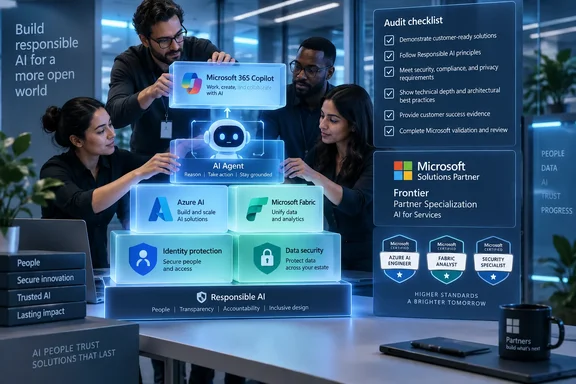
What the specialization actually validates
Microsoft says the specialization recognizes partners who can design, build, deploy, govern, and secure AI agents across the Frontier Transformation stack: Microsoft 365 Copilot, Azure AI Foundry, GitHub Copilot, Microsoft Defender, Entra, and Purview. Microsoft Learn's overview of cross-solution specializations words the stack slightly differently. It lists Microsoft 365 Copilot, Azure AI Foundry, Microsoft Fabric, GitHub, and Microsoft security. The Fabric mention fits the DP-600 skilling requirement below.
Frontier Partner sits in a category Microsoft calls cross-solution area specializations. Frontier Partner and Digital Sovereignty both require prerequisite specializations or Solutions Partner designations, plus any performance and skilling requirements specific to the specialization.
The qualification checklist
Unlike other specializations, Frontier Partner is not aligned to a specific Solutions Partner designation. That does not mean there are no prerequisites. Microsoft's own wording is that requirements across three components must be met simultaneously under the same Partner Global Account.
| Component | Requirement |
|---|---|
| Specializations | Four prerequisites: Microsoft 365 Copilot, AI Apps on Microsoft Azure or AI Platform on Microsoft Azure, Data Security, and Identity and Access Management. |
| Skilling (badge) | Five individuals must complete the Frontier Transformation Engineer badge. |
| Skilling (certification) | Three individuals must earn the Fabric Analytics Engineer Associate (DP-600) certification. |
| Audit | A third-party audit validating delivery capability across design, build, deploy, govern, secure, and operate. |
The people earning the badge and those earning DP-600 can be the same or different. A firm could therefore qualify with as few as five suitably credentialed people, though Microsoft doesn't say that is typical.
Practical details that trip partners up
- Audit sequencing. Partners must schedule and pass the audit, and can only schedule it after meeting the qualification requirements. Audit readiness doesn't replace the prerequisite specializations or the skilling thresholds.
- Audit timing. A Microsoft Community Hub post from the pre-launch period said the audit is conducted remotely by an independent third party and must be scheduled and completed within 30 days of selecting "schedule audit" in Partner Center. That post was not specific to Frontier Partner, so confirm the window in Partner Center. Another Microsoft post said Frontier Partner has a two-year audit cadence. That detail came from the earlier announcement text and should be rechecked against current documentation.
- Linking skilling accounts. Microsoft's application guidance says the badge is earned on Skilling Hub (Level Up), and each employee must link their Skilling Hub account to the Partner Center account for the courses and badges to count. The guidance calls the badge the "Titan" badge. It adds that linking a Skilling Hub account is separate from linking a Microsoft Learn profile.
- Certification must be active. The application guidance asks for employees who hold an active Fabric Analytics Engineer Associate certification. Lapsed certifications may not count.
- Distributors. Microsoft notes that if your business primarily enables resellers or manages channel distribution rather than direct customer delivery, the Frontier Distributor designation is the more relevant offering.
What partners get
Microsoft's September announcement lists these benefits:
- A customer-facing Frontier Partner specialization badge.
- Eligibility for Frontier-aligned co-sell opportunities.
- Microsoft Agent pre-purchase plan (P3) credits and Microsoft 365 E7 licensing.
- Packaged go-to-market resources such as marketing campaigns and case studies, plus Partner Program Concierge support through the qualification and audit process.
The wording matters. These are eligibility and program benefits, not guaranteed deals or revenue. The public pages I reviewed give no quantities for credits or licenses. Microsoft's Learn documentation also says benefits are capped by category, so partners should check what they will actually receive.
Analysis: a cross-practice moat
The channel press frames this as a services opportunity. Channel Insider notes that the requirements make Frontier a cross-practice play. Firms that already combine Copilot, Azure AI, identity and security may have a shorter path, while partners focused on licensing or a single workload may need to build more capabilities first. That is a fair reading of the published criteria. It is an inference, not a Microsoft statement about qualification timelines.
Requiring Identity and Access Management and Data Security alongside Copilot and Azure AI is the interesting design choice. Agents act with identities and touch data. A partner that can't govern both is arguably not ready to ship agents into a customer tenant. For IT admins, the specialization could become a screening signal when choosing an integrator. It is a vendor-defined badge, though, and not an independent measure of project quality. Microsoft also benefits commercially from partners pulling E7 and agent credits through customer accounts.
Channel Insider also points to follow-on work in AI advisory, governance, FinOps, adoption and managed services. That is plausible channel analysis, not a formal benefit of the specialization.
A separate program: Frontier Accelerate for Marketplace
Channel Insider also covers Frontier Accelerate for Marketplace, which is aimed at software companies bringing AI apps and agents to Microsoft Marketplace. It is a separate offering from the services-oriented specialization. The material I reviewed doesn't show that holding the specialization is required to join it, and I couldn't directly confirm its details on Microsoft's own pages.
What to do next
- Check Partner Center to see which of the four prerequisite specializations your Partner Global Account holds.
- Count staff holding the Frontier Transformation Engineer badge (five needed) and active DP-600 certifications (three needed).
- Make sure each person's Skilling Hub account is linked to Partner Center.
- Once the requirements are met, schedule the third-party audit and prepare evidence across design, build, deploy, govern, secure and operate.
Partners short on any of these should expect real investment before the badge appears on their profile.
References
- Microsoft’s New Frontier Specialization Opens AI Agent Opportunities for Partners Channel Insider · 2026-10-06T10:35:27+00:00
- Frontier Partner specialization partner.microsoft.com
- Frontier Partner specialization now available in Partner Center techcommunity.microsoft.com