

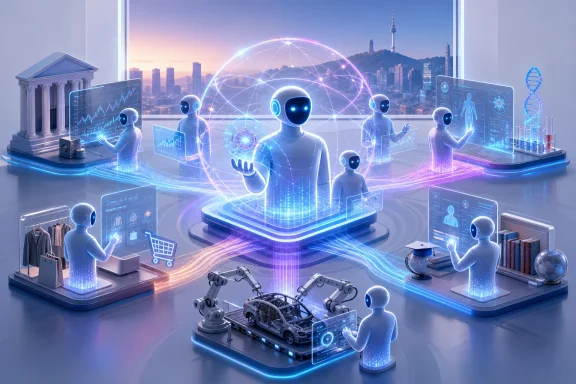
For Windows and enterprise technology readers, the useful signal is the shift in emphasis from a single assistant in an office suite toward a connected stack of Microsoft 365 Copilot, Azure, Microsoft Foundry, data platforms, agents, simulation, and developer tooling. That is also the reason to be cautious. The program establishes what Microsoft Korea and its participating organizations intend to present. It does not independently verify that every deployment has achieved the business outcomes implied by a session title or demonstration.
An enterprise AI agenda, rather than a product launch
Microsoft Korea says the summit will cover finance, retail, manufacturing, healthcare, and education. The announced agenda includes customer and partner sessions alongside technical presentations, giving it the character of an implementation-focused industry event rather than a consumer-device showcase.
That distinction matters. An organization evaluating AI does not usually begin with the question, “Which chatbot should staff use?” It has to decide where data resides, which employees may access it, how outputs will be reviewed, whether workflows can trigger real actions, and who is accountable when an automated recommendation is wrong. The planned sessions suggest that Microsoft wants to frame its offerings as components in that larger operating model.
Microsoft 365 Copilot appears in this picture as one layer of workplace assistance. Azure is positioned as the underlying cloud and AI environment, while Microsoft Foundry is presented in the agenda as part of multi-agent designs. The practical implication is that a company’s AI strategy may increasingly depend on integration work—not merely on assigning software licenses to employees.
For Windows-centric IT departments, that makes endpoint management, identity controls, document permissions, application deployment, and employee training more consequential. If Copilot or related services surface business content in daily workflows, existing information-management practices become part of the AI security boundary. A weak permission model does not become safer because the interface is conversational.
Finance sessions focus on rollout, internal agents, and customer service
The financial-services track is scheduled to include SC First Bank discussing an organization-wide rollout of Microsoft 365 Copilot. Shinhan Investment & Securities and Shinhan Capital are expected to discuss an agent competition and examples of agents used in financial work. KB Kookmin Bank is listed for a session on AI-agent-enabled customer services.
Other planned material adds two especially practical dimensions. NH Investment & Securities is scheduled to cover an Azure-based AI-service platform, while Shinhan Bank is expected to discuss GitHub Copilot in relation to developer productivity.
Together, those topics illustrate that “enterprise AI” is not one implementation category. A broad workplace-assistant deployment raises questions about staff adoption, access control, content quality, and business-policy compliance. A financial-work agent raises a different set of questions: what data it can retrieve, when a human must review its output, whether its activity can be audited, and what happens when it encounters an exception. An AI platform introduces still more concerns around reusable infrastructure and governance. Developer-assistance tooling can affect code creation and review processes without necessarily being the same kind of customer-facing AI service.
The financial setting makes careful language essential. The announcement confirms scheduled presentations, not the accuracy, safety, regulatory acceptability, or financial impact of the featured implementations. A bank or securities firm evaluating comparable tools should look beyond a polished use case and ask for defined approval paths, test evidence, monitoring practices, incident handling, and a clear description of which actions remain human-controlled.
For Windows administrators, the immediate lesson is to avoid treating Copilot deployment as a purely desktop-software project. The work spans Entra-based identity and access practices, device compliance, data classification, retention policy, collaboration spaces, and support processes. Whether a company uses Microsoft’s products or alternatives, the same principle applies: AI will expose the quality of the organization’s existing access and data controls.
Retail cases put data and multi-agent design in the foreground
The retail agenda is scheduled to feature Samsung Electronics’ Galaxy Store discussing a Decision Centric Marketing Agent. The planned presentation combines Azure Databricks-based AI-ready data with Microsoft Foundry multi-agent capabilities, and includes marketing results evaluated through A/B testing as a scheduled topic.
Hyundai Futurenet is also expected to present an AI Shopping Agent applied to Hyundai Department Store’s service branded in Korean as “헤이디.” An English-language rendering has appeared as “Heydi,” but the official Korean agenda uses the Korean name; readers should not assume another Romanization is the company’s preferred brand spelling.
These cases point to an important divide between simple generative-AI features and systems designed to influence commercial decisions. A retail assistant that answers a product question is one thing. A system that synthesizes customer, inventory, campaign, and behavioral data to decide or recommend marketing action is another. The latter requires trustworthy source data, rules for handling incomplete information, controlled experimentation, and a way to detect whether the system drives an unwanted outcome.
The reference to A/B testing is encouraging as a topic because measurement is more meaningful than a generic claim that an AI system is transformative. But the summit is not yet an independent audit. Readers should regard any performance figures or success narratives delivered at the event as presentations by the participating organizations unless separately corroborated.
There is also a consumer-facing public-policy angle. Retail agents may make purchasing journeys more convenient, but they can affect what products are surfaced, how promotions are prioritized, and what behavioral data is used. Companies deploying such systems need understandable disclosures, sound consent practices where applicable, and escalation routes for customers who receive poor or misleading recommendations. Those needs are not eliminated by the use of a familiar Windows, Azure, or Microsoft 365 management environment.
Manufacturing moves from office AI toward physical operations
Manufacturing is the point at which enterprise AI claims become most tangible—and potentially most consequential. The scheduled program divides its post-lunch content into two strands, including design, production, and supply-chain subjects as well as a Physical AI track.
Planned Microsoft and Kawasaki discussions cover robots, production lines, operators, Azure, simulation, and foundation models. A Microsoft and NVIDIA session is expected to address digital twins, simulation, and AI agents on the factory floor.
This is a meaningful expansion beyond document drafting or meeting summaries. Digital twins and simulation can be used to reason about operations before a change reaches a real factory environment. Yet the presence of these terms on an agenda does not establish that AI systems are operating autonomously in production, nor does it demonstrate a safety record, return on investment, or successful scaling across sites.
The strongest practical counterargument to AI-first factory narratives is that industrial environments cannot be managed like a typical knowledge-work application. Production systems must contend with safety, downtime, equipment variation, network segmentation, operator experience, maintenance cycles, and highly specific control requirements. A useful simulation does not automatically validate a decision in a live environment.
For organizations with Windows endpoints or Microsoft cloud services in industrial estates, the sensible question is not whether AI agents can be shown on a factory-floor dashboard. It is whether they are separated from operational technology appropriately, whether staff can override recommendations, how changes are logged, and how a failure mode is contained. Any move from advisory analytics to systems that influence physical processes deserves a proportionately higher standard of testing and human oversight.
Healthcare and education make data governance unavoidable
The healthcare-and-education agenda is scheduled to include Seegene on a global technology-sharing platform and Yonsei University Health System on natural-language retrieval of clinical data. Microsoft’s detailed program says the Yonsei example enables clinical-data queries without SQL.
That promise addresses a real usability barrier: many subject-matter professionals understand the question they need answered but do not write database queries. Natural-language interfaces may therefore broaden access to analysis. But they also create a difficult governance challenge. A user may receive a fluent answer without understanding how the query was interpreted, which source data was included, what was excluded, or whether the result is fit for clinical or operational use.
The agenda also advertises Seegene claims of 20-fold higher research productivity and a 75% reduction in labor effort. Those figures should not be read as independently validated results. They are claims advertised for a planned session, and the available material does not provide third-party corroboration, methodology, baseline definitions, or details sufficient to assess whether they transfer to other organizations.
For healthcare providers and educational institutions, the appropriate response is neither blanket rejection nor uncritical adoption. A natural-language data layer may be valuable if it enforces role-based access, limits use to approved data, records queries and responses, identifies uncertainty, and keeps humans responsible for decisions. In clinical contexts especially, ease of retrieval must not be confused with clinical validity.
What Windows and Microsoft customers should watch for
The summit’s eventual value will depend on details that agenda descriptions cannot settle. Windows and Microsoft customers following the event should pay attention to several questions.
First, ask where the data is and which identities can reach it. The more useful an assistant or agent becomes, the more important it is to verify that it respects existing permissions rather than creating a broad new route to sensitive content.
Second, distinguish assistance from automation. A Copilot-generated draft, an agent recommendation, and a system that triggers a business action carry very different risks. Organizations should define the approval threshold for each category instead of applying one vague AI policy to all of them.
Third, demand measurement that can be examined. Productivity, marketing, and labor-saving claims need baselines, time periods, definitions, and known limitations. A live demonstration can show a capability; it cannot by itself prove broad operational value.
Fourth, assess the management burden. Multi-agent systems, data platforms, code assistants, digital-twin tools, and workplace copilots can each be useful. Combining them can also multiply dependencies, monitoring needs, and support obligations. Standardizing on a Microsoft ecosystem may simplify some integration, but it does not remove the need for architecture, governance, and skilled operational ownership.
Finally, preserve human responsibility. In the announced cases, AI is being applied to marketing decisions, customer service, financial work, clinical-data retrieval, and factory operations. These are domains where a confident output may still be incomplete or wrong. Escalation paths, override authority, logging, and accountability are practical requirements, not bureaucratic afterthoughts.
A useful marker of where Microsoft wants enterprise AI to go
Microsoft Korea’s September 30 summit is best understood as a marker of the company’s enterprise-AI direction in South Korea: less focus on an isolated assistant and more focus on industry-specific systems built around data, agents, cloud infrastructure, and workplace tools. The planned customer roster gives the event relevance across several high-stakes sectors.
But a planned case-study agenda is not a scorecard. The featured sessions may offer valuable implementation lessons, yet attendees and remote observers should separate demonstrated features from independently proven outcomes. The most durable takeaway for Windows users and IT leaders is straightforward: successful AI adoption will be determined as much by data controls, workflow design, security, measurement, and human governance as by the model or Copilot interface itself.
References
- Korea Microsoft to hold Industry Summit on Sept. 30 Digital Today
- 한국마이크로소프트, 9월 30일 ‘인더스트리 서밋’ 개최… “AI로 일하는 기업 향한 산업별 도입·확산 경험 나눈다” Microsoft Source Asia / Microsoft Korea