

The headline is speed and accuracy. The deployment caveat is equally important: Microsoft Learn identifies the new transcription and voice features as public previews, without a service-level agreement, and does not recommend them for production workloads. For enterprise IT teams, availability is not the same thing as production readiness.
Streaming transcription changes when text arrives
Microsoft says MAI-Transcribe-2-Streaming supports 60 languages, continuous automatic language detection, and initial provisional results just over 100 milliseconds after receiving audio. Its internal dictation and subtitling tests reportedly displayed words twice as quickly as the closest competitor. The announcement does not name that competitor or explain the test methodology.
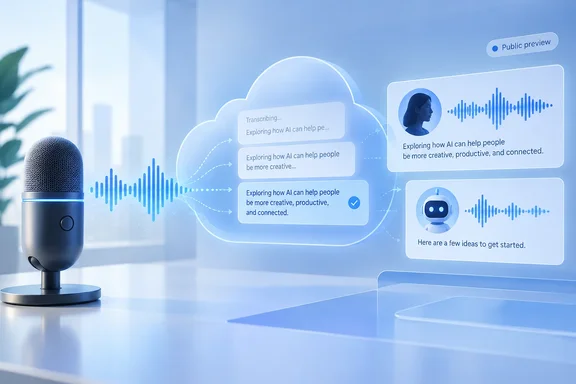
Microsoft Learn explains the underlying behavior: applications send a continuous audio stream and receive intermediate transcripts while someone speaks. Those intermediate results update the current text; final results confirm each segment. Both supported integration methods return these two result types.
That distinction matters more than a stopwatch alone. A partial transcript is a working interpretation, not a settled record. As an engineering implication, developers should distinguish provisional captions from confirmed text and avoid treating an unfinished phrase as authorization for an irreversible action. Faster listening should not become faster misunderstanding.
The No. 1 ranking remains a Microsoft-reported benchmark claim here, rather than an independently reproduced finding. It is a reason to evaluate the model—not a substitute for testing the accents, terminology and audio conditions an application actually encounters.
Two voices, different priorities
Microsoft’s model documentation draws a useful distinction between the speech-generation options:
- MAI-Voice-2.1 prioritizes expressive, high-fidelity output and consistent speakers across long-form narration.
- MAI-Voice-2.1-Flash targets latency-sensitive agents, assistants and call-center interactions.
Microsoft says both support 23 languages across 26 locales, maintaining speaker identity when switching languages while adopting the appropriate native accent. For Flash, it claims generation of 45 seconds of audio with approximately 150 milliseconds of end-to-end latency, 55% faster inference and roughly 60% lower costs than comparable models. Those comparison models are not identified in the announcement.
The practical conclusion is narrower than the marketing: Flash is the option to evaluate for rapid conversational replies; the standard model is the option to evaluate when narration quality takes precedence. Neither positioning establishes how quickly an entire agent will answer after network requests, reasoning and business-system calls are included. That is an application-level measurement.
Pricing: streaming is a separate workload
| Model | Announced rate |
|---|---|
| MAI-Transcribe-2-Streaming | $0.54 per audio hour through December 31, 2026 |
| MAI-Voice-2.1 | $22 per million characters |
| MAI-Voice-2.1-Flash | $15 per million characters |
Microsoft’s launch announcement establishes the streaming introductory rate; its voice-model page confirms the two character-based synthesis prices. These are component prices, not a quoted all-in cost for operating a conversational agent.
For context, Microsoft introduced the preceding, batch-oriented MAI-Transcribe-2 on September 3, 2026, with a limited-time $0.10-per-audio-hour offer through year-end. Its documented capabilities include speaker diarization, word-level timestamps and configurable transcription styles. The cheaper batch rate and the new streaming rate address different processing requirements; comparing them as interchangeable services would obscure the reason streaming exists.
What developers and administrators should know
For transcription, Microsoft Learn documents two integration routes: an OpenAI Realtime-compatible WebSocket API, or the Azure Speech SDK, which manages connections, retries and audio streaming. This provides a concrete starting point for teams evaluating compatibility with an existing application.
Voice cloning also has qualifications. Microsoft Learn describes gated access, a consented reference recording of 5–60 seconds, and generation without additional training. It documents SSML-based emotion and style controls, plus an Azure subscription and a Microsoft Foundry Speech resource as prerequisites for the Azure route.
Microsoft lists all three models through Foundry, MAI Playground, Vercel and Azure Voice Live. The voice models also appear through OpenRouter, while LiveKit support is marked as coming soon.
The bottom line: this is a concrete expansion of Microsoft’s developer-facing speech stack, with faster provisional transcription and two distinct synthesis choices. For enterprise adoption, however, the preview warning belongs beside the benchmark headline—not buried underneath it. Start with evaluation, measure the complete conversational experience, and keep confirmed text separate from the model’s first guess.
References
- Microsoft launches new AI model claiming No. 1 spot for real-time transcription accuracy Neowin · 2026-10-02T03:26:01+00:00
- MAI-Transcribe-2-Streaming overview - Speech Service - Foundry Tools | Microsoft Learn learn.microsoft.com
- MAI-Voice-2.1 and MAI-Voice-2.1-Flash - Speech Service - Foundry Tools | Microsoft Learn learn.microsoft.com