

Where McDonald’s enters the story
The McDonald’s claim needs separating from Microsoft’s application.
In its September 25 coverage, PC Gamer mentions McDonald’s while discussing an older, unrelated Sony patent that envisioned players speaking the brand’s name to dismiss an advertisement. The publication uses that example to illustrate how patent proposals do not necessarily become products—not to report a Microsoft–McDonald’s agreement.
Nothing in that passage establishes that the restaurant chain helped Microsoft develop or file this system. Combining the two examples produces a memorable headline, but it also turns separate patent stories into an unsupported partnership.
There is a genuine advertising proposal here. The burger-shaped conspiracy is not established.
How Microsoft’s proposed ad breaks would work
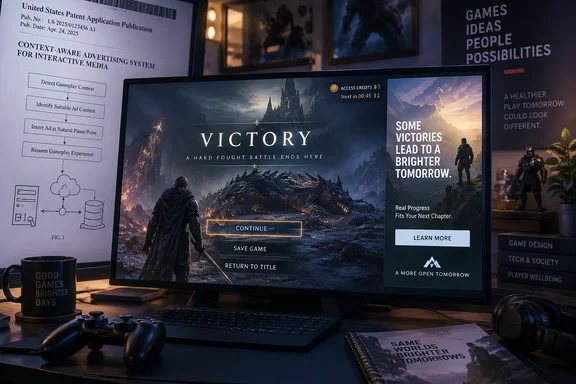
TechSpot describes a system that gives players an allowance of uninterrupted access, measured either in time or game progress. As that allowance approaches its end, the system looks for a suitable interruption point, such as a completed boss fight, finished quest, cutscene ending, or loading screen. It could then suspend interaction, show promotional material, and restore access. Watching the advertisement establishes another access “credit.”
That credit is not necessarily money or an in-game reward. It is permission to continue using the application before another interruption.
The application’s detailed description, reproduced in Patsnap’s patent record, offers several illustrative allowances:
- A duration such as 15 minutes, 30 minutes, or one hour.
- Progress such as completing a level or five rounds.
- Completion of three online multiplayer matches.
- Different durations depending on the game mode.
These are examples of possible implementations, not announced Xbox settings.
The distinction between a clock and a contextual trigger is important. The proposal is not simply “show an advertisement every half-hour, regardless of what the player is doing.” Its intended mechanism combines an access allowance with information about when an interruption might be less disruptive.
The practical problem: stopping input does not stop a match
A particularly useful detail in Microsoft’s application is its explicit acknowledgment that some games cannot safely be paused.
The detailed description notes that online multiplayer environments—and some single-player games—may continue while a user cannot interact. It identifies consequences including losing a match, an avatar dying, or being unable to communicate with teammates.
The filing also distinguishes several possible approaches: pausing or suspending the application, preventing user input, or letting the application continue running behind the promotional content. Those are materially different behaviors.
Our technical assessment: an interruption that is harmless at a campaign chapter boundary could be disastrous in a live match. Recognizing a menu or round-ending screen would not, by itself, prove that a player can safely lose control for the advertisement’s entire duration.
For any eventual implementation, the meaningful test would therefore be more demanding than “did it avoid the boss fight?” Developers would need to establish that the interruption does not outlast the safe window or leave the player exposed when play resumes. Context-aware timing is an attempted solution, not demonstrated reliability.
Could commercial breaks work in PC and console games?
Potentially—but technical feasibility and player acceptance are separate questions.
As an editorial assessment, an explicitly optional, ad-supported access model would present a different proposition from advertising inserted into a game someone already purchased. A player choosing a clearly explained exchange of attention for access could evaluate that trade-off. An unexpected interruption would offer no comparable choice.
Before judging an actual service, players would need answers to several questions:
- Is advertising optional?
- What games and access plans are affected?
- Can advertisements delay a multiplayer return?
- What happens when an advertisement fails to load?
- Is there an uninterrupted alternative?
The available evidence does not settle those commercial and operational questions.
What Xbox and Windows players should take away
The defensible conclusion is narrower than the video’s headline: Microsoft has documented a possible system for exchanging advertisement viewing for continued interactive-software access. The evidence does not establish a McDonald’s partnership, mandatory commercials across Xbox games, or a release schedule.
The proposal deserves scrutiny because it concerns control over a player’s session—not merely an advertisement placed in the scenery. But that scrutiny is strongest when it targets what the application actually describes, rather than treating a patent as a product announcement.
References
- Xbox & McDonalds Want To Put Commercials In Your Video Games! - YouTube YouTube · Tue, 29 Sep 2026 20:00:03 GMT
- Microsoft patent describes in-game advertising triggered by boss fights, loading screens, and cutscenes | TechSpot techspot.com
- US20260260258A1 – Contextually aware management of interactive software application access | Patsnap Eureka eureka.patsnap.com