

The scale of the installed base
Microsoft opens with a big number: nearly 5 million industrial robots operate in factories, up almost 10% in a year. The International Federation of Robotics (IFR) backs this up, with a clarification on timing. IFR's own figures are for 2025. The IFR's World Robotics 2026 release, dated September 24, 2026, says the global operational stock rose 9% to a record 5 million units in 2025. That was driven by an 11% jump in annual installations, with more than 600,000 new units installed worldwide.
So the "today" in Microsoft's opening is last year's year-end stock, not a live count. The same IFR release says the 2025 stock was more than double the figure from seven years earlier. It also forecasts installations rising 9% to 655,000 units in 2026.
IFR also names AI, machine vision and sensing as forces expanding robot capabilities. It says easier programming and integration are lowering deployment costs. That is independent support for the direction Microsoft describes, though not for Microsoft's specific claims.
Microsoft's definition: a loop, not a robot
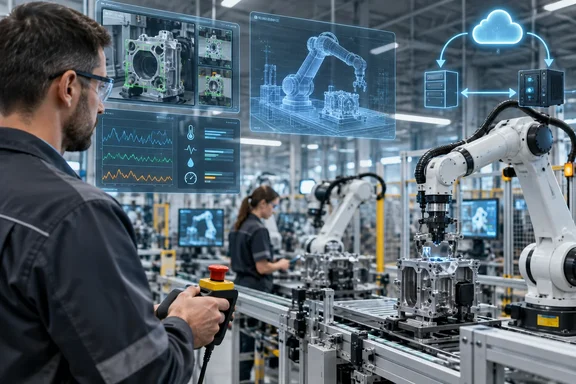
Rodriguez defines physical AI as intelligence operating in the physical world through machines, systems and people. It runs as a continuous loop:
- Perceive: read machines, environments and operational signals.
- Reason: interpret that context and choose the next best action.
- Act: execute through machines, systems and people, then feed the result into the next cycle.
Microsoft separates this from earlier stages. Connected operations gave people visibility, and industrial AI added reasoning over patterns and outcomes. Physical AI adds action in the real world, then measures the result.
This is Microsoft's framing, not an industry standard. The key sentence for IT readers is its warning that once AI moves from recommending on a screen to acting on equipment, value and risk both become physical. The post lists what must be designed in:
- operating limits
- identity and security
- observability
- validated fallback
- human approval and override
The partner examples, with their caveats
Microsoft cites four partner results. None comes with a methodology in the post, so treat them as vendor-reported.
| Partner | Claim as reported by Microsoft | What's missing |
|---|---|---|
| KUKA (iiQWorks.Copilot) | Describe a task, generate code, simulate and deploy. Programming "up to 80% faster" for simple tasks | Baseline, sample size, independent validation |
| Krones | AI agents and physically accurate digital twins cut filling simulations from three or four hours to five minutes or less | Simulation configuration, hardware, scope |
| ARUM (TTMC Brain) | Conversation turns into a machining program, cutting numerical control programming from 177 steps to two | What counts as a "step", and what operator review is needed |
| ABB | Across its customer base, up to 20% higher critical-asset reliability and up to 60% less unplanned downtime | Measurement period, customer sample, typical versus best case |
Two cautions apply. "Up to" figures describe best cases, not averages. And a program generated from a conversation is not safe to run just because it was generated. The post does not describe the verification step before a machining program reaches a spindle. A real deployment will need one.
The real argument: orchestration
The strongest idea in the post is about scaling. A single machine or workcell that works is only the first step. Rodriguez says the harder problem is orchestration across the enterprise, and he describes three shifts:
- Operating model: from site-by-site automation to network coordination across lines, plants, fleets and field environments.
- Decision model: from manual planning to agent-assisted operations. People set intent, policy, approval and override, and agents coordinate work inside those limits.
- Technology model: from disconnected tools to one governed environment, with data, controls and cross-vendor systems working together across cloud and edge.
He ties these to two linked loops. In the first, teams simulate conditions, train and adapt models, validate behavior and failure modes, and iterate before deployment. In the second, teams orchestrate work, execute across machines and people, govern what happens and optimize performance. Operational feedback (conditions, interventions, failures, outcomes) flows back into the next simulation and validation cycle.
His warning is that without reusable data, integration, governance and an operating model, an organization "scales exceptions instead of capability." That fits other industry commentary from the same event. At IMTS, AMT's Ryan Kelly cited ABI Research's finding that 85% of manufacturers remain stuck in AI pilots, unable to move from isolated use cases to full-scale adoption. That figure was not in Microsoft's post, and it is a third-party estimate. It is consistent with the pilot-to-scale problem Microsoft describes.
Governance is the part IT should read twice
For administrators, the governance section is the most relevant. Microsoft says identity, policy, monitoring, security and accountability must travel with a capability from one machine or site to the next. For global manufacturers, it says the architecture must also support sovereignty, data residency and OT security across regions. Leaders need to see what the system can do, why it acted, and when a person must approve, intervene or override.
The post names no specific Microsoft product, configuration or certification that delivers this. It reads as a design checklist, not a compliance recipe. It points to Microsoft's industrial AI platform and a Gartner Magic Quadrant recognition for Global Industrial AIoT Platforms, but the post does not detail either. Readers should expect to do the mapping from principle to tooling themselves.
Context from IMTS 2026
IMTS ran September 14 to 19, 2026, at McCormick Place in Chicago, and Rodriguez's session was titled "Physical AI in Manufacturing: From Insight to Action." Coverage of the show describes a shift in tone. ARC Advisory Group wrote that attendees were less focused on distant "factory of the future" visions and more on deployable applications. ARC noted that Microsoft emphasized Copilot, agent governance, organizational knowledge and AI-enabled process handoffs in a joint session with Rockwell Automation.
Edge hardware also featured. OnLogic listed live demonstrations with Microsoft and other partners on its rugged edge hardware as part of showing physical AI on the factory floor. That is a reminder that this story involves industrial PCs and edge computing as well as cloud services.
A practical starting procedure
Microsoft's advice is to start small, and the steps are straightforward:
- Pick one bounded operation where the outcome matters and the boundaries are clear. Microsoft's examples are quality inspection, maintenance triage, machine programming and process optimization.
- Map the data and operating context needed to make a sound decision.
- Define the autonomy boundary. Decide what the system may recommend, what it may execute, and where a person must approve or intervene.
- Design for reuse so a successful pattern can move to another line, site or fleet.
- Build validation, monitoring, fallback and override into the architecture from the start.
The post does not give numeric acceptance thresholds or a technical implementation recipe. Teams will need to set their own, ideally with safety engineers involved.
Analysis: useful framework, thin evidence
What holds up:
- The robot-stock statistic is corroborated by IFR.
- The advice to start with a bounded, measurable workflow, and to define human approval points up front, is sound.
- Putting identity, observability and fallback inside the architecture is the right instinct for systems that move physical equipment.
What to treat carefully:
- The performance figures are partner-reported "up to" numbers with no stated methodology.
- The post is written by a Microsoft executive and promotes Microsoft's platform positioning, so it will not weigh alternatives or the failure cases.
- The word "can" appears often. Several capabilities, such as perceiving, reasoning and acting across fleets, are described as possible rather than proven at scale.
- Safety-critical industrial settings already carry established engineering and regulatory practice. The post does not say how agent-driven action fits into it.
For IT and OT teams, the takeaway is to treat physical AI as an identity, policy and observability problem as much as an AI problem. If an agent can touch a machine, it needs the same lifecycle controls as any privileged account, plus a human stop button.
References
- Physical AI in manufacturing: From intelligent machines to coordinated operations - Microsoft Microsoft · 2026-10-06T15:00:00+00:00
- IMTS 2026 Conference: From Automation to Autonomy: The Next Era of Manufacturing with Physical AI - Aerospace Manufacturing and Design aerospacemanufacturinganddesign.com
- OnLogic to Demonstrate Physical AI Hardware and Manufacturing Solutions at IMTS 2026 roboticstomorrow.com