

Fermilab joins Microsoft Quantum's Maryland makerspace, and QICK comes with it
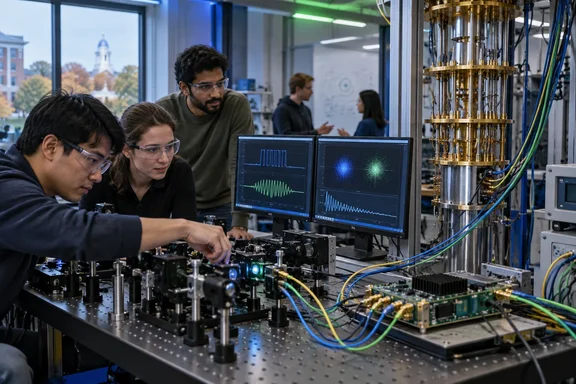
Fermilab's announcement is short and specific. Fermilab is among the initial partners in Microsoft Quantum's newly established quantum research center. Opening in the Discovery District, Maryland, the center will feature a quantum hardware makerspace, where researchers can develop new approaches to hands-on quantum training. As part of that work, Fermilab will expand the capabilities of its Quantum Instrumentation Control Kit, or QICK, an open-source quantum control and readout system, providing flexible new tools to the quantum community.
Fermilab's release describes the makerspace as a place where researchers from academia, industry and government will give students and newcomers access to real quantum hardware and expertise. Anna Grassellino, Fermilab's chief technology officer, said the lab was "thrilled that Microsoft has chosen QICK to be part of the quantum hardware makerspace." She also said Fermilab expects to work with Microsoft on other projects.
Microsoft's announcement, written by Charles Tahan, a Partner at Microsoft Quantum, names Fermilab alongside six companies. AMD, Bluefors, Intel, IQM, Quantum Motion, Riverlane, and Fermilab are the initial makerspace partners, according to the report in Quantum Computing Report, which matches Microsoft's own list. Fermilab is the only national laboratory on that list, and the only partner whose contribution both announcements describe in any detail.
Neither organization has said when learners can start, how enrollment works, who is eligible or what it costs. WindowsForum's earlier coverage of the center noted that Microsoft has not yet announced capacity, schedules or eligibility. The practical news for now is the partnership and the tool, not an open door.
QICK is the layer that turns software commands into qubit pulses
It helps to know what "control and readout" means. Qubits don't take instructions the way a CPU does. Something has to turn a program into precisely timed analog signals that act on the qubit, and then turn the qubit's faint response back into digital data. Fermilab describes QICK as an open-source hardware and software toolkit it built to do exactly that: control qubits and read information back from them.
The project's public GitHub repository is more concrete. It describes QICK as an open-source qubit controller made up of firmware, software and an optional front end, running on Xilinx RFSoC development boards. The stated goal is a powerful, flexible, low-cost and easy-to-learn platform for controlling and reading out many kinds of quantum systems. The repository contains:
- Firmware for the supported RFSoC boards, as both compiled bitstreams and design source.
- The
qickPython package, which talks to the firmware and provides an API for writing QICK programs. - Jupyter notebooks that show how to use it.
The repository documentation lists the ZCU111, ZCU216 and RFSoC4x2 as supported boards and recommends the newer ZCU216 and RFSoC4x2 for better overall performance. It also says QICK does not yet support PYNQ v3.1, the board operating system image, and points users to a quick-start guide listing the recommended images. These details describe the project as it stands today. Neither announcement says which boards the Maryland makerspace will use.
Quantum Computing Report describes how QICK fits into the makerspace: the makerspace integrates Fermilab's open-source Quantum Instrumentation Control Kit (QICK)—an FPGA/RFSoC-based control and readout framework adapted across superconducting, trapped-ion, cold-atom, and silicon spin-qubit architectures—to train students and researchers on physical signal processing, pulse design, and component integration. That fits Microsoft's goal. Students who learn pulse design on QICK learn the part of the stack that is usually hidden inside expensive commercial controllers.
QICK already has users. A Fermilab item from September 1, 2026 featured senior scientist Gustavo Cancelo discussing an open source platform developed at Fermilab that has become a widely adopted tool for quantum control and readout across four continents. Fermilab also says QICK's development was originally funded mainly through its role in the Quantum Science Center, a DOE National Quantum Initiative research center headquartered at Oak Ridge National Laboratory.
Why Microsoft wants QICK to work beyond superconducting qubits
The important part of the collaboration is its reach across hardware types. Fermilab says QICK was originally designed for superconducting qubits, and that its team has since worked with partners to adapt it to trapped ions, cold atoms, silicon-spin qubits, quantum dots and biological qubits. That's a list of adaptations. It doesn't mean QICK is equally mature or ready for production on every one of those platforms, and neither announcement makes that claim.
Tahan's comment makes clear that Microsoft wants more than a classroom tool. He said the work with Fermilab "extends beyond training." Microsoft says the two are working to make quantum-control technology usable across more hardware platforms, while also working with UMD to explore how tools such as QICK could fit into education. Constellation Research summarized it the same way: Microsoft's partnership with Fermilab is focused on applying quantum control technologies across hardware platforms.
This is our inference from Microsoft's own description of its strategy, but it fits. Microsoft describes the Microsoft Quantum platform as running from developer tools down to a real-time operating system for quantum computers in Azure, with support for different qubit technologies. The company is building topological qubits on its Majorana 2 chip and is working with Atom Computing on neutral-atom machines. A control layer that works across qubit types lines up with a platform that wants to host more than one kind of hardware.
The limits matter. Fermilab says it "aims to add" capabilities. It has not published a feature list, release date, roadmap, funding figure or benchmark. The announcements also don't say QICK will become an Azure service or a commercial Microsoft product. Right now QICK is an existing open-source project, and the Microsoft collaboration is a stated plan to extend it.
The Maryland center around the makerspace: 15,000 square feet, DARPA and Majorana 2
The Fermilab partnership sits inside a much larger site. Microsoft says the state of Maryland bought and renovated the Discovery Center with support from Governor Wes Moore's Capital of Quantum Initiative, and that Microsoft then worked with UMD and the initiative to design a 15,000-square-foot quantum research center inside it. Quantum Computing Report independently puts the facility within the Discovery District in College Park, Maryland.
Microsoft says the building has space for its proprietary research, space for DARPA's topological system and future prototypes, labs and offices for partner companies, and a community training lab. Hardware makers can use the partner space to integrate their machines or components with the Microsoft Quantum platform.
The headline news from the opening was about DARPA. Microsoft said it has opened its quantum research center in the University of Maryland's Discover District and said it will provide topological qubits built on its Majorana 2 quantum chip for independent testing and evaluation by the Defense Advanced Research Projects Agency (DARPA). That work is separate from Fermilab's role. It isn't a Fermilab deliverable, and on-site access doesn't prove anything about how the chip performs. As daily.dev noted, Microsoft's Majorana 2 chip, which replaces aluminum with lead in its material stack, has drawn skepticism from parts of the scientific community, and the DARPA testing is meant to address those doubts.
Microsoft announced two other programs at the center that relate to the makerspace. Microsoft established annual measurement-based quantum computing workshops and funded new quantum postdoctoral research fellowships at UMD. The workshops will focus on faster and more accurate measurements, error-correcting codes, and ways to verify and validate measurement-based computation. In measurement-based computing, measurement results help determine subsequent operations in a quantum calculation. That puts the speed and accuracy of readout close to the center of Microsoft's research, and readout is one of QICK's two core jobs.
The MIT license keeps QICK outside Microsoft's proprietary stack
Developers and research groups may worry that a Microsoft partnership will pull an open tool into a closed product. The public record points the other way. Fermilab says in its announcement that it is committed to keeping QICK open source so that people in academia, the national labs and industry can train workers and build applications on top of it.
The repository puts that commitment in writing. QICK's source code is released under the MIT License, and the project's open-source statement says QICK is and will remain fully open source under that license. It also says commercial partnerships or integration agreements with third-party companies don't change the project's licensing, governance or availability. The statement applies to all of the firmware, software and documentation, which will stay freely available in the public repository.
The same repository gives a practical warning for anyone planning to build on QICK. It says the firmware and software are still very much a work in progress, and that the developers try to keep APIs consistent but can't guarantee backward compatibility. Updates arrive as pull requests with notes on breaking changes. Versions follow a major.minor.PR scheme, and tagged releases guarantee that the demo notebooks and firmware images work with the library. The project recommends running at least the latest tagged release and watching the repository for notifications.
Other outside groups have also built on QICK. In a separate effort that Fermilab reported in June 2026, the company Harmoniqs has been integrating QICK with its Piccolo.jl control and calibration software. That project has nothing to do with Microsoft, but it shows QICK being used as a shared base layer by several parties.
What this means for developers, researchers and IT teams
Most WindowsForum readers don't need to do anything. This announcement doesn't change Windows, Azure subscriptions or any Microsoft product you run today. The people who can act are university labs, quantum hardware startups, educators and engineers interested in the control-electronics side of quantum computing, and their first step is to track the open-source project and wait for makerspace access details.
For anyone who wants to evaluate QICK now, the path doesn't depend on Microsoft. The public repository, the MIT license, the supported RFSoC boards and the quick-start guide are all available today. Treat Fermilab's planned expansion as future work until actual releases show up in the repository.
Organizations that follow Microsoft's quantum strategy should see this as one more sign that the company is building a platform meant to work across qubit types. The partner integration space in College Park is the physical place for that work. Microsoft has not published an application process.
- Fermilab is one of seven initial makerspace partners at Microsoft Quantum's College Park, Maryland center, announced on September 22, 2026, alongside AMD, Bluefors, Intel, IQM, Riverlane and Quantum Motion.
- QICK is Fermilab's MIT-licensed qubit controller: firmware, a Python API and Jupyter examples for the Xilinx ZCU111, ZCU216 and RFSoC4x2 boards.
- New QICK capabilities are planned but have no published feature list, timeline or funding figure, so don't budget or schedule around them yet.
- The QICK project says partnerships with outside companies won't change its licensing, governance or availability.
- Makerspace enrollment, eligibility, capacity and cost haven't been announced, so career changers and students near Washington, D.C. should watch for UMD or Microsoft updates.
- The DARPA Majorana 2 testing at the same site is a separate Microsoft effort and isn't part of Fermilab's contribution.
Microsoft could have built its training program on proprietary controllers. By choosing a national lab's open-source control kit as a foundation, it gets a tool already used on four continents and adapted to several kinds of qubits, and Fermilab gets a high-profile commitment that keeps QICK open. The first concrete test will be in QICK's public repository. New capabilities from the Microsoft collaboration should show up there as documented pull requests and tagged releases that anyone can inspect, download and run on their own RFSoC board.
References
- GitHub - openquantumhardware/qick: QICK: Quantum Instrumentation Control Kit · GitHub github.com
- Microsoft Quantum | Microsoft’s Quantum Research Center Opens in Maryland quantum.microsoft.com
- Fermilab and Microsoft partner to provide new quantum tools and expand quantum research - Fermilab (.gov) Fermilab (.gov) · 2026-09-22T20:35:37+00:00