

The anniversary and what Microsoft actually announced
In a statement released on September 30, 2026, Microsoft said it opened its first Romanian office in 1996. The company says it now employs around 2,000 people in Bucharest, Iași and Timișoara, and that those teams handle core engineering, development and support work for customers far outside Romania. It also says it has several open positions. These are Microsoft's own figures. The statement gives no breakdown by role and no hiring totals.
Microsoft lists four areas where it plans to focus its technology, expertise and partnerships:
- Business adoption. It wants to help companies of all sizes become more productive and reach new markets. It frames this as "responsible" adoption in line with European values and regulations, aimed at firms that don't use AI yet.
- Public services. It names public administration, education and healthcare as places where secure cloud and AI could make services simpler and faster.
- Skills. It promises continued investment in digital skills with universities, partners and institutions.
- Competitiveness and resilience. It argues that AI used at scale and backed by strong cybersecurity can raise productivity and help Romania compete on equal terms inside the EU.
Each of these is a statement of intent. None comes with a funding amount, a named government contract, a timeline or a measurable target. The anniversary statement is a description of where Microsoft wants to go, not a list of new projects.
Section summary: The headcount and history are useful context. The four pillars describe direction, not commitments.
The number behind the message: 18%
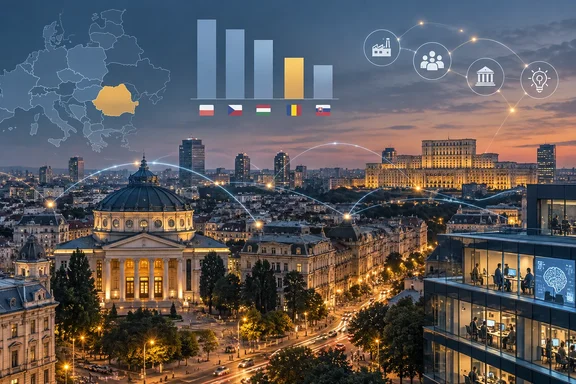
Microsoft uses its Global AI Diffusion Report as the hook. The Q2 2026 figures show 18% of Romania's working-age population using generative AI. The comparable figures are 32.3% in Poland, 33.3% in Hungary and 31.2% in the Czech Republic. That puts Romania 65th of the 147 economies measured.
The report also shows something the anniversary statement leaves out: Romania is slightly below the global average. Microsoft says in June, AI usage was 18.8% of the working-age population worldwide, an increase of about 1% from the first quarter of this year. Romania's 18.0% sits just under that, and well under the Global North at 28.8% in the second quarter, up from 27.5% in the first quarter.
The trend line
Microsoft publishes the country data behind its reports, which lets you track Romania over time. The H2 2025 report shows Romania going from 15.30% to 16.20% between the first and second halves of 2025. The Q1 2026 report puts it at 17.5%, a 1.3-point quarterly change. In Q2 2026 it reached 18.0%, a change of 0.5, which is half the world's quarterly gain of one percentage point.
Microsoft's published dataset gives the same history for the countries it compares Romania with. It also includes Bulgaria, a neighbor the press release doesn't mention, which Microsoft's data shows at 25.40%, 27.30%, 29.70% and 30.7% across the four periods.
| Economy | H1 2025 | Q2 2026 | Change (pp) |
|---|---|---|---|
| Hungary | 27.9% | 33.3% | +5.4 |
| Poland | 26.4% | 32.3% | +5.9 |
| Czech Republic | 26.0% | 31.2% | +5.2 |
| Bulgaria | 25.4% | 30.7% | +5.3 |
| Romania | 15.3% | 18.0% | +2.7 |
Changes calculated by WindowsForum from Microsoft's published figures.
The calculated changes show that Romania isn't only starting from a lower point. Its neighbors are pulling further ahead. In H1 2025 the gap between Romania and Poland was 11.1 points. In Q2 2026 it was 14.3 points. Bulgaria is a closer comparison than Poland in income and EU accession history, and it is now about 12.7 points ahead. Microsoft's view that Romania "needs speed" is supported by its own data, more strongly than the press release lets on.
Section summary: Romania is just below the global average, and the gap with its regional peers grew over five measurement periods.
What the metric does and does not measure
Readers should know where these figures come from. Microsoft measures the proportion of working-age individuals — those aged 15 to 64 — who used a generative AI product during the period in question, drawing on aggregated and anonymized Microsoft telemetry data and adjusting for variation in device market share, internet penetration, and population.
Some caveats follow from that:
- It is a modelled estimate, not a census. It starts from telemetry on Microsoft platforms and is then adjusted. Microsoft says itself that no single metric is perfect.
- The method is about to change. Microsoft says there has been a significant rise in new AI tools and models over the past year, and its next report will expand the measure to include usage of these new tools. The company expects that to raise user share in almost every economy. Q2 2026 numbers may therefore not compare cleanly with the next release.
- Some country figures may be regional averages. The data-analysis site Pebblous checked the Q2 leaderboard against Microsoft's public data and reported that for 36 of 147 economies, the published rate is a shared regional average. Pebblous did not say whether Romania is one of them. Its separate figures for Romania in every period suggest it isn't, but readers should take care with fine-grained rankings.
- It counts usage, not impact. A share of people who touched a generative AI product says nothing about enterprise deployments, productivity, or whether public services have actually improved.
Section summary: Use the 18% as a directional signal from Microsoft's telemetry. It is not a full count of how AI is used in Romania.
Partners, "Frontier Firms" and how far the evidence goes
Microsoft names three Romanian organizations as moving toward the "Frontier Firm" model from its 2025 Work Trend Index. That model describes companies where people and AI agents work together and intelligence is available on demand. The three are customers Regina Maria and Banca Transilvania, and partner Druid AI.
Druid AI co-founder and COO Andreea Pleșea gives the most concrete detail. Druid's platform runs on Microsoft Azure and extends Microsoft Copilot with governed AI agents. She says the partnership helps customers move from pilot projects to agents delivering business results under governance that leadership can trust. Regina Maria CEO Fady Chreih calls Microsoft a long-standing partner that brings innovations and use cases in healthcare and public health.
Neither quote includes a deployment, a metric or a result. Banca Transilvania appears without any detail at all. The examples show who Microsoft works with. They don't show what AI has done for those organizations.
Politics also plays a part. David Galbraith, Deputy Chief of Mission at the U.S. Embassy in Romania, presented the anniversary as an example of the U.S.-Romanian partnership. He said further improvements to Romania's legal framework and governance would help the country benefit from cloud, AI and cybersecurity alongside American companies. That is a diplomatic message as much as a technology one.
The employer ranking, and what workers say they want
For the sixth year in a row, Microsoft was named Romania's most desired employer in Catalyst Solutions' Most Desired Employers 2026 study. Catalyst says the survey ran from November 2025 to April 2026 and collected 10,892 free, unaided responses from professionals and early-career candidates. It asked respondents to name their top five employers. Catalyst notes that company size, geographic presence and the range of roles can push nomination totals up. The ranking measures candidate preference, not employee satisfaction.
The same survey has more useful findings for IT leaders planning AI rollouts:
- 55% of respondents want employers to provide AI training and support.
- 55% want transparency about how AI is used at work.
- 54% want guarantees that data is protected and AI is adopted ethically.
- 50% want upskilling or reskilling opportunities.
- 49% want assurance that AI won't hurt their jobs.
Catalyst's reading is that respondents accept AI on conditions rather than rejecting it. That lines up closely with the "responsible adoption" message in Microsoft's statement.
What this means for IT pros and businesses in Romania
This is general industry analysis, not a Microsoft claim. A low share of individual users often means companies are rolling AI out slowly, but it doesn't have to. Copilot and agent deployments also run into licensing costs, data-governance work, and EU AI Act compliance planning. If Microsoft is serious about closing the gap, look for concrete signs: named public-sector deployments, published skills-program numbers, and SMB offers with prices attached. Until those appear, the four pillars are a set of intentions.
For administrators, the Catalyst findings work as a checklist. Training, transparency and data protection are what employees say they want before they'll adopt AI with confidence. Those also happen to be the areas where Entra, Purview and Intune policies come in.
Bottom line: Microsoft's 30 years in Romania have produced a real engineering hub. The company's own data now shows Romania falling behind its neighbors on AI use. Whether the anniversary leads to measurable change will depend on commitments Microsoft hasn't announced yet.
References
- 30 years of Microsoft in Romania: A solid foundation for the country to move forward more quickly into AI era - Business Review Business Review · 2026-10-01T09:44:58+00:00
- January, 2026 Global AI Adoption in 2025 A Widening Digital Divide microsoft.com
- May, 2026 Global AI Diffusion Q1 2026 Trends and Insights microsoft.com