

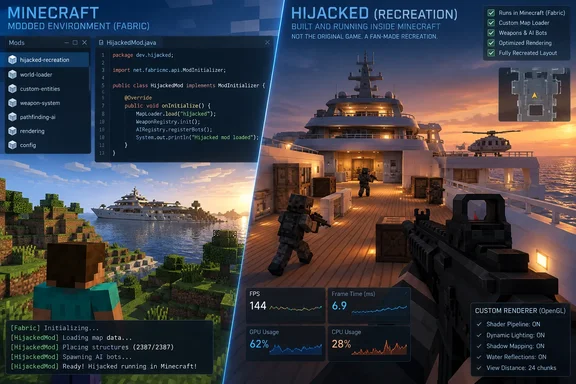
Tom’s Hardware reported the demonstration on September 17 after Luckey Faraday posted footage and a description of the project on X. Faraday says an earlier browser-based version first appeared as a playable screen inside Minecraft, before GPT-6 Astra was tasked with rebuilding it for Minecraft’s own rendering context. The reported frame rate comes from that demonstration; no downloadable Fabric build, supported Minecraft version, hardware specification, or repeatable benchmark has been published alongside it.
That missing material changes how readers should interpret the clip. It is an impressive rendering and integration demo, but it is not yet a mod release that Minecraft players or server operators can install, test, or treat as a stable multiplayer project.
“Native in Minecraft” describes the host, not the original game engine
The phrase “running natively in Minecraft” is easy to misread. Based on Faraday’s account, Minecraft is acting as the host application: the reconstruction runs in the Java process, uses the client’s graphics environment, and is installed through the Fabric mod-loading stack. Black Ops II itself is not being booted as a nested Windows program, emulated console title, or embedded browser tab.
That distinction is substantial technically. A browser port placed on an in-game virtual monitor is still a web application rendering in its own browser environment. A Fabric mod instead runs code during Minecraft’s initialization and can hook into client-side classes, rendering, inputs, assets, and game events. Fabric’s own documentation describes its loader as a lightweight way to load Java mods, with entry points for client and server behavior and mechanisms for changing game classes.
Faraday’s demonstration therefore appears to be closer to a miniature first-person shooter built alongside Minecraft than an emulation project. Sharing Minecraft’s OpenGL context can eliminate the awkward “game within a browser within a game” layer, but it also makes the port dependent on Minecraft’s rendering lifecycle, mod-loader compatibility, and whatever hooks the project relies on.
A fluid 45 fps clip shows that the concept can render at a playable rate on one machine. It does not establish frame pacing, GPU utilization, minimum specifications, compatibility with shaders, behavior on integrated graphics, or stability after a Minecraft update. Those are the measurements that turn an eye-catching prototype into software other people can responsibly use.
The public code supports the browser project, not the Minecraft claim
Faraday’s public GitHub repository for the earlier project is titled Claude of Duty: Vibe Slops II. It identifies itself as an unofficial browser-based Three.js first-person shooter using an export of the Hijacked map, capsule collision, and a baked Recast navigation mesh. Its code and documentation describe a web build pipeline, browser testing through Playwright, and runtime debugging controls designed around the browser version.
The repository also provides a revealing technical detail: its collision system is described as a geometry-derived approximation because the extracted files did not contain usable original Black Ops II physics brushes. In other words, even the prior browser version was not a direct transplant of Treyarch’s gameplay implementation. It recreated usable collision and navigation from map geometry and available assets.
That is not a knock on the work. Reconstructing map traversal, combat movement, bot navigation, lighting, and hit detection outside the original engine is difficult, and the browser project’s documentation shows more than a static map import. It has separate tooling for collision, navigation, visual testing, enemies, graphics settings, mobile controls, and recording test output.
But the repository currently visible to the public is a JavaScript and Three.js project, not a Java/Fabric Minecraft repository. It contains no documented Minecraft target version, Fabric metadata file, Fabric API dependency declaration, mod JAR, installation instructions, source tree for a Java client mod, or build instructions for the claimed Minecraft implementation. That absence does not disprove a separate or private Fabric branch. It does mean the public record cannot independently verify the key claims about the Minecraft version’s architecture or its 45 fps performance.
For a demo that explicitly credits GPT-6 Astra with the rebuild, this is the line readers should keep clear: the available code demonstrates that Faraday has built a browser FPS reconstruction with real implementation detail. The Minecraft conversion is presently supported by Faraday’s own description and video, relayed by Tom’s Hardware, rather than a released artifact that outside developers can inspect.
Fabric makes the integration feasible, but release details decide whether it is usable
Fabric is a natural fit for an experiment like this because it gives a Java mod access to Minecraft’s client initialization and rendering-side behavior without requiring a standalone launcher or a custom fork of the game. A properly packaged Fabric mod needs a metadata file declaring its identity, version, dependencies, and entry points; compatibility is normally tied tightly to the Minecraft version and loader environment it targets.
None of those basic deployment details are public for this project. There is no indication whether the mod is strictly client-side, whether it expects Fabric API, whether it rewrites Minecraft classes with mixins, or whether the reported build can connect to a normal multiplayer server. There is also no confirmation of how it handles mouse capture, key bindings, audio routing, render scaling, resource reloads, or conflicts with OptiFine-style replacements, shader mods, performance mods, and other Fabric clients.
The multiplayer question is particularly important. A client-local FPS scene with bots needs no dedicated server support. A version that lets several Minecraft players join a Hijacked match has to synchronize player positions, shots, damage, matches, bots, and map state across a server—while also deciding whether Minecraft gameplay continues in the background. Faraday mentioned possible future multiplayer modes, which indicates that capability is not part of the demonstrated result.
For administrators, the immediate practical advice is simple: do not treat a video clip as a deployable Minecraft mod. Wait for a versioned release, a published checksum or source repository, an explicit Minecraft and Fabric Loader compatibility list, and a clear statement about whether it belongs on clients, servers, or both. A downloadable JAR claiming to be this project without those basics should be regarded as untrusted, especially because mods execute code within a player’s game environment.
Asset rights are a more immediate obstacle than graphics performance
The visible browser repository is unusually direct about its status. It calls itself an unofficial, non-commercial fan project, says it is not affiliated with Activision, Treyarch, Microsoft, Anthropic, or the named brands, and limits its MIT license to the project’s original code and documentation. It further states that game art, audio, maps, models, animations, names, and other third-party material remain with their respective owners.
That notice matters more than the “AI made it” framing. An AI-assisted rewrite of source code does not give a project rights to redistribute a commercial game’s map, textures, sound effects, character assets, weapon models, or other protected content. Nor does compiling a reconstruction into Java or packaging it in a Fabric JAR turn extracted assets into open-source material.
The browser project’s stated non-commercial intent may explain its experimental posture, but it does not amount to a license from Activision or Microsoft. Until the Minecraft build’s asset sourcing and distribution model are documented, its safest likely path is as a private technical demonstration or a mod that requires users to supply legally obtained assets themselves. Even that approach would need careful design and a clear public explanation.
The credible takeaway is narrower—and still notable
The video’s technical achievement is the apparent removal of the browser layer. If Faraday’s implementation works as described, it shows that an AI-assisted developer can move an existing fan reconstruction across runtimes: from a web-based Three.js shooter to a Java component that renders in Minecraft’s client environment. That is a useful proof of workflow, particularly for modders experimenting with imported scenes, custom game modes, and non-Minecraft rendering inside a Minecraft mod.
It does not yet show that GPT-6 Astra autonomously ported Black Ops II, that the original game runs within Minecraft, or that a 45 fps result is reproducible beyond the recorded test machine. Those stronger conclusions would require a public build, source review, performance captures, and a clear separation between code written or revised by the model and code supplied by the developer’s existing browser project.
For now, the project is best understood as a technically credible but unverified-in-public Fabric prototype built on a more thoroughly documented browser reconstruction. The next meaningful milestone is not another gameplay clip; it is a released mod package with its target Minecraft build, Fabric dependencies, asset requirements, and limits spelled out clearly enough for other developers to reproduce the result.
References
- Developer uses GPT-6 Astra to get CoD Black Ops 2 Hijacked map running natively inside Minecraft — achieves 45fps performance using Minecraft’s OpenGL context Tom's Hardware · 2026-09-17T11:17:02+00:00