

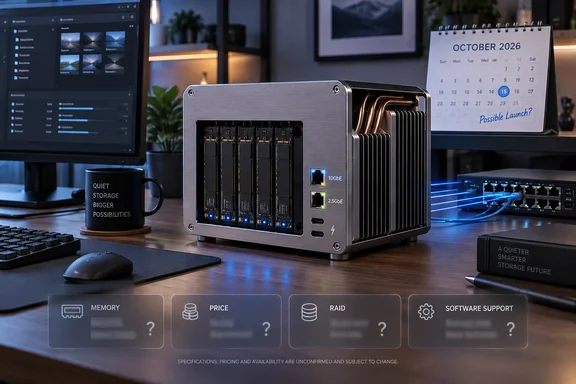
For homelab users and small creative teams, the appeal is straightforward: five M.2 NVMe bays, 10GbE, 2.5GbE, USB4 and passive cooling in a very small enclosure. But Minisforum’s latest teaser confirms the parts most likely to sell the S5 while still omitting the information that determines whether it can replace a conventional NAS: price, storage-management features, operating-system maintenance policy, and even a settled memory specification.
The important detail buried beneath the “up to 40 TB” claim is that the S5’s five M.2 2280 bays are PCIe 4.0 x1 slots. That does not make the design weak—five SSDs can still provide excellent parallel I/O for virtual machines, photo libraries, backups and multiple network clients—but it makes the S5 a different proposition from a five-bay system with x4 NVMe links per drive. Buyers should treat it as a compact, quiet network appliance with a large flash pool, not assume every installed SSD will run at the speed shown on its retail box.
Core 3 304 is a real low-power platform, not an AI workstation CPU
Intel’s own specifications identify the Core 3 304 as a launched Series 3 processor, formerly called Wildcat Lake. It has one Cougar Cove performance core and four Darkmont low-power efficient cores, for five cores and five threads total. The processor can boost its P-core to 4.3 GHz, has a 15 W base power rating, and can reach 35 W at maximum turbo power.
That is a sensible fit for a fanless NAS. File serving, media indexing, containerized utilities, light virtualization, backup jobs and encrypted network traffic tend to benefit more from steady efficiency and capable I/O than from a large core count. Intel also lists AV1 encode and decode support, Quick Sync Video, and a modest integrated GPU, features that could help a media server transcode compatible formats.
It is not, however, a serious local-LLM box by the standards set by Minisforum’s own higher-end NAS products. The Core 3 304 has no dedicated NPU listed in Intel’s public specifications, while its integrated graphics peak is far below the compute resources found in systems using Ryzen AI Max+ or Intel Core Ultra processors. Minisforum has marketed the S5 around its MinisOpenClaw assistant and AI-assisted photo search, but the company has not explained which models, inference back ends, memory limits, or offline capabilities will ship in the final retail software.
That omission matters more than the “AI NAS” label. Semantic search of a photo library can be useful, but administrators need to know whether indexing happens locally, whether it requires an online account or cloud service, how much storage it consumes, and how the vendor handles updates to the model and its dependencies. Minisforum’s announcements make a privacy-oriented pitch around local data, but the public S5 material does not yet document those operational details.
Five x1 SSD bays put the 10GbE port in perspective
Minisforum’s official May announcement described the S5 as having five M.2 2280 PCIe 4.0 x1 slots. Earlier coverage from ServeTheHome and reporting around the May unveiling put the system’s combined storage throughput at up to 10.8 GB/s, while also identifying the 10GbE controller as a Realtek RTL8127.
The distinction between aggregate and client-visible performance is important. A 10GbE Ethernet connection has a practical ceiling of roughly 1 GB/s to 1.1 GB/s after protocol overhead, so one workstation copying files to the S5 will be constrained by the network long before it reaches the combined bandwidth of five installed SSDs. The 2.5GbE port is more useful for a second client, management traffic, a backup target, or a separate LAN segment than for exploiting the flash array’s maximum potential.
The five x1 links are still sufficient for the use cases Minisforum is targeting. A single PCIe 4.0 x1 connection has far more bandwidth than a 1GbE or 2.5GbE network client can consume, and even a 10GbE transfer generally will not saturate a modern PCIe 4.0 x1 SSD link. The limitation appears when several drives must service intensive internal work at once: multi-VM storage, heavy RAID or parity reconstruction, database workloads, or concurrent direct-attached USB4 and network transfers.
This is why the dual USB4 ports are potentially more significant than the company’s marketing suggests. Each is rated for 40 Gbps, well beyond 10GbE networking, and they could make the S5 useful as a fast directly attached storage device as well as a network appliance. Minisforum has not said whether its MinisCloud OS exposes a supported DAS mode, how USB4 bandwidth is shared, or whether the ports support host-to-host networking. Those answers will determine whether USB4 is a genuinely useful workflow feature or simply a well-stocked rear panel.
The published specifications still do not agree on memory and ports
Minisforum’s S5 specifications have shifted between presentations. In June, the company and Notebookcheck described a configuration with 12 GB of LPDDR5X-7500 memory and 64 GB of UFS 2.2 system storage. Reporting from the May Intel launch event, including IT Home, instead described up to 16 GB of LPDDR5X-7200 memory. The new listing reported by Notebookcheck identifies the Core 3 304 but does not state the installed memory capacity.
For a NAS intended to run an operating system, containers, indexing software and “AI agent” features, that is not a minor loose end. LPDDR5X is soldered memory, so buyers are unlikely to have an upgrade path if the shipping model carries 12 GB. That capacity is adequate for conventional SMB file sharing and light services, but it becomes tighter if MinisCloud relies on memory-resident indexing, virtual machines, or local inference workloads.
The port count also needs a final, official specification sheet. Minisforum’s May product announcement listed two USB 3.2 Type-A ports, two 40 Gbps USB4 ports, HDMI 2.1, 10GbE and 2.5GbE. The latest Notebookcheck report describes the same core network and USB4 configuration but mentions only one additional USB Type-A port. Earlier Computex reporting also described Wi-Fi 7 and Bluetooth 6 support, while Minisforum’s English-language launch announcement focused on the wired ports and did not spell out the wireless module.
None of those discrepancies necessarily indicates that hardware was removed. Product pages often simplify port lists or reflect region-specific configurations. But a NAS is an appliance, and purchasers need a definitive answer before ordering: how much fixed memory is included, whether Wi-Fi 7 is standard, how many USB-A ports are physically present, and whether the listed storage controller supports the RAID modes and drive-health monitoring they expect.
Passive cooling shifts attention from CPU heat to SSD behavior
Minisforum’s aluminum enclosure, heat pipe and substantial heatsink arrangement are central to the S5 design. The Core 3 304’s low base power makes passive processor cooling credible; Intel even lists embedded options for the chip, and Wildcat Lake devices have already appeared in compact systems. The harder thermal question is the SSD array.
Five high-capacity NVMe drives installed in close proximity can generate substantial heat under sustained writes, rebuilds, cache-heavy transfers or indexing jobs. A fanless chassis eliminates moving parts and noise, but it also means the case must absorb and shed heat from both the SoC and every installed drive. Minisforum has not published sustained transfer testing, SSD temperature data, or a drive compatibility list for the S5.
That does not rule out the design. It means the first independent reviews need to test more than a short sequential benchmark. Buyers should look for long 10GbE writes, simultaneous USB4 and Ethernet traffic, drive temperatures after hours of indexing, and performance recovery once the drives’ SLC caches are exhausted. Those are the tests that separate a silent flash NAS from a small PC that performs brilliantly for thirty seconds.
Price and platform support will decide whether the S5 makes sense
The S5’s bare system price remains undisclosed, and that is the largest remaining variable. Five 8 TB NVMe SSDs can technically create the advertised 40 TB pool, but the media alone will cost far more than many conventional five-bay NAS units equipped with large hard drives. The all-flash approach makes sense where silence, low latency, physical size, resilience to vibration, or frequent small-file access are worth paying for; it is a poor capacity-per-dollar choice for bulk archival storage.
Minisforum is trying to occupy a narrow but credible category: a silent 10GbE flash appliance that can sit beside a workstation or in a living space without the mechanical noise of hard disks and fans. The Core 3 304, dual Ethernet, USB4 and five SSD bays give it the ingredients to do that job well.
Before the mid-October launch, Minisforum still needs to publish the information that determines whether IT buyers can deploy it confidently: final RAM and port configurations, supported file systems and RAID options, backup and restore procedures, firmware and OS-update commitments, remote management capabilities, and the price of the base unit. Until then, the S5 is a promising hardware design with an unusually incomplete appliance story.
References
- Minisforum reveals launch window for Wildcat Lake all-flash NAS Notebookcheck · 2026-09-17T16:28:00+00:00