

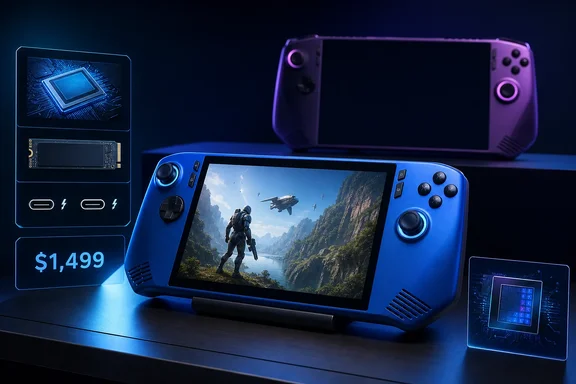
Retailers have filled in most of the missing picture. CompSource lists the US model as the Claw 8 EX AI+ CG3M-072USY at $1,499, while ExcaliberPC lists the same configuration for pre-order at that price with an October 30 arrival estimate. ExcaliberPC’s listing identifies the machine as a Luminous Blue handheld with Intel Arc G3 and Arc B370 graphics, 32GB of LPDDR5X-8533 memory, and a 512GB PCIe 4.0 NVMe SSD.
The $1,499 figure is the central change. MSI’s currently available Claw 8 EX AI+ CG3EM with Arc G3 Extreme carries a $1,799 price on MSI’s US store. The apparent $300 reduction is meaningful, but buyers should read it as a retailer-confirmed price rather than an MSI-announced MSRP until the company puts the CG3M on sale itself.
MSI’s support document makes the CG3M real
Notebookcheck reported that MSI appeared to be preparing the lower-spec handheld after the CG3M surfaced in product documentation. The strongest confirmation is MSI’s own external-display support PDF, which names the Claw 8 EX AI+ CG3M in the Claw product table and gives it the same dual-Thunderbolt 4 display-output behavior as the CG3EM and CG3EM Launch Pack models.
That is narrow confirmation, but it matters. It shows the CG3M is an MSI-recognized configuration rather than a retailer-invented SKU, placeholder listing, or a misidentified previous-generation Claw. MSI has still not supplied the full technical sheet, product photography, regional availability list, or official launch statement that buyers would normally expect before a device starts appearing in stores.
The missing announcement creates some ambiguity around details that normally would be settled by a manufacturer page. ExcaliberPC describes the US unit as Luminous Blue, while the existing Arc G3 Extreme Claw 8 EX AI+ is sold in Void Purple. The retailer also says the new unit will arrive October 30, 2026. CompSource, meanwhile, shows the same CG3M-072USY part number and $1,499 price but marks it out of stock without publishing a release date.
For now, the reliable conclusion is limited: MSI is preparing the configuration, and two US listings agree on its identity and price. The October 30 date is a retailer estimate, not an MSI commitment.
Arc G3 removes two Xe3 graphics cores and 5W of headroom
The CG3M’s defining downgrade is Intel’s standard Arc G3 processor. Intel’s specifications place it below the Arc G3 Extreme in three areas that matter in a Windows handheld: graphics resources, graphics clocks, and configurable power range.
Both chips use a 14-core CPU arrangement and share a 46 TOPS NPU, so the CG3M is not a radically different device for Windows tasks, game launchers, streaming, or lighter CPU-bound games. The graphics side is where MSI is saving money. Arc G3 uses Intel’s Arc B370 integrated GPU with 10 Xe3 cores at up to 2.2GHz; Arc G3 Extreme uses Arc B390 graphics with 12 Xe3 cores at up to 2.3GHz.
Intel also rates Arc G3 for an 8W-to-30W configurable TDP range, whereas Arc G3 Extreme extends to 35W. That does not establish a fixed 30W-versus-35W MSI performance mode—the handheld maker decides the modes, cooling policy, and power limits—but it does mean the standard chip has less ceiling available to MSI.
On paper, the B370 loses one-sixth of the Extreme model’s Xe3 core count before clocks or power limits are considered. That is a hardware comparison, not a frame-rate forecast. Real handheld gaming results depend heavily on the title, XeSS version, driver maturity, shared-memory bandwidth, resolution, and whether MSI lets the CG3M sustain its upper power setting. No independent CG3M benchmarks have yet been published.
The performance gap may be less conspicuous in games that are CPU-limited, in older titles, or when a player targets a 60fps cap with XeSS enabled. It should be more visible in GPU-bound modern games at the native 1,920 × 1,200 resolution, especially in the performance mode that pushes the silicon closest to its limit. Buyers should therefore treat the CG3M as a cheaper configuration intended to make the Claw chassis more attainable, rather than an equivalent Claw 8 EX AI+ with a different badge.
Tom’s Hardware’s testing of the $1,799 Arc G3 Extreme Claw found that its B390 graphics was the machine’s defining advantage, with a large lead in its handheld benchmarks. The new model gives up the exact component that justified much of the flagship’s premium. MSI will need to show the B370’s real-world results before anyone can say whether $300 is enough of a discount.
The display, battery, and Windows setup appear intact
The savings do not appear to come from the parts of the handheld a player touches every session. ExcaliberPC lists the same 8-inch, 1,920 × 1,200, 120Hz IPS touchscreen with 500-nit brightness and 100% sRGB coverage. It also lists 32GB of LPDDR5X-8533 memory, Wi-Fi 7, Bluetooth 6.0, Hall-effect sticks and triggers, two Thunderbolt 4 ports, a microSD reader, and Windows 11 Home.
MSI’s existing Arc G3 Extreme model has an 80Wh battery, dual Thunderbolt 4 ports, MSI Center M, and the company’s Xbox Mode launcher. The external-display guide indicates the CG3M keeps the same two-port display arrangement. That makes this look like a silicon-and-storage variant of the same physical platform, not a stripped-down Claw built around a smaller screen or battery.
For PC players, that continuity is more important than the marketing name. A handheld’s display, controls, cooling, ports, and battery determine whether it is usable as a compact Windows machine between gaming sessions. The CG3M should retain the ability to dock to a monitor, connect storage or peripherals over Thunderbolt 4, and run the same Steam, Xbox, Epic Games Store, Battle.net, and other Windows software stacks as the flagship.
It also means the lower-price model inherits the ordinary friction of a Windows handheld. MSI Center M’s Xbox Mode may offer a console-style front end, but the machine remains a Windows 11 PC underneath. Driver updates, launcher logins, game-specific controller behavior, scaling quirks, and occasional desktop troubleshooting do not disappear with a dedicated handheld interface.
The 512GB SSD is a larger compromise than it first appears
The CG3M’s other clear reduction is storage: 512GB instead of the Arc G3 Extreme model’s 1TB SSD. For a $1,499 handheld designed around current Windows games, that is a consequential cut.
After Windows 11, recovery partitions, driver packages, launchers, and updates, a 512GB drive does not leave a full 512GB for games. A handful of large contemporary PC titles can consume most of the practical free space, and keeping enough spare capacity for shader caches, game patches, and Windows servicing reduces it further. A 1TB drive is not luxurious in this category; it is increasingly the baseline for a player who keeps more than a small rotating library installed.
There is a mitigating detail. ExcaliberPC lists one M.2 2280 PCIe 4.0 SSD slot, and Tom’s Hardware found the existing Claw 8 EX AI+ straightforward to open, using six Phillips screws to remove the rear panel. That suggests storage should be upgradeable rather than permanently fixed, although MSI has not yet published CG3M-specific service documentation or a warranty policy covering user upgrades.
The economic logic is therefore less clean than a $300 saving implies. A buyer who immediately replaces the 512GB SSD with a quality 1TB or 2TB M.2 2280 drive gives back part of the price difference and must reinstall or clone Windows. A buyer who mostly streams from a desktop, uses smaller games, or relies on microSD storage for lighter titles may find 512GB sufficient.
Wait for MSI’s specifications before pre-ordering
The CG3M is a credible answer to the Claw 8 EX AI+’s $1,799 barrier, but it is still an unannounced product being defined by retailer data. Intel’s Arc G3 is a legitimate handheld platform with the same basic CPU architecture as Arc G3 Extreme, and MSI’s documentation confirms the model exists. The unanswered question is whether its lower GPU configuration delivers performance that still makes a $1,499 Windows handheld persuasive against rival machines.
Prospective buyers should wait for MSI to publish the CG3M’s official power profiles, warranty terms, exact battery specification, software support page, and US availability. Until then, the October 30 retailer date and $1,499 price are the best available indicators—not promises—and the 512GB SSD should be treated as part of the cost calculation rather than a footnote.
References
- MSI appears to be preparing a cheaper handheld with Intel Arc G3 Notebookcheck · 2026-09-14T17:00:00+00:00