

Upgradeability is the professional advantage
Notebookcheck tested a Core Ultra 9 386H configuration with RTX 5070 Ti Laptop graphics, 32 GB DDR5-5600 memory and a 1 TB SSD. Its results apply to that configuration, not every Stealth 16 variant.
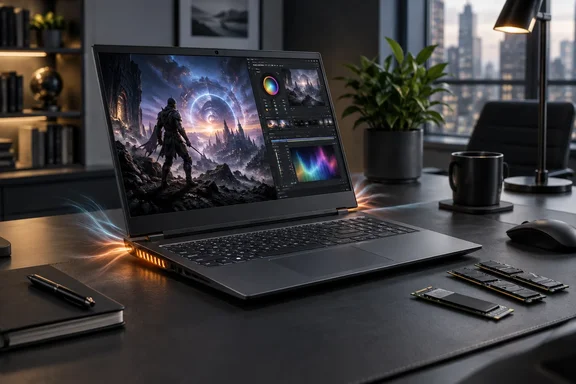
MSI’s official specifications independently confirm two memory slots supporting up to 128 GB and two PCIe Gen4 M.2 storage slots. Importantly, MSI advertises memory support up to DDR5-7200, but explicitly says actual frequency depends on the memory combination and CPU capability. Buyers should not mistake the platform’s maximum supported speed for the speed of the installed RAM.
That distinction makes the upgrade story more useful than a headline capacity alone. For a professional considering future expansion, the questions are both “How much memory can it hold?” and “What configuration will actually run at the expected speed?”
Maximum GPU power comes with a noise bill
MSI specifies the RTX 5070 Ti’s 125 W maximum graphics power with Dynamic Boost, qualifying that figure as scenario-dependent. It is a ceiling, not a promise of constant operation at that wattage.
Notebookcheck reports that Performance mode needs Apex enabled to approach that ceiling. Its measurements show the acoustic cost:
| Gaming setting | Average fan noise |
|---|---|
| Balanced | 47.1 dB(A) |
| Performance, Apex off | 50.8 dB(A) |
| Performance, Apex on | 52.3 dB(A) |
| Performance, Apex and CoolerBoost on | 56.7 dB(A) |
These are laboratory measurements, not guaranteed readings in every room. Nevertheless, the progression makes the trade-off clear: the highest-power configuration is not the quietest colleague.
Excellent display specifications, missing conveniences
MSI confirms a 16-inch, 2560 × 1600 OLED panel running at 240 Hz, with typical 100% DCI-P3 coverage and VESA DisplayHDR True Black 600 certification. Those are substantial display credentials for a machine spanning entertainment and creative work.
Notebookcheck nevertheless flags absent G-Sync, Advanced Optimus and touch support, alongside weak speakers and a typing-oriented keyboard. Switching between iGPU, dGPU and MSHybrid modes requires a reboot. Its 9-hour-16-minute Wi-Fi browsing result also needs context: the reviewer recommends iGPU mode for extended battery life, not discrete-GPU gaming.
Which compromise matters most?
Notebookcheck contrasts the Stealth with the reviewed Razer Blade 16: the Razer offers stronger gaming-oriented features and a 160 W graphics ceiling, but non-upgradeable memory. That comparison is model-specific, not a verdict on every Blade.
For buyers prioritizing expansion, MSI’s documented memory and storage slots are the concrete differentiator. For those prioritizing gaming conveniences, Notebookcheck’s omissions deserve equal attention. The sensible purchasing question is not whether this laptop can wear two hats—it can—but which compromises you are willing to live with while it does.
References
- MSI Stealth 16 AI B3WH review: Part Gamer, Part Creator, All Professional - Notebookcheck Notebookcheck · 2026-10-03T20:48:00+00:00
- Stealth 16 AI+ – SLIM SHARP STYLISH us.msi.com