

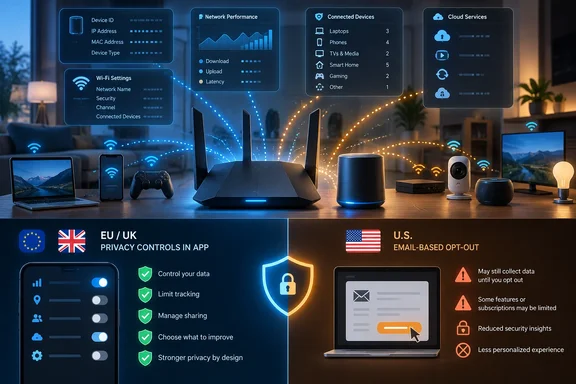
BGR’s overview correctly points readers to Netgear’s privacy and analytics policies, and Netgear states that, outside of its Smart Parental Controls service, it does not collect a customer’s interactions with non-Netgear websites. In plainer language: the company says ordinary router telemetry is not a record of every website a household visits. Yet the same policies show Netgear is collecting far more than a bare minimum needed to register a router.
For U.S. owners, the central complication is that Netgear’s current support article only documents in-app analytics controls for accounts registered in the European Union or United Kingdom. Its broader Analytics Data Policy still offers an email-based opt-out, but warns that doing so can restrict security notifications and may end access to trial or paid subscription services.
The router telemetry Netgear says it receives
Netgear’s privacy policy, last updated on March 5, 2026, applies across its routers, mesh systems, modems, access points, apps, websites, and subscription services. It separates ordinary customer-account information from the telemetry collected by devices and apps, but those categories overlap whenever a router is registered to a MyNETGEAR account or managed through the Orbi or Nighthawk app.
The device and network data listed in the policy includes IP addresses, MAC addresses, serial numbers, firmware versions, configuration and Wi‑Fi settings, wireless and wired network status, internet speed, error rates, disconnect events, CPU and memory use, reboot analytics, modem status, debug logs, and the time and duration of service use. Netgear’s separate Analytics Data Policy adds LAN-port and USB-device use, Wi‑Fi band and channel, security type, signal-strength information, satellite model and status on Orbi systems, and connected-client characteristics such as connection type, device type, and brand.
That is telemetry, not the contents of a customer’s web traffic. Netgear does not list browser history, DNS lookups, full URLs, message content, or packet captures among the categories it collects from a standard router. Its privacy policy specifically says that, except for Smart Parental Controls, it does not collect information about a person’s interactions with non-Netgear sites.
Still, “we do not collect browsing activity” should not be read as “we collect almost nothing.” A device inventory that identifies types and brands of clients, paired with network-health records, usage timing, location inferred from IP address, a device serial number, and an account identity, can create a detailed operational picture of a household network. It can tell Netgear what hardware is present, when the broadband connection has trouble, which features are used, and whether services such as Armor, gaming features, or parental controls are activated.
The company says this data supports product improvement, customer support, fraud prevention, security operations, and marketing. The inclusion of marketing deserves attention: the Analytics Data Policy says device type and usage data may be used to identify products or services that could interest a customer.
Smart Parental Controls are the stated exception
Netgear’s exception for Smart Parental Controls is more than a footnote. The service is designed to manage a household’s internet access and online behavior, so its function necessarily requires more visibility than baseline router diagnostics.
Its privacy policy says that, for parental controls, Netgear may collect preferences and information about online activities to provide the service. The policy does not provide a granular public inventory of which activity records are retained, how long they are kept, or precisely which reports a parent can see for each protected device. Customers enabling the feature should treat it as a separate privacy decision rather than assuming it follows the same limits as ordinary router telemetry.
That distinction also applies to connected services. Netgear Armor, for example, is sold as a security product powered by Bitdefender. Netgear’s policy says it shares personal information with Bitdefender in connection with an Armor subscription and operating the service. That is not the same as selling a browsing history to an ad broker, but it is a third-party data disclosure associated with an optional service.
BGR’s broad conclusion that Netgear does not share data with third parties needs that qualification. Netgear says it does not sell personal information in the traditional cash-for-data sense, but its current privacy policy also says it discloses personal information to vendors, service providers, resellers, distributors, advertising partners, and co-branded service partners. It further says it may provide non-sensitive personal information and service-use information to advertising partners, including ad networks and social-media platforms, for advertising.
The real dividing line is therefore not “shared” versus “never shared.” It is what information is involved, whether a user enabled a partner-backed service, and whether the sharing is for operating a service, marketing, advertising, legal compliance, or another stated business purpose.
The opt-out path differs by country and setup method
Netgear’s support guidance makes the cleanest in-product opt-out available to users in the EU and UK. During first-time setup in a router’s web interface, supported customers can choose Skip when the router asks permission to collect and use data to improve products and provide support. In the Orbi or Nighthawk app, the corresponding choice is also Skip.
After setup, the same support article directs EU and UK users to the Nighthawk or Orbi app, then to Settings > Data Collection, where they can turn off Allow Data Collection. But Netgear adds two constraints that are easy to miss:
- The router web-interface option depends on the device having been purchased in a region that supports opt-out, identified by a worldwide SKU.
- The app-based option depends on the Netgear single sign-on account being registered in the EU or UK.
Those restrictions mean a U.S. customer should not assume the Data Collection switch will appear in the app simply because they own a compatible Nighthawk or Orbi model. Netgear’s support article is explicitly framed for EU and UK residents, and it does not present the same screen-by-screen control as a universal U.S. option.
The company’s Analytics Data Policy supplies another route: it says users can request an opt-out by emailing its analytics-policy address. That is the most relevant documented route for an owner who lacks the EU/UK app setting, though Netgear does not explain in that policy how it verifies the request, how quickly it applies across linked products, or whether every router generation supports the same treatment.
The policy also attaches a significant trade-off. Netgear says opting out can limit its ability to warn a customer about security issues affecting their device and may prevent use of trial or paid subscription services. That warning deserves to be taken literally by anyone relying on Armor, Smart Parental Controls, or cloud-managed router features. Before opting out, record the router’s model, serial number, firmware version, and active subscriptions so support and warranty tasks do not become needlessly difficult.
Privacy requests are different from turning off router analytics
Netgear’s general privacy controls are broader than its router-analytics controls, but they solve different problems. The company’s privacy policy gives users ways to request access, correction, deletion, or limits on certain processing, subject to legal and service-related exceptions. It also offers U.S. residents a method to opt out of processing defined under state laws as a sale or targeted advertising.
That advertising opt-out should not be confused with withdrawing router telemetry consent. Turning off personalized advertising can reduce the use of data for ad targeting; it does not necessarily stop a router from sending diagnostics needed for a subscribed service, security protection, account operation, or firmware-related support.
Similarly, deleting an account can be a much larger action than declining analytics. Netgear says a deletion request may require an account closure or subscription cancellation in some cases. For a household using an Orbi mesh system, a paid Armor plan, or parental controls, that may be disproportionate to the privacy concern being addressed.
A measured approach is to first review the router’s app settings, disable optional services that are not in use, decline analytics during setup where the option appears, and then make a written analytics request if the in-product setting is unavailable. Ask Netgear to confirm whether the request covers the router, mobile app, cloud account, and any linked subscription separately.
The practical takeaway for Netgear owners
Netgear’s published record supports a more precise conclusion than the usual “routers collect data” warning. Standard Netgear router telemetry appears focused on device identity, configuration, performance, diagnostics, feature use, and connected-device characteristics; the company says ordinary operation does not include collecting users’ activity on non-Netgear websites. Smart Parental Controls are the declared exception, and partner-backed services such as Armor introduce additional sharing and service dependencies.
For customers in the United States, the advertised analytics opt-out is not as straightforward as a universal app toggle. The visible in-app procedure is documented for EU and UK accounts, while Netgear’s general Analytics Data Policy points everyone else toward a request by email — with the possibility of losing security notices or subscription functionality.
The FCC’s March 2026 restrictions on approval of new foreign-produced consumer router models do not change those privacy settings for existing Netgear hardware. Owners do not need to replace a working router because of that policy shift; they should instead keep firmware current, review which cloud features are enabled, and make a deliberate choice about the analytics and subscription services attached to the device already running their home network.
References
- What Data Do Netgear Routers Collect, And Can You Opt Out? bgr.com · 2026-09-19T11:47:00+00:00