

The release, posted by modder Le Corbeau on the Through the Looking Glass forums and subsequently covered by ixbt.games and DSOGaming, arrives three decades after Looking Glass Studios’ original Thief engine was built around a very different PC graphics model. NewDark 1.29 moves vertex transformation work from the CPU to the GPU in its optional Hardware Transform & Lighting, or HWTL, variant. The result is access to shader-era effects that the classic renderer could not provide.
For Windows players who keep classic Thief installs alive through fan patches and custom missions, that is a substantive change. It can improve the look of the original missions, but it can also change what light means in a stealth game whose original visibility model was designed around baked lighting rather than real-time shadow casting.
NewDark’s HWTL path is separate from the normal update
The first correction to the initial reports is terminology: the project calls the new renderer HWTL, not “HTWL.” It stands for Hardware Transform & Lighting, a DirectX 9-era approach that shifts vertex transformations from the processor to the graphics card. NewDark retains the older Software Transform & Lighting path for the sky renderer and inventory models, so 1.29 is a hybrid rather than a wholesale rewrite of every rendering component.
That split explains both the ambition and the caution embedded in the release notes. Players can switch the HWTL renderer at runtime with the toggle_hwtl_enable command, but the release documentation describes the software path as broadly similar to the ordinary NewDark build while warning that the HWTL alternative may be incomplete and less performant in some circumstances.
The update includes Percentage-Closer Soft Shadows, normal mapping, parallax occlusion mapping, screen-space ambient occlusion, soft particles, environment mapping, reflective and refractive water, volumetric fog, light volumes, underwater shafts, luminance adaptation, and post-processing effects. Those terms risk making the release sound like a conventional HD texture replacement. It is more consequential than that: NewDark is introducing a new rendering model beneath the original art, level geometry, and mission logic.
Some of those effects will depend on assets and maps being prepared for them. The project’s own documentation says only dynamic and animated lights are supported as HWTL lights, and that original missions and fan missions may need relighting—specifically, selected lights need an AnimLight property—to get the strongest result. A player should not expect every torch, lantern, room, or custom mission to suddenly behave like a modern dynamic-lighting scene simply by copying in the files.
Shadow detection can alter the stealth rules
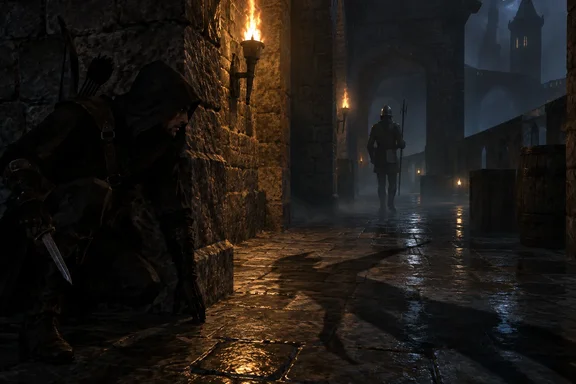
The most striking addition is experimental player shadows paired with AI awareness of those shadows. With the relevant settings enabled, an enemy can detect Garrett’s projected silhouette instead of reacting solely to the older light-gem-driven visibility calculation.
That is a genuine gameplay feature, not merely a screen-space flourish. In classic Thief, darkness is a deliberately legible system: players use the light gem and the game’s established level lighting to judge when they are hidden. A dynamic player shadow can create a new source of exposure near a torch, fireplace, or other eligible light. Conversely, community discussion of early tests suggests the updated system may create opportunities to use dynamic shadows in ways the original levels were never designed to support.
The operative word remains experimental. Footage and player reports posted in the Thief community show the effect functioning, but they also show rough edges. One early tester said the shadow effect appeared particularly demanding in The Black Parade fan campaign even on high-end hardware; others reported that the shadows would not appear after installation, or that the HWTL executable crashed when starting a new game. Those are user reports rather than a formal compatibility matrix, but they matter more than the promotional screenshots because this release has not yet reached the plug-and-play maturity most players associate with TFix.
There is also a content-specific limitation. Community members testing the feature noted that Thief Gold can display Garrett’s player shadow as a simple box-like shape, while Thief II can render a more character-like figure. The difference is a reminder that HWTL is working within two related but not identical engines and data sets. Players hoping for visual parity between the two games may not get it in this first experimental release.
Windows 10 or newer is the practical target
NewDark’s documentation says the HWTL variant may run on Windows 7 and later, while recommending Windows 10 or later. It also calls for a relatively modern CPU and GPU with solid DirectX 9 support, adding that many early DX9-generation cards do not meet the minimum requirements.
In practical terms, the mention of DX9 does not mean any old DirectX-compatible laptop is suitable. The added shadow maps, ambient occlusion, parallax effects, volumetrics, and post-processing introduce a workload that classic Thief players have never had to budget for. The developer’s “relatively modern” hardware guidance is vague, and no official GPU list, target frame rate, resolution benchmark, or detailed performance table accompanied the release.
Early feedback reinforces that omission. Users can point to individual configurations that look promising or struggle, but there is not yet enough structured testing to say which GPUs, drivers, Windows builds, or distribution versions are trouble-free. Anyone using an unusually configured system, a long-standing fan-mission installation, or an old GOG or Steam build should treat HWTL as a separate test deployment rather than an in-place upgrade.
That is especially true because the archive includes more than one component. The ordinary NewDark files, contributor files, the HWTL files, a dedicated HWTL executable, and the mods/hwtl add-on do not amount to a one-file graphics toggle. The HWTL mod needs to be activated through the game’s existing mod-loading mechanism and is recommended to receive the highest priority. Configuration variables such as player_shadow 1, ai_aware_of_shadow 1, shadow_enable 1, and hwtl_enable 1 expose the new features, but they also create more ways for a partial installation to look as though nothing changed.
The patching tools are catching up
A more practical route is already emerging for Thief Gold. RoguePatcher 1.29.0, released September 16 and based on NewDark 1.29’s September 14 release, adds the experimental HWTL component. That is significant because a maintained patcher can eventually turn the project’s multipart archive and manual configuration into a reproducible installation process.
It does not yet make HWTL a conservative recommendation for every player. The community discussion around the release is full of installation questions, missing effects, and requests for documentation. A player who wants a dependable replay of the original campaigns or a stable fan-mission setup should keep a known-working installation intact. The HWTL build belongs in a copied game directory until the patching tools and community guides settle on a tested configuration.
Players who do experiment should begin with the stock missions before loading a large fan campaign. Confirm that the HWTL executable launches, activate mods/hwtl, verify that the renderer is enabled, and introduce expensive effects one at a time. If performance or lighting becomes unacceptable, the retained software-rendering path offers a straightforward retreat without abandoning NewDark 1.29’s other fixes and improvements.
This is a renderer experiment, not Nightdive’s remaster
ixbt.games framed the update alongside Nightdive Studios’ in-development Thief: The Dark Project Remastered, but the two efforts should not be conflated. NewDark 1.29 is a community-maintained modification for existing classic releases; it neither replaces Thief Gold and Thief II with new commercial editions nor establishes what Nightdive’s remaster will support.
The timing may nevertheless put useful pressure on expectations. NewDark demonstrates that the old Dark Engine games can gain modern-style rendering features while preserving their original levels and modding scene. It also exposes why a remaster involves more than adding effects: colored lighting, asset support, mission balance, player feedback, frame pacing, and stable installation all affect whether improved graphics preserve the atmosphere and rules that made Thief distinctive.
For now, the concrete consequence is simpler. NewDark 1.29 gives technically confident Windows players a way to test dynamic shadows and shader effects in Thief Gold and Thief II today, while everyone else has a clear reason to wait for RoguePatcher, TFix, and mission authors to turn an impressive experimental renderer into a predictable upgrade.