

ASCII.jp carried the Japanese announcement on September 30, 2026. Its English edition published an AI-translated version on October 1 and points readers to the Japanese text as the authoritative one. Newtech has not given an exact October sale date, a price, drive capacities, network port details, warranty terms or regional availability. Anyone hoping for a spec-sheet bargain hunt will have to wait.
What's new in the Ness1300
The Ness1300 replaces the Ness1200 and is the newest model in the Ness line, which started in 2016. The changes are a refresh, not a redesign:
- Processor: The Japanese announcement names an Intel Pentium G7400. As general industry background, that is a low-power, entry-level desktop chip. It suits a dedicated file appliance, not heavy compute work.
- Memory: The system moves to DDR5. Newtech does not say how much memory is installed.
- Operating system: It ships with Windows Server IoT 2025 for Storage Standard. Newtech presents this as moving to a new platform for long-term, stable operation.
- RAID controller: Newtech keeps its in-house "Kite" RAID controller.
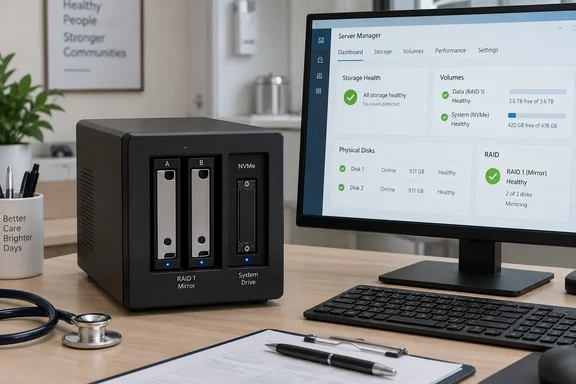
- Storage layout: The operating system runs from an NVMe M.2 SSD, while data sits on 3.5-inch SATA hard drives. Newtech says keeping the OS and data fully separate gives faster boot times, simpler maintenance and less risk of the whole system going down.
Newtech does not say whether the OS SSD is itself redundant, how many data drives the unit holds, or how large they can be. Those are the first questions a buyer should ask.
Section summary: The Ness1300 is a generational update to Newtech's existing line, with a newer CPU, DDR5 memory, the 2025 Windows Server IoT release and the same Kite mirroring controller.
Why the Windows edition matters
"Windows Server IoT 2025 for Storage Standard" is a mouthful, and each part of the name means something. Microsoft's documentation describes Storage Standard as a dedicated file server appropriate for Network Attached Storage, Storage Area Network Gateway, or another storage solution. Microsoft also says that because Windows Server IoT is the same as Windows Server, you can use the familiar development and management tools that you use with your general-purpose Windows Servers.
The licensing is different, though. According to Microsoft, the OEM channel licenses Windows Server IoT with special dedicated use licensing terms, and prior versions were referred to as Windows Server for Embedded Systems or Windows Storage Server. Admins who remember Windows Storage Server boxes are looking at the same idea under a new name.
In practice, this is not a general-purpose server that happens to be small. Microsoft's licensing rules say these appliances must not be used as a substitute for general-purpose computers. Microsoft's own list of excluded uses includes Exchange, SharePoint, ERP and CRM software. If a small office was hoping to run a line-of-business database on it as well, it should check the license terms with Newtech first.
A Windows Server IoT licensing guide from Microsoft distributor Trinware notes one cost advantage of the Storage edition: no CALs are required, saving OEMs licensing costs. The same guide describes the 2022-generation rules and lists restrictions on the smaller Storage Workgroup edition, including no NVMe-enabled hardware. That guide covers the earlier release, and Newtech has not explained why it chose Storage Standard. Still, a Workgroup restriction like that would clash with the Ness1300's NVMe OS drive.
On lifecycle, Microsoft's published table lists Windows Server IoT 2025 as version 26100, available 2024-11-01, with end of servicing on 2034-10-10, under the Fixed Lifecycle Policy. That is the operating system's servicing window only. It does not commit Newtech to supporting the hardware until 2034.
Distributor Arrow says the 2025 release improves storage performance, claiming up to 70% more storage IOPS performance than Windows Server 2022 on identical NVMe systems. That is a platform-level vendor claim. It has not been measured on the Ness1300, and the unit's data drives are SATA hard drives anyway.
Section summary: The Storage Standard edition gives the Ness1300 full Windows Server code under licensing that limits it to dedicated storage use. The OS servicing window runs to October 2034, separate from any Newtech hardware support.
The Kite controller and its protection features
Newtech describes Kite as a hardware controller dedicated to RAID 1 mirroring. The company says it has a long track record as an OEM component in industrial PCs. Its main claim is that mirroring in dedicated hardware uses less CPU than software RAID. Newtech offers no benchmark to back that up, which is worth noting next to an entry-level CPU.
The listed protection features are:
- Hot swap: You can replace a hard drive without shutting the unit down.
- Auto-rebuild: Mirroring starts again automatically once a new drive is inserted.
- Error recovery: If one drive returns a read error, the controller reads the data from the other drive, answers the host and repairs the bad spot.
- Patrol read: The controller scans the drives while they are idle and fixes errors automatically.
- Error-skip rebuild: A read error during a rebuild does not stop the system.
Patrol read and error-skip rebuild deal with the moment small-office admins fear most: one drive has already failed, and the surviving drive hits a bad sector while the mirror rebuilds. Newtech says these features support round-the-clock use, such as continuous camera recording and electronic medical record systems that need to stay up.
Newtech also offers an optional 24/7 gold on-site maintenance service with fast dispatch for hardware failures. It is sold as an add-on, not included as standard, and the announcement gives no response times or coverage areas.
Section summary: Kite mirrors two drives in hardware and adds recovery features aimed at the risky rebuild window. Newtech's claim that this beats software RAID is not independently tested.
Chassis, remote management and monitoring
The unit measures 154 mm wide, 270 mm deep and 188 mm high, not counting protrusions and feet. Newtech uses a large-diameter fan for quieter running, which matters in a clinic reception area, though it gives no noise figure.
A BMC (Baseboard Management Controller) port lets admins power the unit on or off and check its hardware status remotely. Newtech does not list the supported protocols or security settings. As a general best practice, treat a BMC port as a privileged interface. Put it on an isolated management network and change any default credentials before deployment.
A bundled management tool monitors the RAID setup and system health. If it detects a problem with a drive, the controller or temperature, it notifies the user and writes error logs to both the controller and the drives so they can be reviewed later. Newtech does not say how alerts are delivered, for example by email or on-screen pop-up. Test that before trusting it to wake anyone up.
Who should look at it, and what to check first
The Ness1300's natural buyers are clinics, small offices and camera installers who already know Windows and want a vendor-supported mirrored box with a clear replacement path. Newtech says it keeps offering successor models specifically for customers who want to stay on the same setup for years.
A word of caution from experience: RAID 1 protects against a drive failing. It does not protect against ransomware, accidental deletion, theft or a burst pipe above the server. Newtech does not claim it does. A clinic storing patient records still needs separate, ideally offline or off-site, backups.
Before buying, ask Newtech:
- How many drive bays it has and the maximum capacity
- What network ports it has and how fast they are
- How much memory is installed
- Whether the OS SSD is protected or easy to restore
- How the monitoring tool sends alerts
- What security options the BMC supports
- The price, warranty terms and what the gold on-site maintenance tier includes
Bottom line: The Ness1300 is a modest but credible update to a long-running Windows-based NAS line. It pairs Windows Server IoT 2025, with servicing until 2034, with dedicated hardware mirroring in a box small enough for a reception desk. Whether it fits your site depends on the specs Newtech has not yet published.
Update: Report details two drive bays, 8 GB RAM and maximum storage capacity (October 7, 2026)
According to Notebookcheck’s October 7 report, the Ness1300 has two 3.5-inch SATA drive bays, supports hard drives of up to 24 TB each and includes 8 GB of DDR5-4800 memory. These specifications fill several gaps in the initial announcement, which did not identify the installed memory, bay count or maximum drive capacity.
Notebookcheck reports a maximum of 48 TB of raw storage, with 24 TB usable when the two drives operate in RAID 1. Buyers should therefore distinguish the headline capacity from the mirrored capacity available for files. The outlet also lists 4 TB, 8 TB, 16 TB and 24 TB storage configurations, although the supplied report does not explicitly explain how those configuration labels are defined.
The operating-system drive is reportedly a 240 GB M.2 NVMe SSD, adding a capacity figure to the previously disclosed separate boot-drive arrangement. The report still does not establish whether that SSD has redundancy or a vendor-provided recovery process. Pricing, warranty terms and regional availability also remain unresolved in the supplied coverage.
References
- Newtech's Ness1300 NAS Launches in October, Prioritizing Data Protection in Compact Spaces ASCII.jp · 2026-10-01T02:30:00+00:00
- Japanese brand launches compact two-bay NAS with up to 48 TB storage and 2.5GbE - Notebookcheck Notebookcheck · 2026-10-07T02:57:00+00:00
- Windows Server IoT 2025 arrow.com