

Game Informer's answer was blunt. The magazine argued that the next PlayStation and Xbox face a "perfect storm" of problems:
- Current consoles have sold unevenly.
- Cross-generation games have stayed around for years.
- Visual upgrades are harder to notice.
- Component costs keep climbing.
- Physical discs are going away.
Microsoft is directly involved in this story. It has raised Xbox prices, it is testing a disc-to-digital program, and it has not said whether its next console will keep a disc drive. Here's what's confirmed, what isn't, and what it means for Xbox and Windows PC players.
The Argument: Why "Good Enough" Is a Real Threat
Game Informer made three main points:
- Upgrades are harder to notice. The magazine argued that graphics did not improve as clearly between PS4/Xbox One and PS5/Xbox Series X|S as in past generations. Faster frame rates and shorter loading times are real gains, but they are harder to sell to casual players.
- Cross-generation support lasted a long time. Many big games kept shipping on older hardware, so players had less reason to upgrade.
- Prices keep rising. Component shortages and trade policy have pushed hardware costs up while many households are short on money.
The magazine's strongest point was about competition, not nostalgia. With physical games, you can compare prices across retailers, buy used copies or wait for a sale. Game Informer argued that without a disc drive, a platform holder never has to cut a price if it doesn't want to. It compared this to PC gaming, where Steam competes with the Epic Games Store, GOG and others, and said it doesn't expect Sony or Microsoft to allow third-party stores on their consoles.
That comparison should interest Windows gamers most. On PC, stores compete for your money. On consoles, the platform holder runs the only store.
Section summary: Game Informer's case is that weak generational leaps, long cross-generation support, high prices and less retail competition together make the next upgrade hard to justify.
What's Actually Confirmed and What Isn't
Some of this debate runs ahead of the facts, so it helps to separate them.
Sony's disc decision is confirmed, but its scope is narrower than the headlines. On July 1, 2026, Sony Interactive Entertainment announced on the PlayStation Blog that it will stop producing physical game discs for all new PlayStation games starting in January 2028. After that date, new games will be sold only in digital formats, through PlayStation Store or at retailers. Sony also said the change does not affect games that were released, or scheduled to release, on disc before January 2028.
Sony did not formally announce that a specific next-generation console will lack a disc drive. Game Informer wrote about PlayStation's next hardware dropping discs, which is a reasonable reading of where things are going. But Sony's announcement covers disc production for new games, not the design of future hardware.
Players reacted badly. The comment section under Sony's post filled with long-time PlayStation owners saying they would switch to PC, keep their PS5 for good or skip the next console entirely.
Rumors about Xbox following Sony remain rumors. Microsoft has not announced a disc-drive decision for its next console. Gadget Hacks cited GamingBolt reporting that an Xbox executive did not commit either way on whether Project Helix would continue supporting discs. Until Microsoft says more, the question stays open.
Sales figures need careful handling. Game Informer said neither PS5 nor Xbox Series X|S has outsold its predecessor. Sony's own data partly supports that. Its corporate sales page lists more than 95 million PS5 units sold in (shipped to retailers) as of June 30, 2026, against more than 117 million PS4 units as of June 30, 2022. Sony's annual PS5 figures have also fallen: 20.8 million in fiscal 2023, 18.5 million in fiscal 2024 and 16.0 million in fiscal 2025.
The PS5 is still on sale, though, so the comparison is between a finished lifetime total and one still growing. Microsoft does not publish a comparable official lifetime total for Xbox Series X|S, so the Xbox half of the claim rests on outside estimates rather than company figures.
Section summary: Sony's January 2028 disc cutoff is official. Hardware plans for the next consoles, including whether they have drives, are not. The PS5-versus-PS4 gap is real in Sony's data but not final, and there are no official Xbox figures to compare.
Microsoft's Pricing Problem Is Already Here
You don't need to guess at next-generation prices to see the pressure, because current Xbox hardware already shows it. On June 25, Microsoft announced worldwide Xbox console price increases effective August 1, 2026:
- 512 GB models went up by US$100.
- 1 TB models went up by US$150.
- The 2 TB model is being discontinued.
That followed an increase of $20 to $70 in the U.S. the previous October. Microsoft blamed the component crisis. It said console storage and memory prices had risen more than 2.5 times, and it expects them to double again by fall 2027. It also pointed out that consoles are usually sold for less than they cost to make, unlike phones or PCs, so they are hit especially hard.
Microsoft paired the price increase with ways to spread or reduce the cost:
- Buy Now, Pay Later on eligible hardware bought through Microsoft Stores
- 0% APR financing for up to 12 months through partners
- Planned trade-in and pre-owned console programs with retailers
- Certified Refurbished consoles at up to US$100 off list price
These numbers don't tell you what a next-generation Xbox will cost. That price is not public, and any figure you see online is a guess. They do explain why Game Informer expects next-gen hardware to cost an "unprecedented" amount. When the current consoles need price increases and financing plans mid-generation, next-generation prices look like a serious problem.
Section summary: Microsoft has already raised Xbox prices twice in under a year, citing memory and storage costs, and it expects those costs to keep rising.
Microsoft's Counter-Move: Disc-to-Digital
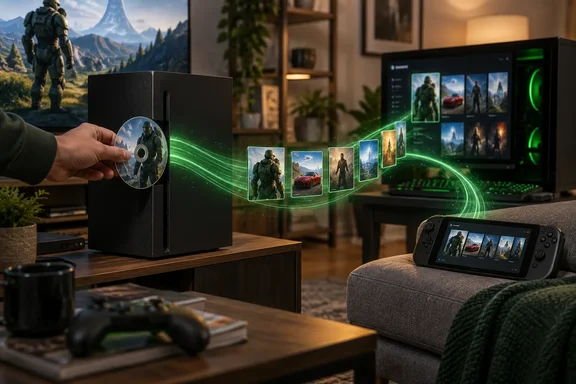
Microsoft's most interesting recent move on physical games runs against the industry trend. On August 26, Xbox VP of Next Generation Jason Ronald announced a feature that adds digital benefits to physical discs. According to Microsoft, most XBOX One and XBOX Series X disc-based games support this new feature. Players can claim a digital entitlement by inserting a supported disc into an XBOX One or XBOX Series X console and launching the game.
Windows Central reports that the digital version gets the same benefits as any other digital Xbox copy, including Xbox Play Anywhere support, meaning access on an Xbox Ally handheld or Windows PC and support for Xbox Cloud Gaming. That makes this a Windows story too: a disc bought for an Xbox One can become a game you play on your PC.
How to claim a digital license (Insider test)
- Join the Xbox Insider Program through the Xbox Insider Hub, on console or on Windows PC. Testing began August 31, and Windows Central reported the feature first appeared in the Alpha and Alpha Skip-Ahead rings.
- On a console with a disc drive, insert a compatible Xbox One or Xbox Series X disc into your Xbox Series X. Select the disc tile with the menu button on your dashboard, and select "Claim Digital License." Launching the game from the disc also triggers the claim.
- Stay online. Tech Insider reports the console checks the disc with Microsoft's servers, so launching offline won't trigger a claim.
- Check your library. Windows Central says you can now install the game from your library without the disc too, and it'll have a symbol on it denoting that it was claimed from a disc.
Things to know before you claim
- Series S owners can't start a claim. Gadget Hacks reports that the Series S can play a game once it's been claimed elsewhere but can't originate a claim itself, since it has no drive to read from.
- Older discs aren't included. Original Xbox and Xbox 360 discs aren't part of the programme, and Microsoft hasn't said whether that will change.
- Unsupported discs show an error. The message reads "Digital license unavailable. This game is not participating in digital licensing."
- The license follows the disc. Windows Central explains that if you sell the disc or lend it to a friend, they will receive the digital entitlement after installing it for the first time. Then, your digital rights will be removed until you get the disc back or re-purchase it.
- You don't need to reinsert the disc regularly. Microsoft sources told Windows Central there is no timeout period, despite claims on social media.
- Cloud play isn't free. Gadget Hacks notes that claiming a disc does not by itself make cloud streaming free. Xbox Cloud Gaming currently requires an eligible Game Pass subscription for owned-game streaming.
Microsoft says it is starting with thousands of titles and will add more over time, but not every title is available at launch. Gadget Hacks notes Microsoft hasn't published a full list of which games carry a redeemable Xbox disc-to-digital entitlement. Microsoft also hasn't given an exact date for the broader rollout.
Section summary: Disc-to-digital is still an Insider-only test, but it offers what Sony's plan doesn't: your disc keeps its resale value and also works on Windows PC and in the cloud where the game supports it.
Analysis: Will People Actually Buy the Next Generation?
Game Informer is asking the right question, and the evidence mostly supports its concern. Even so, there is a case for caution on both sides.
The case for "good enough": Sony's own data shows PS5 behind PS4's lifetime total, with annual shipments falling. Microsoft is raising prices and adding financing plans before the next generation has even been announced. Meanwhile, Play Anywhere, cloud streaming and handhelds like the Xbox Ally make it less important which specific box you own. When your library follows you to a Windows PC, a new console is less essential.
The counterpoint: Game Informer admits that most players already buy digitally. Sony says it made the change because of that shift in what customers prefer. Angry comment sections do not always predict what people buy, and plenty of gamers who swore they'd never buy digital-only now own a PS5 Digital Edition or a Series S. Game Informer's worry about disc-free pricing is a reasonable concern, but no one has shown yet that digital-only consoles lead to permanently higher prices.
Microsoft's position is uncertain. The disc-to-digital program amounts to Microsoft telling players it values their physical libraries, weeks after Sony announced the end of new discs. Whether that leads to a disc drive in the next Xbox is the question that matters most for Xbox's hardware future, and Microsoft hasn't answered it.
The Bottom Line
What's official:
- Sony will stop making discs for new PlayStation games in January 2028. Existing disc games are unaffected.
- Microsoft raised Xbox console prices worldwide on August 1, 2026, citing memory and storage costs.
- Microsoft is testing disc-to-digital licensing for Xbox Insiders, with Play Anywhere and cloud access where games support them.
What isn't:
- Next-generation console prices
- Release dates
- Whether the next Xbox has a disc drive
Game Informer concluded that both companies will need to make a very strong case for their next hardware, and the evidence backs that up. If you own an Xbox One or Series X with a drive and a shelf of discs, joining the Insider program to test the disc-to-digital feature makes sense. It carries little risk, and you may end up playing some of those games on your Windows PC.
References
- Xbox Disc-to-Digital Compatible Games List: Delisted Titles Work << Windows Tips :: Gadget Hacks windows.gadgethacks.com
- Xbox's disc-to-digital program goes live for Insiders on Monday — Here's how it works | Windows Central windowscentral.com
- Here's how Xbox disc-to-digital works in practice (with video): A HUGE game preservation win | Windows Central windowscentral.com