

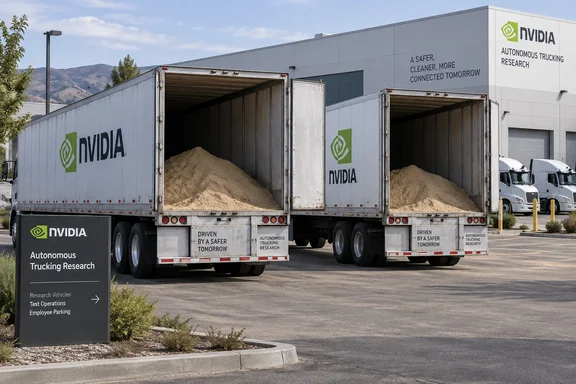
The distinction matters. A technology company’s logo is not a cargo manifest, and in this case the sand had a legitimate engineering purpose: simulating freight loads during autonomous-truck testing.
What happened—and where
The San Francisco Standard’s September 25 reporting places the theft late on Wednesday, September 23, 2026, at PlusAI’s testing warehouse in Fremont, California. Workers discovered the trailers missing the following morning and reported the theft to Fremont police shortly after 9:30 a.m. This also differs from HotHardware’s description of a daylight theft.
According to company representatives interviewed by the Standard, locks on the trailers’ air-brake couplings appeared to have been forced off. Security footage reportedly showed two unfamiliar tractor units at the warehouse; PlusAI’s own truck cabs were left untouched. Those are company-reported details, not findings from a police report independently reviewed here.
Recovery began with an acquaintance sending a PlusAI executive a photograph of the trailers near an office in neighboring Newark. The company confirmed their location, and Newark police recovered them. The Standard distinguishes the Fremont theft site from the Newark recovery location—a useful clarification given the differing locations in subsequent coverage.
As of the September 25–28 reports, no arrests had been reported. HotHardware said the trailers were recovered with the sand intact.
Twenty tons total, not per trailer
The reported load was roughly 20,000 pounds in each trailer, adding up to 40,000 pounds—or 20 U.S. short tons across both trailers. It was not 20 tons in each one.
PlusAI used the sand as simulated cargo for research and development. Nvidia’s connection was the companies’ autonomous-trucking collaboration, not a reported shipment of graphics cards or AI accelerators. The trailers’ contents were test ballast, not semiconductor-manufacturing material.
That makes the outcome amusing without making the trailers a deliberate trap. Nothing in the reporting establishes that PlusAI loaded them with sand to fool criminals.
Branding is evidence of a partnership, not a motive
PlusAI marketing executive Lauren Kwan told the Standard she believed the prominent branding might have led the thieves to expect valuable equipment. That is an attributed explanation, not a confirmed account from identified suspects.
There is a genuine technology-supply-chain backdrop. Daily Caller News Foundation reporting, also carried by BizPacReview, cited Verisk CargoNet’s estimate of $304.6 million in cargo losses during the second quarter of 2026, compared with $135.7 million a year earlier. It also identified enterprise computers, networking equipment, components and cryptocurrency-mining hardware as targets. Those figures concern broader cargo theft, however—not the value of this incident or a GPU-specific theft rate.
For PC and enterprise-IT readers, the takeaway is therefore narrower than the headlines suggest: this was a recovered trailer theft involving an autonomous-trucking company and Nvidia-branded equipment, not a documented loss of Nvidia chips. The sand supplied the punch line; it should not bury the facts.
References
- Nvidia GPU heist ends with the most disappointing score - bizpacreview.com bizpacreview.com · 2026-09-28T21:57:44+00:00
- Thieves Chase GPU Paydirt In NVIDIA Trailer Heist, Steal 20 Tons Of Sand Instead - HotHardware HotHardware · 2026-09-28T14:53:00+00:00
- Cargo Theft Losses More Than Double to $304 Million in Q2 Despite a Drop in Thefts, Driven by High-Value Metals and Technology Heists | CargoNet cargonet.com