

What Nvidia and the partners are actually shipping
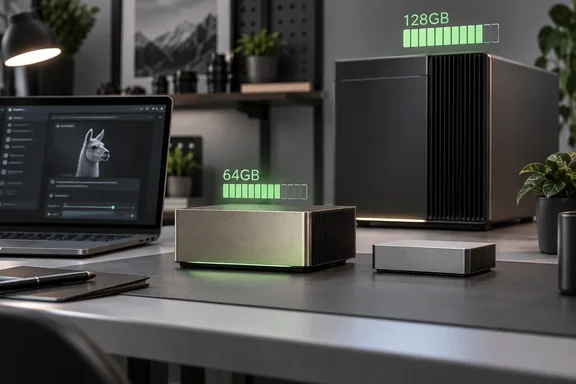
The GB10-based 64GB configuration is a capacity cut, not a new chip. Tom's Hardware reports that the same 20-core Arm CPU complex carries over unchanged, as does the 273 GB/s of shared memory bandwidth. Tom's Hardware also says the ConnectX-7 networking stays, so the 64GB machines can still be clustered later.
Some key facts on availability:
- Who sells it: The new model launches Oct. 23 exclusively through OEM partners Acer, ASUS, Dell, GIGABYTE, HP and MSI, with pricing starting at $4,999 US. That means no Founders Edition at 64GB.
- Storage is cut too: The Register describes the new system as a cut down version of the DGX Spark with half the memory and storage. Check each vendor's exact SKU before you order.
- Lenovo is missing: Nvidia's certified-systems list names Lenovo's ThinkStation PGX as a GB10 partner system. Lenovo is not among the six vendors named for the 64GB launch.
The 128GB price went up
The 64GB model arrives alongside a price rise for its bigger sibling. The Register reports that Nvidia raised the price of its 128 GB DGX Spark on Friday to $6,950, nearly 75 percent above its price a year earlier. A Japanese report from AI Watch gives the same $6,950 figure.
Tom's Hardware cites a different number for 128GB GB10 systems. It says they currently cost roughly $7,000 to $9,000 if you can find one in stock. Treat these as separate figures. One is Nvidia's direct price, and the other is a street-price estimate that includes partner systems.
Context helps here. The Spark launched on October 15, 2025 at a $3,999 MSRP, then rose to $4,699 on February 23, 2026. The same source says Nvidia blamed worldwide constraints in memory supply. So $4,999 for 64GB is a discount only relative to the new 128GB price. The Register notes it is still 25 percent more than the 128 GB version retailed for at launch.
Is 64GB enough?
It depends on the job. Nvidia's pitch is that models in the 26-35 billion parameter range, Qwen 3.8 27B for example, are now good enough for private local inference agents. The Register adds that the smaller machine isn't as well suited to certain AI workloads like fine tuning.
Capacity is the issue, not just model size. Nvidia's porting guide says the CPU and GPU share one pool of memory with no fixed carve-out. Model weights, the operating system, other processes and the KV cache for long contexts all draw on it. Tom's Hardware itself says Qwen 3.8 27B fits in 32GB only "with limited context."
The original launch material shows how much headroom the 128GB model offered. Nvidia described inference on models with up to 200 billion parameters and fine-tuning of models up to 70 billion parameters on that system. Those are Nvidia's claims for the 128GB product, and nobody has verified them for the 64GB one. Treat the 64GB machine as a lower-cost option for models that fit comfortably, not as a cheaper version of the same machine.
A rough decision guide, from general industry knowledge and not from Nvidia's testing:
| Your workload | Likely fit |
|---|---|
| Local inference on a model around 27B parameters | 64GB is probably adequate |
| Long context windows or several models at once | 128GB gives more headroom |
| Fine-tuning larger models | 128GB, or a cluster |
| Pure budget experimentation | 64GB, if your target model fits |
Clustering and Sync
Nvidia's documentation says each DGX Spark has two QSFP ports. Each port provides up to 200 Gb/s, but the speed is also determined by the cable you use. The QSFP ports support Ethernet configuration only.
Nvidia's Cluster Assistant guide says the tool validates the devices, applies ConnectX-7 network settings, checks link performance, and configures SSH between nodes. It supports up to three Sparks connected directly by cable, and up to four through a switch.
The assistant sets up networking only. It does not set up inference or fine-tuning workloads, so you still have to configure those yourself. It also needs the April 2026 system software release or later on every device.
Clustering is not a way to get one big memory pool. Two 64GB boxes are not a 128GB Spark. Whether a model can span them depends on the framework and how it splits work across nodes. The AI Watch report says Nvidia claims two clustered 64GB units deliver about 1.7 times the performance of one. It also says mixed 64GB/128GB clusters work but are limited by the smaller machine's memory. I found no Nvidia documentation for either claim, so treat them as unconfirmed.
Why Windows users should care
Nvidia Sync runs on Windows, macOS and Ubuntu, and manages SSH connections, port forwarding and tunnels to the Spark. A Windows PC can serve as the front end while the Spark does the heavy work.
Two new Sync features are involved. Tom's Hardware and the AI Watch report both describe a Model Launcher that would download and start models across one or more systems and link them to the OpenCode coding agent. AI Watch says it is planned for the end of October. I found no Nvidia documentation for it, so don't count on it until it ships.
The caveats
- Memory market rhetoric: Tom's Hardware uses colorful language about RAM prices. The concrete evidence is Nvidia's own price increase and its stated memory-supply reasons, not broader market analysis.
- Prices can move: Tom's Hardware warns the $4,999 figure might not hold, given how fast memory and storage prices are shifting. "Starting at" is not a guarantee, so check vendor listings at launch.
- Alternatives exist: Critics have long argued that AMD Strix Halo systems offer comparable inference value for less. With the 64GB model at $4,999, that comparison matters more than before.
Bottom line
The 64GB Spark is a sensible product for people who run mid-sized open models locally and don't need fine-tuning headroom. It is not cheap by any historical standard. If your target model fits in 64GB with enough room left for your context length, the lower price makes sense. If it doesn't, the 128GB model or a cluster is still the safer choice, and you should plan around the memory limits before you buy.
References
- Nvidia introduces 64GB DGX Spark to throw local AI fans a lifeline amid the RAMpocalypse Tom's Hardware · 2026-10-02T13:00:00+00:00
- Hardware Overview — DGX Spark User Guide docs.nvidia.com
- List of NVIDIA-Certified Systems — NVIDIA Certification Programs Documentation docs.nvidia.com