

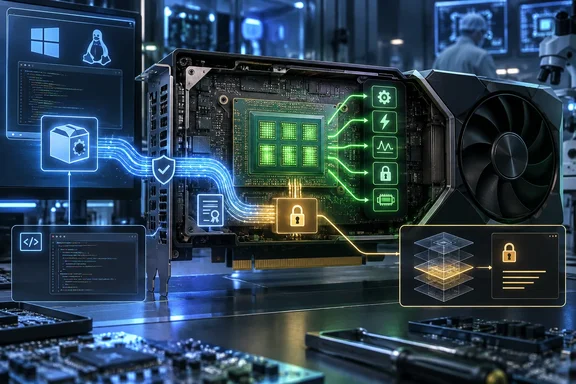
For PC owners, the important point is not that an RTX card secretly contains a tiny RISC-V computer. It is that on supported Turing-generation and newer GPUs, driver installation increasingly means deploying a paired system: Windows or Linux runs the familiar Nvidia driver, while signed firmware runs resource-management code on the GPU. Initialization, clocks, power states, and other hardware-facing operations no longer all live on the CPU side.
Nvidia says GSP firmware is used by default on supported GPUs and identifies Turing as the baseline architecture for that path. Its current Linux driver documentation also confirms that the firmware is distributed with the driver package rather than residing solely in the graphics card’s board firmware. The GSP is therefore a driver compatibility component, not an optional RISC-V experiment that enthusiasts can ignore when diagnosing a failed Nvidia driver update.
Nvidia’s billion-core number needs context
Nvidia hardware engineering vice president Frans Sijstermans called the company’s estimate of roughly one billion RISC-V cores shipped in Nvidia products during 2024 a “personal, unofficial guesstimate.” The scale is plausible because Nvidia is counting embedded management processors across its chips, not one RISC-V CPU per GeForce card.
Nvidia’s 2024 RISC-V presentation says the architecture replaced its proprietary Falcon microcontroller design and is used for video codecs, display functions, memory training, context switching, resource management, power management, security, networking, and deep-learning acceleration. A large GPU can include multiple instances of controllers handling those separate jobs. The number is impressive, but it should not be read as evidence that Nvidia has shipped a billion general-purpose RISC-V computers.
XDA Developers reports that Nvidia estimated between 10 and 40 RISC-V processors per chip, depending on the product and its configuration. Nvidia’s public presentation does not provide that exact per-chip range, so it remains an attributed estimate rather than a specification buyers can check against a particular RTX SKU. Nvidia also has not published a consumer-facing inventory that says how many RISC-V cores exist on an RTX 4060, RTX 5090, or workstation card.
The broader claim is supported by Nvidia’s public record. Its slides show three in-house core families: NV-RISCV32, NV-RISCV64, and NV-RVV, the latter paired with a 1,024-bit vector unit for deep-learning acceleration. Nvidia also says it has added more than 20 custom extensions, including 64-bit physical and virtual addressing support, 2KB pages, secure debugging, ROM protection, and cache-management instructions.
That makes this implementation distinctly different from a stock RISC-V development board. RISC-V supplies the instruction-set foundation; Nvidia controls the silicon implementation, extensions, firmware, boot chain, and software interface.
The GSP is where host-driver work went
The GSP is the RISC-V block that matters most to administrators and driver developers. Nvidia’s own architecture material depicts it as a four-core RV64 design with a platform-level interrupt controller, DMA, memory isolation, tightly coupled memory and cache, a host interface, and coherent links into the wider GPU. In other words, it is a management computer built into the accelerator, with direct access to hardware that the PC’s CPU reaches only indirectly.
Nvidia says this arrangement can improve performance by giving management code lower-latency access to GPU internals. The company’s presentation offers a second motivation: placing more control-plane work on the GPU can reduce the host-visible MMIO, or memory-mapped I/O, surface. That is valuable for performance, but it is also an architectural boundary. A smaller host-visible control surface means less of the GPU’s internal behavior is available to an outside driver.
The practical split is between host-side Resource Manager code and GSP-side Resource Manager code. The host driver sends requests through a messaging interface; firmware on the GPU performs hardware-specific operations. Nvidia’s open Linux kernel modules expose portions of that transport and supporting definitions, but the GSP firmware remains signed proprietary code.
This is why calling Nvidia’s Linux driver “open source” without qualification is misleading. The kernel-module source is published under a permissive license, but the implementation that manages much of the physical GPU resides in a binary firmware image. Nvidia’s own Linux documentation says GSP firmware is enabled by default for Turing and later supported GPUs; its open-module repository distributes tooling that lets Nouveau extract compatible GSP-RM firmware.
The more accurate description is an open host-side kernel module paired with closed, signed GPU firmware. That is a meaningful improvement for Linux packaging and integration, but it is not a fully inspectable graphics stack.
RISC-V did not make Nvidia GPU firmware open
The XDA Developers report correctly identifies the central irony: an open instruction set does not create an open device. Nvidia’s RISC-V presentation explicitly shows signed manifests and partition policies, secure boot, cryptographic hardware, memory isolation, and a separation kernel as parts of the Peregrine subsystem wrapped around its RISC-V cores.
Those choices make sense for Nvidia’s data-center business. A GPU shared between virtual machines needs stronger isolation than a traditional desktop graphics pipeline. Nvidia’s GSP diagrams place the Resource Manager and vGPU runtimes behind a separation kernel, with guest drivers communicating with their assigned virtual GPU partitions rather than directly controlling physical hardware. The company says that design supports shared cloud GPUs and confidential-computing features.
But the same boundary changes the experience for independent driver projects. Nouveau’s presentation at the Linux Plumbers Conference describes the transition bluntly: the “secrets” moved to GSP, leaving the remaining kernel code suitable for release but not generally upstreamable as a complete Linux driver. The project also notes that signed firmware became a major barrier beginning with Maxwell 2-era hardware, particularly for power-management and reclocking work.
There is a genuine upside. Nouveau can use Nvidia-supplied GSP firmware on Turing and later hardware instead of having to recreate every low-level programming sequence itself. That has helped make modern power-management support more realistic than it was during the years when unsigned community firmware could not control key functions on post-Maxwell GPUs.
The cost is dependence. If Nvidia changes the firmware interface, fails to provide a compatible image, or leaves a feature undocumented, the open driver has little room to substitute its own implementation. The ability to load signed firmware is access to Nvidia’s control plane, not ownership of it.
Windows users inherit the architecture, but not the switch
Nvidia’s public GSP configuration instructions are aimed at Linux. The company documents a Linux module parameter, NVreg_EnableGpuFirmware, and says nvidia-smi -q can show whether GSP firmware is active. That is useful for Linux troubleshooting because an administrator can identify a firmware version, disable the GSP path for testing where Nvidia supports that option, and reboot.
Windows users should not assume an equivalent supported toggle exists. Nvidia’s published GSP guide does not document a consumer Windows registry setting, Control Panel option, or GeForce App control for disabling GSP firmware. On a normal Windows gaming PC, the GSP is part of the driver’s internal deployment model, not a feature panel setting.
That distinction matters when a Windows update or Nvidia driver update causes black screens, initialization failures, sleep-resume problems, or device-code errors. GSP may be involved, but there is no sound basis for applying Linux driver parameters to Windows systems or treating firmware disablement as a standard consumer fix. The supported first response remains a clean installation of the appropriate Nvidia driver branch, confirmation that Windows detects the card normally, and collection of driver and Event Viewer logs before changing anything more invasive.
For enterprise administrators, the firmware boundary has a more immediate consequence: driver versioning is inseparable from the GPU firmware payload shipped with that driver. A roll-back may change both host code and the GSP code it loads. Treat it accordingly in change-control testing, particularly in virtualized GPU, pass-through, and compute deployments.
Nvidia’s vGPU documentation adds an operational wrinkle. In certain Linux bare-metal and GPU pass-through arrangements, Nvidia explicitly requires GSP firmware to be disabled for some vGPU products, while supporting it for vGPU for Compute. Its documentation says Windows vGPU deployments should omit that disablement procedure. That is a reminder that “GSP enabled” is not automatically the right state for every professional deployment; the supported configuration depends on product, operating system, GPU architecture, and licensing mode.
Falcon’s replacement was an engineering decision
RISC-V reached Nvidia GPUs because Falcon, Nvidia’s older proprietary microcontroller architecture, had become too limiting for the company’s expanding requirements. Nvidia’s presentation calls RISC-V Falcon’s successor, and its slides emphasize the advantages that the newer internal core designs gained: 64-bit addressability, symmetric multiprocessing on the larger RV64 design, memory-protection features, and custom extensions for GPU integration.
This was not ideological adoption of an open standard. Nvidia chose an ISA it could modify, minimize, and integrate into reusable subsystems. Its Peregrine design combines an NV-RISCV core with configurable cache and tightly coupled memory, DMA, cryptographic engines, ROM, interrupt support, and other peripherals. The reusable package lets Nvidia deploy related control processors across GPUs, networking hardware, and other products without repeatedly maintaining a proprietary instruction set from scratch.
The result is a much more capable management substrate than a single-purpose video-decoding controller. It also explains why RISC-V’s highest-volume deployments can remain invisible to consumers: these cores do not boot Windows, run games, or appear in Task Manager. They bring up the GPU, mediate access to its internals, enforce security policy, and keep its resource manager close to the hardware.
Nvidia’s July 2025 announcement that CUDA support was coming to RISC-V host processors points in the opposite direction: RISC-V may eventually become visible as the CPU architecture running an operating system and CUDA applications. Tom’s Hardware reported that Nvidia presented the work as enabling a RISC-V CPU to serve as the main application processor in a CUDA AI system. Nvidia did not publish a broad availability timetable with that announcement.
For today’s PC owners, though, RISC-V’s Nvidia breakthrough is already deployed beneath the driver stack. The next Nvidia driver package for a supported Turing-or-newer GPU is likely to carry more than code for Windows or Linux: it also carries the signed software that runs the small RISC-V management system inside the card.