

NVIDIA's US 2026/0277953 A1 Puts an LLM in Front of the GPU Profiler
The application is titled "Generating responses to queries using one or more neural networks." NVIDIA Corporation is the listed assignee, and the application number is US 19/263,148. It was filed July 8, 2025, and claims priority from an Indian provisional application filed March 16, 2025. Its status is pending, so no patent has been granted and the claims could still be narrowed or rejected.
The problem statement is simple. In the filing's words, GPU optimization is hard because "GPU programs can be very complex and points of optimization can be difficult to identify." NVIDIA adds that developers often already have GPU performance data but lack the guidance to act on it. The proposed answer is an agent that turns a question into code, runs that code to pull the relevant data, and writes a response specific to that developer's program and GPU.
RespawnFirst first reported the filing and pitched it as a way to help developers optimize games. As VideoCardz points out, the tool would cover GPU programs, compute kernels and other workloads rather than being specifically designed to fix poorly optimized PC games. The Ukrainian outlet dev.ua reached the same conclusion on its own. The patent text supports this broader reading. Its examples are about kernels, occupancy, per-instruction metrics and comparing two kernels. It never mentions frame rates in a particular game.
Game developers are still covered, because a game's rendering and compute work is also GPU work. The filing just doesn't name a game engine, a graphics API, a GPU generation, or a specific NVIDIA profiling product.
How the Router, Report Agent and Generated Scripts Would Work in NVIDIA's Filing
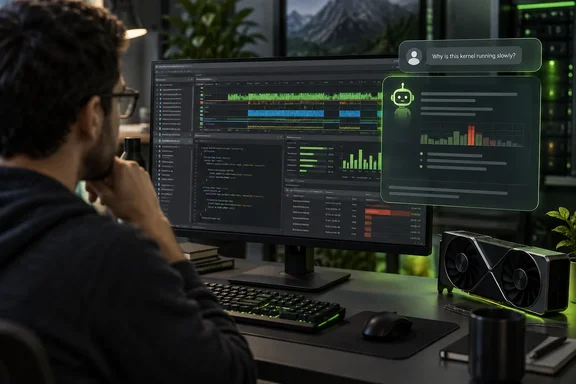
The filing describes an "LLM-based chat interface for one or more compute profiling tools." A chat agent takes input as text or audio and can call several analytical tools. The named tools are a profiler, an occupancy calculator, a "language processor" that runs scripts, a mathematical tool, and a web search tool that can pull context from blogs and developer forums.
Queries go through a supervisor, or router. The filing describes separate agents for general questions and for kernel-specific questions, with the router classifying each query first and sending it to the right one. The general agent handles GPU concepts, architecture, programming models, what a metric means, and how to use the tools, and it relies on retrieved documentation. The report agent handles questions about a particular profiling run. The supervisor can also reject questions that have nothing to do with the profiler, which keeps the assistant narrow in scope.
A performance question about a specific program would go roughly like this:
- The developer asks a question tied to a program or kernel, such as what limits its occupancy or where its hot spots are.
- The system gets a profile report, either one the user already captured or one produced by invoking the profiler automatically.
- The agent writes a script, with Python given as the example, to pull the relevant details out of the report through a scriptable "report interface."
- The language processor runs the script and returns the processed data to the agent.
- The agent combines that data with occupancy calculations, documentation and other tool output, then writes an answer that points to hot spots and bottlenecks and suggests optimizations.
The filing lists what such a report may contain: GPU resource utilization, performance metrics, and stall reasons per instruction. The suggested fixes can include using library functions or existing programming-model and GPU features. It also describes a tool that produces a version of the source program annotated with profile markers, so the agent can link its advice to specific lines of the kernel.
The occupancy calculator is described as taking block size, register usage and shared-memory usage and estimating how effectively the GPU's resources are used. Anyone who has written CUDA will recognize those inputs, because they are the usual limits on how many threads a GPU can keep in flight. The filing also describes comparison queries, where the agent takes two kernels and their reports, calculates the speedup, and identifies the root cause of the difference.
Why NVIDIA's Agent Needs RAG and Few-Shot Prompting for Profiler APIs
One of the more candid passages admits a real weakness. The report interface may be a "low-resource API," meaning public language models were probably never trained on how to use it. NVIDIA's fix is in-context learning. The system supplies an API guide inside the prompt, uses few-shot prompting (showing the model a few worked examples), and in some versions trains the agent on sample scripts.
Retrieval-augmented generation (RAG) is used for the same purpose. The agent retrieves profiler documentation, programming-model guides, report-interface examples, API references and GPU architecture material, and the filing presents this as a way to reduce hallucinations. The agents are described as following a ReAct-style loop of "Thought-Action-Observation," in which they reason, call a tool, check the result and repeat. Responses can also be tailored to the user: longer explanations with definitions for beginners, shorter answers for experts.
The filing also mentions evaluation. It says response quality may be checked against a custom evaluation set built from expert knowledge of the tools, with ground-truth answers collected manually from profiler results and documentation. That is a method, though, not a result. The filing reports no accuracy figures and no benchmarks. It also doesn't say which language model would be used or whether that model runs locally or in the cloud.
Where Coverage of the Nvidia AI Profiling Patent Overstates It: Nsight Stays in the Loop
Some coverage has gone further than the filing supports. Tech4Gamers wrote that the AI would write custom profiling code "taking manual profiling tools like Nsight out of the equation completely", and its headline promised a tool to "fix unoptimized games." The patent text says something different. The profiler remains a core component, and the generated scripts extract information from the profile reports it produces. The language model sits on top of the profiler rather than replacing it.
The tools that would plausibly supply that data already exist. NVIDIA's Nsight Systems, currently at version 2026.5.1 per NVIDIA's developer site, is a system-wide performance analysis tool. It shows CPU and GPU activity on one timeline and traces graphics APIs including Vulkan, OpenGL, DirectX 11, DirectX 12 and DXR. With GPU Metrics Sampling turned on, it also shows SM utilization, Tensor Core activity, instruction throughput and warp occupancy. The filing never names Nsight Systems or any other product, so there is no evidence yet that the assistant would plug into a particular NVIDIA tool.
The "automatic fix" framing also fails. As dev.ua put it, the new AI tool doesn't automatically fix errors in your code; it's intended to make it easier to examine what's going on "under the hood" and pinpoint "bottlenecks". The output is an explanation and a set of suggestions. A developer still has to make the change, test it and ship it, and none of this reaches players until they do.
The tbreak outlet makes a related point about deployment: the proposed workflow would run on the developer side, not on players' PCs. Nothing in the filing describes code running on consumer GPUs through a driver or game update.
Generated Diagnostic Code Is the Weak Point in NVIDIA's Design
Every agent that writes and runs code carries the same risk: the code can be wrong. Patentlyze, which tracks AI-agent patent filings, describes the design as a bet that a neural network can generate correct, safe profiling code reliably enough to run automatically on live GPU workloads. Patentlyze argues that running malformed or misdirected diagnostic code could produce misleading results or, worse, interfere with the workload being measured, and the patent does not describe any explicit sandboxing, validation, or correction loop for the generated code. tbreak credits RespawnFirst with the same observation.
The filing gives some context for that concern. In the flow it describes most concretely, the generated scripts parse a profile report that has already been captured, which is a smaller risk than running arbitrary code on a live workload. The filing also allows the profiler to be invoked automatically, though, so the line between reading a report and driving a live capture isn't fully defined. The ReAct loop is iterative, which suggests the agent can see a script's output and try again, but that falls well short of a formal validation step.
A quieter risk is a plausible but wrong conclusion. A script can run cleanly and still pull the wrong metric or misread a stall reason, and the model will then explain that mistake confidently. RAG and grounded examples are NVIDIA's stated defenses. Nobody outside NVIDIA has published results showing how well they work on real profiling questions.
Local Script Execution Is Described, but Privacy Is Not Promised
Studios and companies that treat kernel source and performance traces as sensitive IP will look for one detail. The filing says the language processor can run scripts locally, "allowing system 100 to retrieve and manipulate data without sharing sensitive information externally."
That describes one embodiment. It isn't a privacy policy. The same filing describes a web search tool that pulls context from blogs and forums, and it says nothing about where the language model runs, what gets sent to it, or how long anything is kept. The design leaves room for a version where all analysis happens on a developer's workstation. If this ever ships, the actual defaults will determine whether a security team approves it.
Project G-Assist Tunes Gamers' PCs; This Filing Targets Developers' Kernels
NVIDIA already sells a consumer AI assistant, so comparisons were inevitable. Per dev.ua, Project G-Assist in the NVIDIA App accepts voice or text queries and can report basic statistics: GPU load, temperature, clock speed, power consumption, FPS, and also recommend or change game graphics settings.
The patented system works at a different level. VideoCardz notes that it goes deeper by targeting developers and analyzing the code and performance data behind GPU workloads rather than just reporting system statistics or suggesting graphics settings. G-Assist helps a player pick settings. This filing would help the people writing shaders and compute kernels figure out why they're slow.
The two do share an interface idea: text or voice questions answered by an agent that has access to tools. Reading the filing as a developer-facing version of G-Assist is fair as an interpretation. Neither NVIDIA nor the filing says so.
What this means for you
Unless you write or tune GPU code, you don't need to do anything, and even if you do, the only immediate step is to keep your current profiling workflow. Nothing here can be downloaded, previewed or enabled today. The filing does tell you which skills will stay useful: capturing good profiles, and being able to check whether an explanation fits the data. An agent like this would only be as good as the reports it reads.
If you evaluate developer tools for a studio or engineering team, the filing gives you a checklist for any future AI profiling assistant, from NVIDIA or anyone else. Ask where the model runs, what leaves the machine, whether generated scripts are sandboxed or limited to read-only report access, and how the vendor measures answer accuracy.
- US 2026/0277953 A1 is a pending NVIDIA patent application published September 17, 2026, and it announces no product, release date, name or supported hardware.
- The proposed agent answers questions by generating scripts that pull data from GPU profiler reports, so it still depends on tools like the profilers NVIDIA already ships rather than replacing them.
- The filing covers GPU programs and compute kernels in general, and applying it to game stutter or frame-time problems is a reasonable extension rather than a documented use case.
- The system would produce diagnoses and suggested optimizations, and developers would still make, test and ship any actual fix.
- Local script execution is described as one option, but the filing does not establish where the language model runs or what data would leave a workstation.
- Outside reviewers have flagged that the filing describes no explicit sandboxing or validation of generated code, which is the first thing to check if a product based on it appears.
Patent applications are cheap signals, and many never become products. This one is unusually specific, though: it describes a router, split agents, a report-scripting interface, an occupancy calculator and an evaluation method, and that looks like engineering work that already exists in some form. If NVIDIA ships something based on it, the likeliest form is a chat layer added to the profiling tools developers already use, not a separate tool that makes them unnecessary. Its value will depend on whether its generated scripts read the data correctly and whether it keeps a studio's traces on the studio's own machines. For now, the only milestone on record is the USPTO's examination of the claims.
References
- NVIDIA Files Patent for AI Tool to Help Developers Diagnose GPU Performance Issues TechPowerUp · 2026-09-25T16:30:13+00:00
- NVIDIA wants AI chat to help developers analyze GPU performance, new patent shows - VideoCardz.com videocardz.com
- Nvidia Patent: AI That Writes GPU Profiling Code Automatically patentlyze.com