

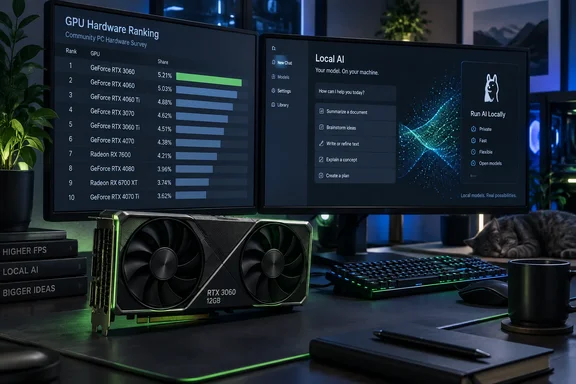
MakeUseOf linked the five-year-old card’s popularity to running large language models locally in its September 21 report. The hardware’s continued relevance is supported by Valve’s rankings and Ollama’s GPU compatibility documentation. The proposed explanation for its popularity goes further than those records can show.
What Steam’s ranking actually tells us
Valve’s August “All Video Cards” table puts the leading entries close together:
| GPU | July 2026 share | August 2026 share | Monthly change |
|---|---|---|---|
| GeForce RTX 3060 | 3.88% | 3.92% | +0.04 percentage points |
| GeForce RTX 4060 Laptop GPU | 3.64% | 3.84% | +0.20 percentage points |
| GeForce RTX 5070 | 3.62% | 3.77% | +0.15 percentage points |
| GeForce RTX 4060 | 3.63% | 3.60% | −0.03 percentage points |
The RTX 3060’s August increase was modest. Its share was also below the 4.15% recorded in April, so this five-month view does not demonstrate a sudden surge in adoption. It shows an older card retaining a substantial installed presence while newer models compete for the top positions.
The desktop and laptop versions must remain separate. Valve lists the RTX 3060 Laptop GPU independently, at 1.85% in August; that figure is not part of the desktop card’s 3.92%.
Steam’s optional, anonymous survey measures hardware among respondents. It is neither a retail sales chart nor a record of why people bought their graphics cards. Existing owners keeping their PCs can contribute to a high ranking without buying anything new.
Consequently, the survey cannot distinguish a gamer retaining an RTX 3060 from an owner using the same PC for games, video work and local AI. A hardware ranking cannot establish purchasing motivation.
Why the 12GB card is relevant to local AI
The local-AI argument nevertheless has a practical foundation. Graphics memory provides space for a model’s parameters and the additional data needed while generating responses. A card can therefore remain useful for workloads constrained by memory capacity even when its gaming performance is no longer leading its price class.
Ollama, software for running language models locally, explicitly lists the RTX 3060 as supported hardware with Nvidia compute capability 8.6. Its GPU documentation specifies Nvidia driver version 550 or newer for that supported hardware. That establishes software compatibility, rather than merely suggesting that an older gaming GPU might work.
Compatibility does not establish how large a model will fit or how quickly it will respond. The model’s parameter count, numerical representation, working memory and conversation length all affect its requirements.
MakeUseOf calls 12-billion- to 14-billion-parameter models a “sweet spot” for the 12GB card. That should not be treated as a universal sizing rule. Quantization—storing model values at reduced precision—changes memory requirements, while longer context consumes additional space. A model name or parameter count alone is insufficient to promise comfortable operation.
For someone choosing hardware for local inference, the useful comparison is therefore a named model, its quantization and intended context length running in the intended application. “Supports Ollama” answers the compatibility question; it does not answer the capacity or performance questions.
The same caution applies to a multi-GPU homelab. Ollama documents selecting multiple Nvidia devices, but that support does not by itself validate a particular model’s distribution across cards, its speed or a complete system budget. Buying a second RTX 3060 should follow a workload-specific plan rather than an assumption that adding memory capacities guarantees the desired result.
Popularity does not settle the buying decision
There is dated reporting of renewed retail availability. XDA Developers reported on July 14 that the RTX 3060 12GB had reappeared at US retail for $329, its original launch-price level. That supports a specific historical price report, not a broadly available September price of approximately $320.
That July price point has not been independently corroborated here as a current offer. Retail stock also does not, by itself, establish MakeUseOf’s claim that Nvidia restarted the card specifically to address a memory shortage.
Gaming buyers need a different set of evidence from local-AI buyers. Memory capacity alone does not establish frame rates at 1080p or 1440p, and a Steam ranking supplies no performance measurement.
MakeUseOf published game results attributed to Jason Vitmer, but the accompanying account does not establish the full test configuration, driver and game versions, or consistently explain the role of upscaling and frame generation. Those figures are not a sufficient basis for promising equivalent performance on another PC or declaring the RTX 3060 the best current purchase.
For an existing owner, Ollama’s explicit support provides a concrete reason to consider another use for the card before replacing it. For a prospective buyer, the decision should rest on the exact memory configuration, current price and demonstrated performance in the intended games or AI workload.
The RTX 3060’s August Steam lead is real. Its usefulness for local AI is credible. The evidence supports both conclusions separately, without establishing that one caused the other.
References
- Nvidia's forgotten GPU became the most popular card on Steam, but not for the reason you'd think MakeUseOf · 2026-09-21T12:00:14+00:00
- Steam Hardware & Software Survey store.steampowered.com