

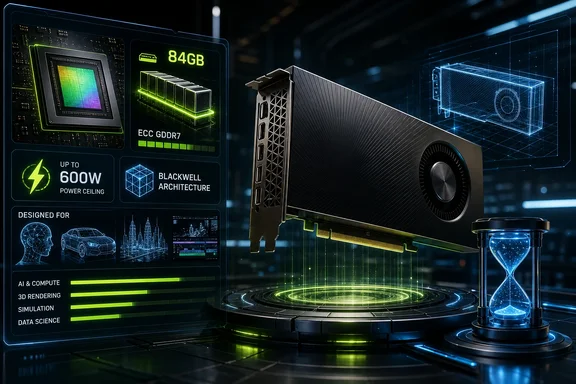
That distinction matters for IT buyers, workstation builders, and Windows professionals planning local AI or graphics deployments. The card has a preliminary specification sheet and a board-partner listing, but no confirmed release date, no announced price, and no independent testing in the reviewed material. Its published details point to a high-end, rack-aware professional product rather than a straightforward drop-in upgrade for every desktop PC.
Listed, not released
The RTX PRO 5500 was not part of NVIDIA’s original March 18, 2025 announcement of Blackwell RTX PRO workstation desktop GPUs. That announcement named the RTX PRO 6000, 5000, 4500, and 4000 families, among others, but not a 5500 model. Its appearance in the current catalogue therefore represents an addition to that initial lineup, although the available records do not establish when NVIDIA first published the 5500 listing.
What the listing does establish is product intent. NVIDIA calls it a professional desktop GPU, built on the Blackwell architecture, while also saying it is designed for rack-mounted workstation deployment. Those descriptions should be read together. The RTX PRO 5500 is clearly aimed at managed professional environments and dense compute installations, but the evidence does not support the stronger claim that it cannot be used in a conventional desktop workstation.
The more immediate limitation is availability. A published specification page can help organizations assess compatibility and start procurement planning; it does not mean that a distributor can supply the product or that a system integrator has qualified it for a particular chassis. NVIDIA also marks the listed specifications as preliminary and subject to change. Until availability is confirmed, every prospective deployment plan should treat the numbers as planning inputs, not final purchasing specifications.
The headline specification: 84 GB of ECC GDDR7
The central differentiator is memory capacity. NVIDIA lists 84 GB of GDDR7 ECC memory and 1,398 GB/s of bandwidth. For Windows workstations, capacity can be as consequential as raw GPU throughput when a workflow needs a large local dataset, scene, model, or collection of high-resolution assets to remain in GPU memory.
That does not prove a specific application will run faster, because performance depends on software support, precision formats, model architecture, CPU and storage configuration, and the workload itself. Nor is there reviewed benchmark evidence for the unreleased card. Still, 84 GB creates a potentially important middle ground in NVIDIA’s own product segmentation:
- The RTX PRO 5000 is listed with 48 GB or 72 GB of memory and up to 300 W power.
- The RTX PRO 5500 is listed with 84 GB and up to 600 W.
- The RTX PRO 6000 Blackwell Workstation Edition is listed with 96 GB and up to 600 W.
In other words, the 5500 narrows the capacity gap to the flagship while retaining a 12 GB difference. For a team whose workload fits in 84 GB but not 72 GB, that difference could be operationally significant. For a team that truly requires more than 84 GB on one GPU, the published stack still points to the 96 GB RTX PRO 6000 as the next option.
The capacity should not be confused with system RAM. A Windows PC can have far more conventional memory, but moving working data between system memory and the GPU introduces a different set of performance constraints. The value proposition of an 84 GB professional card is specifically that a supported workload may be able to keep more of its active working set in local GPU memory.
What is confirmed — and what still comes from a partner listing
NVIDIA’s preliminary specifications confirm several key platform details: PCIe Gen 5 x16 connectivity, active air cooling, up to four DisplayPort 2.1b outputs, up to 600 W maximum power, and three ninth-generation NVENC engines plus three sixth-generation NVDEC engines. Those media engines and display outputs make the product relevant to more than server-style AI inference; video, visualization, and display-heavy professional environments are also part of the apparent target market.
A PNY product listing supplies further detail: 21,760 CUDA cores, a 750 mm² die containing 92.2 billion transistors, a 416-bit memory interface, and one PCIe CEM5 16-pin auxiliary-power connector. NVIDIA’s own preliminary RTX PRO 5500 page does not independently publish the CUDA-core count, die size, transistor count, or bus width. That does not mean the partner’s figures are incorrect, but it does mean these should be described accurately as partner-listed specifications rather than as fully corroborated fields from NVIDIA’s card page.
The 21,760 CUDA-core figure is notable because NVIDIA gives the GeForce RTX 5090 the same core count. This is a useful architectural comparison, but it is not a sound basis for promising equivalent real-world performance. The RTX 5090 is listed with 32 GB of GDDR7 and 1,792 GB/s bandwidth, whereas the RTX PRO 5500 is listed with 84 GB and 1,398 GB/s. Differences in memory configuration, power behavior, drivers, application certification, and professional features can all matter. Equal core counts are a data point, not a benchmark result.
The 416-bit question is not settled
Some early discussion has treated PNY’s 416-bit interface figure as necessarily erroneous. The available documentation does not justify that conclusion.
PNY lists 84 GB of ECC GDDR7, a 416-bit interface, and 1,398 GB/s of bandwidth together. NVIDIA’s preliminary product table does not provide an alternate bus-width figure. The bandwidth number alone is also not proof of an impossibility: dividing 1,398 GB/s across a 416-bit interface indicates roughly 26.9 Gb/s per pin, below the 32 GT/s maximum shown in Micron’s published GDDR7 catalogue.
There may still be unanswered engineering questions around the precise implementation, including how the stated capacity maps to the interface. But absent clarification from NVIDIA or PNY, the responsible conclusion is uncertainty, not a confirmed specification error. Organizations that need exact memory-topology details for a technical purchasing decision should seek a final data sheet from the vendor rather than relying on early commentary.
Power, cooling, and physical fit will shape deployments
The air-cooled RTX PRO 5500 is listed as a dual-slot card measuring 4.4 inches high and 11.1 inches long. On paper, that is a familiar expansion-card profile, but the up-to-600 W power specification makes it a demanding component in practice.
PNY specifies a single PCIe CEM5 16-pin power connector. NVIDIA’s workstation guidance uses that exact CEM5 16-pin terminology for the connector used on next-generation professional visualization products. The reviewed records contain no product-specific evidence of connector failures or reliability problems on the RTX PRO 5500, particularly because the product has not been released for independent testing. It would be inappropriate to import assumptions from unrelated products into this card’s reliability assessment.
There are nevertheless concrete integration questions for Windows workstation owners and IT departments:
- Power supply capacity: A system must have a power supply and cabling arrangement appropriate for a GPU specified at up to 600 W, alongside the CPU, storage, networking, and other components.
- Chassis airflow: Active cooling does not remove the need for a chassis that can move substantial heat. Small cases, crowded expansion bays, and poorly planned rack enclosures deserve particular scrutiny.
- Connector clearance: Builders should account for cable routing and bending clearance near the CEM5 16-pin connection, rather than checking card length alone.
- Platform expansion: PCIe Gen 5 x16 is the listed interface. The card can still be evaluated in the context of a specific platform, but buyers should confirm lane allocation and physical-slot spacing in systems that also need capture cards, high-speed networking, or storage adapters.
- Deployment format: NVIDIA describes both a rack-oriented air-cooled card and an available liquid-cooled solution in the RXM form factor. The documentation does not support claims that liquid cooling is merely planned for a later date.
These considerations do not make the RTX PRO 5500 unsuitable for desktops. They do mean that a workstation purchase should start with chassis, PSU, thermal, and support validation instead of treating the GPU as a routine graphics-card upgrade.
A potentially costly gap between the 5000 and 6000
NVIDIA has not announced RTX PRO 5500 pricing in the reviewed material. That prevents any firm value judgment against the RTX PRO 5000 or RTX PRO 6000.
There is one useful pricing boundary: NVIDIA Marketplace lists the RTX PRO 6000 Blackwell Workstation Edition at $16,000, though that listing is marked out of stock. This confirms that the top workstation model occupies five-figure territory, but it does not establish where the 5500 will land. It could be substantially less expensive, close enough to complicate the choice, or subject to different regional and partner pricing. Any specific RTX PRO 5500 price prediction would be speculation.
For procurement teams, the unresolved price is especially important because the 5500’s published positioning is not simply “more performance.” It is an 84 GB, 600 W option between a lower-power 5000 tier and the 96 GB flagship. Its eventual appeal will depend on whether the price premium over a 72 GB RTX PRO 5000 is justified by the capacity jump, and whether the saving versus an RTX PRO 6000 is large enough to offset giving up 12 GB of memory.
What Windows professionals should do now
The RTX PRO 5500 Blackwell is worth tracking for organizations whose applications benefit from large local GPU memory, professional graphics capabilities, multiple modern display outputs, or a rack-deployable workstation design. It may ultimately offer a useful compromise between the RTX PRO 5000 and RTX PRO 6000 tiers.
For now, it is a catalogue listing with preliminary specifications, not an available product with a verified price or public performance record. Windows users considering it should wait for confirmed availability, final vendor documentation, workstation compatibility guidance, and independent workload testing. They should also validate software support and driver requirements with the makers of their specific applications.
The important correction to the early narrative is simple: NVIDIA has disclosed a compelling 84 GB professional GPU, but the evidence currently supports describing the RTX PRO 5500 as forthcoming. Its real-world position in Blackwell workstations will be determined only after its final specifications, price, availability, and measured performance become clear.