

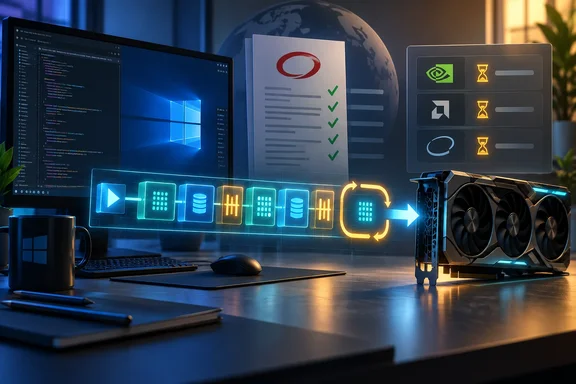
cl_khr_command_buffer a finalized Khronos extension, giving OpenCL developers a standard way to record a repeatable sequence of GPU commands once and replay it with less host-side submission overhead. For Windows applications that run the same kernel pipeline frame after frame, batch after batch, or inference after inference, the change creates a stable target for future driver support—but it does not mean existing OpenCL drivers gained the feature today.
Phoronix first reported the OpenCL 3.1.2 publication on September 17, and the Khronos Group’s OpenCL-Docs repository now lists version 3.1.2 as its latest tagged release. Khronos’ changelog confirms both the release and the important wording: cl_khr_command_buffer has been “finalized and is no longer experimental.”
That wording corrects a potentially consequential shortcut in descriptions of the release. The command-buffer facility has not been promoted into the mandatory OpenCL core API in the way several extensions were when OpenCL 3.1 launched in May. It remains a KHR extension. Developers still need to discover support at runtime rather than assuming it merely because a device reports OpenCL 3.1 compliance.
Command buffers reduce repeated CPU-to-driver work
Traditional OpenCL programs submit work through a command queue. For a repeated workload, the host application typically sets up commands for kernels, copies, fills, barriers, and dependencies every time it runs the sequence. That can be a reasonable cost for a large GPU job, but it becomes material when an application sends many short workloads or tightly pipelined stages.
The cl_khr_command_buffer extension lets an application create a command buffer, record compatible commands into it, finalize the buffer, then submit that prepared sequence repeatedly through clEnqueueCommandBufferKHR. Khronos describes the intent plainly: separating command-stream setup from dispatch reduces the overhead of enqueueing the same workload multiple times.
The practical gain is not that the GPU suddenly executes kernels faster. A command buffer does not rewrite a kernel, increase memory bandwidth, or change a device’s compute throughput. It reduces work on the host and in the driver’s submission path. That can lower latency and help keep an accelerator busy when a Windows application has a recurring chain of relatively small compute operations.
Khronos’ own rationale points to repetitive, pipelined workloads and compares the abstraction to command-buffer models already familiar in Vulkan, Direct3D 12, and Metal. The intended audience includes applications with a known execution graph: media processing loops, imaging pipelines, industrial workloads, simulation steps, and repeated pre- or post-processing around machine-learning inference.
Finalization settles the API contract, not deployment
The new status is valuable because experimental OpenCL extensions can change. A developer who integrated an experimental feature was accepting the risk that argument layouts, symbols, semantics, or restrictions could be revised before Khronos finalized the specification. OpenCL 3.1.2 removes that particular uncertainty for the base command-buffer extension.
Khronos’ public headers already expose the command-buffer API family and capability flags, including controls related to simultaneous use and mutable command buffers. The 3.1.2 changelog also adds a missing error condition for clEnqueueCommandBufferKHR, a small documentation change with outsized value for implementers and developers trying to distinguish an invalid program state from a driver defect.
But specification finalization and implementation availability are different events. Khronos’ release materials do not identify which current Intel, NVIDIA, AMD, Qualcomm, or other OpenCL drivers implement the finalized extension, whether pre-final implementations match the release exactly, or when Windows driver packages will advertise it. No vendor driver announcement accompanied the specification tag.
That leaves a clear operational rule: do not compile out the conventional command-queue path. Applications should query for cl_khr_command_buffer in the platform or device extension information, obtain the extension entry points appropriately, and fall back to ordinary enqueue calls when the extension is unavailable. A device that supports OpenCL 3.1 can still lack this optional extension.
For shipping software, this also means testing by driver version and device, not just by OpenCL version string. The feature is designed precisely around command submission behavior, an area where queue capabilities, synchronization semantics, and vendor implementation details can decide whether the complexity earns a measurable improvement.
The initial feature has deliberate limits
The finalized extension records a defined subset of OpenCL command types rather than every operation an application can put on a normal command queue. Khronos’ specification excludes commands that map or migrate memory, read or write memory objects, or enqueue native kernels from command-buffer recording.
Those exclusions are not incidental. Command buffers are meant to run after submission without requiring further application interaction until their recorded commands finish. Host-visible readbacks, writes, mapping calls, and certain migration operations complicate that model because they create points where the CPU expects direct control or data access.
Synchronization inside a command buffer also differs from an ordinary event-heavy queue design. Rather than having each recorded command wait on or return OpenCL event objects, the extension uses device-side synchronization point identifiers for dependencies among recorded commands. That avoids ambiguity when the same command buffer is replayed multiple times and reduces host involvement in the recorded sequence.
Developers should therefore view command buffers as a way to package a stable GPU-side portion of a workflow—not as a container for an entire application pipeline. A Windows application that uploads fresh input, launches several compute kernels, and reads a result back may be able to record the central kernel sequence while leaving transfers and host coordination outside the command buffer.
The wider command-buffer family remains mixed in maturity. The separate mutable-dispatch, multi-device, and mutable-memory-command extensions have had experimental status in the OpenCL documentation. OpenCL 3.1.2 finalizes the base extension only. Code that needs to alter recorded kernel arguments, work sizes, or other properties between replays must check the relevant additional support instead of treating base command-buffer availability as proof that those advanced paths are present.
OpenCL 3.1.2 is mostly a precision release
Outside command buffers, OpenCL 3.1.2 is a maintenance-focused specification update. Khronos lists improved consistency in memory-object API error-code documentation, clarification for clSetProgramSpecializationConstant in separate compilation and linking, guidance for the CL_MEM_KERNEL_READ_AND_WRITE memory flag, and more precise descriptions for image-format queries, null program-source strings, and non-uniform work-group support.
None of those items introduces a broad new programming model. They do matter for tool authors, conformance testing, driver implementers, and developers diagnosing edge cases across hardware vendors. Error-code consistency is especially useful in a cross-vendor API, where a documented failure condition becomes part of the contract that applications can test and handle rather than an implementation-specific surprise.
The release also follows a notable correction in OpenCL 3.1.1. Khronos had made observing an event reach CL_COMPLETE a synchronization point in the original OpenCL 3.1 specification, then reverted that change in 3.1.1 because of possible performance regressions. The sequence is a reminder that even a point release can alter behavior at the API boundary; version labels alone are not enough for developers maintaining portable low-level code.
What Windows developers should do now
Most Windows users and administrators do not need to do anything. OpenCL 3.1.2 is a specification release, not a Windows Update, GPU driver release, or runtime installer. It changes the target available to driver teams and application developers.
Teams maintaining OpenCL software can begin preparing without requiring the extension in production:
- Audit workloads for a repeated, fixed command sequence where CPU-side queue submission appears in profiles rather than assuming every multi-kernel workload will benefit.
- Keep the existing queue-based implementation as a fallback, because support must be queried per device and driver.
- Treat mutable command-buffer features as separate optional capabilities, even when the base
cl_khr_command_bufferextension is reported. - Re-test synchronization, profiling, and error handling when enabling the extension, since command-buffer dependencies are not modeled as the same per-command host event flow used by normal queue submission.
The immediate consequence of OpenCL 3.1.2 is a stable API target, not a universal performance switch. The first Windows releases that advertise cl_khr_command_buffer support—and publish enough implementation detail to show which workloads benefit—will determine whether the finalized specification becomes a practical tool for mainstream OpenCL applications or remains chiefly an option for specialized compute stacks.