

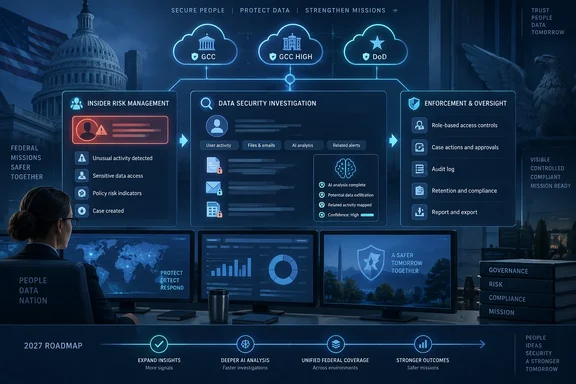
The important qualification is in the roadmap metadata: this is a government-cloud availability item, not evidence that Microsoft is inventing the underlying workflow for the first time. Microsoft Learn documentation already describes the ability to open a Data Security Investigation from an Insider Risk Management case, including the exact Purview case action used to begin the process. The commercial product documentation was updated in June 2026, while the roadmap entry was last updated on September 16, 2026.
For government customers, that gap is the news. Organizations in GCC, GCC High, and DoD should not read the roadmap as confirmation that they can enable the integration now. Microsoft marks it in development and provides a target date more than a year away.
The roadmap is about sovereign-cloud parity
The Microsoft 365 Roadmap entry says the feature will be available in GCC, GCC High, and DoD. Those are separate Microsoft 365 government environments with different compliance commitments, service boundaries, and rollout schedules from Microsoft 365 commercial tenants.
GCC is used by eligible U.S. public-sector organizations and contractors. GCC High is designed for more tightly controlled workloads, including organizations handling information subject to higher federal and defense requirements, while the DoD environment is reserved for the U.S. Department of Defense. Bringing an AI-assisted content-investigation workflow into those clouds requires more than exposing a button in the Purview portal: Microsoft has to make the service, its data processing path, and its supporting controls available within the relevant environment.
That distinction explains why a feature documented for Purview users can still appear as a future item for government tenants. Microsoft’s published documentation describes the workflow in general terms, but the Roadmap entry is the first clear scheduling signal supplied for this specific Insider Risk Management integration across all three listed government clouds.
Microsoft has not said whether GCC, GCC High, and DoD will receive the capability simultaneously, whether feature depth will differ by cloud, or whether the December 2027 date applies to every component of the workflow. The Roadmap labels the release ring as General Availability, but roadmap dates remain planning targets rather than contractual delivery commitments.
What the case-to-investigation handoff does
Insider Risk Management is designed to flag potentially risky user behavior using signals tied to data handling and policy violations. A case investigator can review activity that may suggest data leakage, intellectual-property theft, security-policy violations, or inadvertent exposure. Those signals identify who and what activity may warrant attention; they do not necessarily answer what sensitive content was involved or how serious the exposed material is.
Data Security Investigations is Purview’s content-analysis workflow for examining files, email, messages, and other scoped material after a suspected breach, exfiltration event, or insider-risk incident. Microsoft says the service combines search, AI-assisted categorization, risk examinations, and mitigation planning to help teams determine which content deserves closer review.
The integration is meant to preserve the connection between those two stages. Rather than starting a broad manual investigation after an Insider Risk Management case is escalated, the investigator can initiate a Data Security Investigation from the case and inherit the relevant items as initial data sources. Microsoft’s documentation describes the Purview action as “Investigate data security with AI.”
The word pre-scoped deserves attention. It means the new investigation begins with material associated with the case, rather than automatically searching every file, mailbox, or SharePoint location belonging to the employee. Investigators can then decide which items remain in scope and add context to guide the AI analysis. That is operationally preferable to treating an insider-risk alert as permission for an unlimited content search, particularly in environments where legal, HR, privacy, and security teams must agree on investigative boundaries.
Existing documentation exposes the operational limits
Microsoft Learn lays out a workflow that government administrators should use as a planning baseline, while recognizing that it is not yet a confirmation of availability in their tenant. An Insider Risk Management case is opened in the Purview portal, the investigator selects Case actions, chooses the data-security investigation option, names the investigation, selects case items for the scope, and may add context for the AI analysis.
Several conditions matter before a team turns that sequence into a runbook.
- The investigator needs an appropriate Insider Risk Management role, with Microsoft listing the Insider Risk Management and Insider Risk Management Investigator roles for creating an investigation from a case.
- Data Security Investigations has its own access model. Microsoft says members of the Compliance Administrator and Organization Management role groups receive administrative and contributor access, while members of the Data Security Management and Insider Risk Management role groups receive contributor access.
- The service requires billing and usage configuration for storage and AI analysis. Microsoft’s documentation says charges are based on the data added to investigations and the AI capacity used to analyze it.
- Microsoft warns that investigations created from Insider Risk Management cases containing more than approximately 3,000 items might not return complete results. The actual threshold can vary with file names and paths.
That last limit is the practical constraint buried beneath the roadmap’s simple description. A case involving mass downloads, broad SharePoint sharing, mailbox exports, or repeated sync activity may generate more evidence than the integrated investigation can reliably process in a single pass. Teams will need a documented approach for segmenting large cases, retaining the original case evidence, and avoiding an assumption that an AI-assisted investigation represents an exhaustive review.
AI analysis should inform escalation, not decide it
Microsoft positions Data Security Investigations as a way to categorize content, surface risks such as credentials or sensitive data, and prioritize items for review. Its own application documentation also warns customers to use human judgment for consequential decisions and to keep the product within governed security workflows.
That is especially relevant for Insider Risk Management. A risky-user signal can involve mistake, policy ambiguity, compromised credentials, unusual working patterns, or malicious behavior. Content analysis may help establish the impact of a potential incident, but it should not become a shortcut to an employment, disciplinary, legal, or access-control decision without corroborating evidence and the organization’s established review process.
Microsoft’s privacy-by-design description for Insider Risk Management remains relevant here. The product pseudonymizes users by default and supports role-based access controls and audit logging. Government tenants planning for the future integration should verify that the people who can de-pseudonymize a user, review sensitive content, run AI examinations, and approve mitigation actions are intentionally separated where policy requires it.
The integration may reduce the time between a risk alert and a more complete understanding of exposed data. It also concentrates more sensitive material, analyst judgment, billing exposure, and audit requirements in a single workflow. That makes access design and case-handling procedures part of the deployment, rather than post-launch cleanup.
What GCC, GCC High, and DoD administrators can do now
There is no production feature to enable from Roadmap ID 501781 today. The December 2027 target means government customers have time to identify the process failures the integration is intended to address: manually moving case evidence between teams, unclear ownership for post-incident content review, and slow determinations of whether a user’s activity involved regulated or mission-sensitive information.
Administrators can also inventory who holds Insider Risk Management, Data Security Management, Compliance Administrator, and Organization Management roles; review how the organization authorizes access to user content; and establish a response plan for large evidence sets that may exceed the documented approximately 3,000-item investigation limit.
The concrete milestone is December 2027, assuming Microsoft maintains its current roadmap target. Until Microsoft publishes government-cloud availability guidance and the feature appears in the relevant Purview portals, GCC, GCC High, and DoD teams should treat the entry as a planning signal—not as a released capability.