

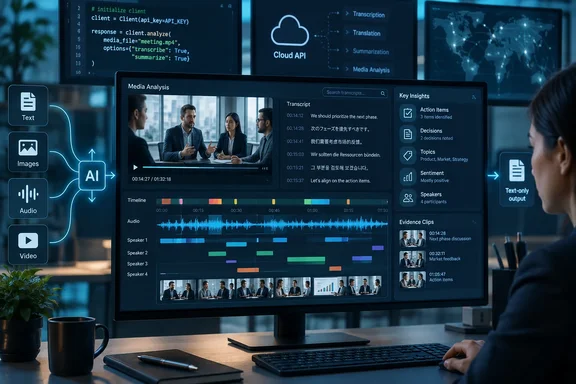
Neowin first reported the September 18 launch, including Alibaba’s claim that audio-input pricing has fallen by more than 98% and audio-video input pricing by more than 93%. Alibaba’s QwenCloud documentation independently confirms the core release details: a 1 million-token context window, OpenAI-compatible access through DashScope, text/image/audio/video inputs, and text output. IT Home also reported the launch and Alibaba’s benchmark figures in China.
The important correction is one Alibaba’s marketing language can obscure. Qwen3.8-Omni-Flash is native multimodal in what it can understand, but it is not currently an audio-output model. Teams building call-center analysis, meeting intelligence, media indexing, compliance review, or video research tools can use it directly; teams building conversational voice agents will still need a text-to-speech layer or an older Qwen Omni endpoint that supports audio responses.
A long-context media model aimed at evidence retrieval
Alibaba positions Qwen3.8-Omni-Flash around agentic audio-video understanding: the model can decide what portions of a lengthy recording to inspect rather than treating every frame and every second of audio as equally relevant. This approach is meant for tasks such as locating a claim in a board meeting, identifying the point where a product demonstration fails, extracting decisions and owners from a call, or assembling a cited research-style report from a video archive.
The company says the model supports up to one hour of audio-video input and a 1 million-token context window. Its Model Studio documentation lists a practical maximum input of 991,808 tokens in non-thinking mode and 983,616 with thinking enabled, plus a maximum 131,072-token response. Those are large limits, but they should not be mistaken for a guarantee that every long media file can be submitted without preprocessing. Duration, file size, resolution, frame sampling, and audio channel configuration still determine the number of tokens consumed.
Alibaba also lists support for two-channel and four-channel spatial audio understanding. For enterprise recordings, that can be more consequential than another generic “multimodal” claim: stereo or multichannel material can preserve distinctions between speakers, room positions, or tracks that are often flattened before conventional transcription. The documentation says the model recognizes 113 languages and dialects, matching Qwen3.5-Omni’s language coverage.
For Windows administrators and internal-tools developers, the practical use case is not replacing Teams, Zoom, or Stream. It is building a post-processing layer that can turn recorded media into searchable notes, incident evidence, action lists, risk summaries, or structured JSON consumed by another workflow.
Alibaba’s benchmark win is really a workflow claim
Alibaba says Qwen3.8-Omni-Flash raised its OmniVideoBench result from 63.4 to 67.8 while reducing token use per query from 145,736 to 79,117—a 45.7% reduction. IT Home reported the same figures. The company attributes the change to its agentic mode, which performs iterative, question-led evidence gathering rather than a single static pass through the entire video.
That is potentially more useful than a modest raw score improvement. Long-video AI costs tend to compound when applications repeatedly submit the same footage for different questions: “What was decided?”, “Which customer complained?”, “When did the error occur?”, and “What needs follow-up?” A model that can inspect only the relevant spans can lower both latency and billable input while improving the odds of finding the right segment.
But the comparison needs to be read accurately. The 63.4-to-67.8 result compares different handling modes in Alibaba’s own evaluation, not a clean independent head-to-head showing that the new model itself gained 4.4 points against an unchanged baseline. Alibaba also acknowledges that results vary depending on whether static or agentic execution is used. The company’s numbers support the conclusion that its workflow can be more efficient; they do not yet establish that every deployment will reproduce the savings.
No independent benchmark rerun was available at publication time. That is normal on release day, but it means organizations should treat Alibaba’s Gemini comparison as a vendor claim and test it against the recordings, languages, speaker overlap, terminology, and privacy requirements that matter to them.
“Beats Gemini on audio” needs a pricing and capability check
Alibaba says Qwen3.8-Omni-Flash is close to Gemini 3.8 Flash on audio-visual tasks and exceeds it on general audio capability, while dramatically reducing audio-input cost. Neowin framed that as undercutting Gemini on audio. The stronger conclusion supported by the record is that Alibaba has made an aggressive hosted offering for batch-style audio and video understanding, particularly where input volume dominates the cost.
The launch does not establish a universal Gemini replacement. Benchmark tables depend on prompting, model modes, tools, scoring rules, and whether a model is permitted to use an agentic search process. More importantly, the Qwen model’s documented text-only output sets a product boundary. A service can be cheaper at understanding an hour of recorded speech while still requiring separate components for speech generation, real-time interruption handling, voice activity detection, and conversational turn-taking.
Alibaba’s own catalog illustrates the distinction. Qwen3.5-Omni models are documented as accepting text, image, audio, and video while returning both text and audio; real-time variants accept streaming audio and include voice-oriented features. Qwen3.8-Omni-Flash expands context and media-understanding capacity, but it moves the current release toward analysis and orchestration rather than full duplex voice interaction.
That split matters in procurement. A media-intelligence pipeline may benefit from Qwen3.8-Omni-Flash immediately. A voice bot product should compare the full cost and operational complexity of Qwen plus text-to-speech against a competing native-audio service, not compare input-token prices in isolation.
OpenAI compatibility lowers migration work, not governance risk
Alibaba provides an OpenAI-compatible endpoint, with documentation showing use of the standard OpenAI client after changing the base URL and supplying a DASHSCOPE_API_KEY. It supports Chat Completions and Responses-style access, function calling, structured outputs, context caching, and web search tooling. That compatibility can reduce code changes for teams that already use the OpenAI SDK or abstractions built around it.
It does not make Qwen a drop-in operational substitute. Developers still need to verify message schemas for media attachments, tool-call behavior, error handling, rate limits, caching semantics, and model-specific thinking controls. An application that succeeds with plain chat completion calls can still break once it begins sending video references, multichannel audio, large files, or structured-output requests.
The regional footprint deserves equal attention. Alibaba’s English documentation lists Model Studio availability in China’s Beijing region, Singapore, Hong Kong, Tokyo, Frankfurt, and U.S. Virginia. API keys are tied to the selected region. Enterprises handling employee calls, customer recordings, regulated meetings, or source footage should confirm where media is uploaded, processed, stored, logged, and retained before assuming that an endpoint in U.S. Virginia resolves every data-residency or contractual requirement.
Alibaba recommends its Qwen-MM-Plugins companion package to expose native multimedia features to agent frameworks. That can speed prototyping, but it also introduces another integration layer that security teams should review for dependency controls, outbound connections, credential handling, and the treatment of temporary media objects.
The immediate opportunity is media triage, not hands-off automation
The most credible near-term use for Qwen3.8-Omni-Flash is reducing the manual work required to find relevant material in recordings. IT departments could use it to summarize support calls and surface repeated failure patterns; security operations teams could use it to index training or incident-review footage; software teams could use it to mine usability sessions and screen-recorded bug reports.
Those outputs should remain reviewable. A model that produces a polished meeting summary can omit a qualification, misidentify a speaker, or treat an unresolved proposal as a decision. When the output triggers ticket creation, compliance action, HR escalation, or customer follow-up, the safe design is to preserve timestamps, source excerpts, confidence signals, and a human approval step rather than allowing an agent to act on a narrative alone.
Alibaba’s release gives developers a new low-cost contender for long-form audio-video analysis, with a particularly attractive proposition where the same archives must answer many different questions. Its advertised savings may prove meaningful, but the feature that will decide adoption is simpler: whether Qwen3.8-Omni-Flash can reliably find the right evidence in an organization’s own recordings before its text-only output and regional deployment model add more complexity than they remove.
References
- Alibaba's Qwen3.8-Omni-Flash undercuts Gemini on audio Neowin · 2026-09-18T04:24:01+00:00