

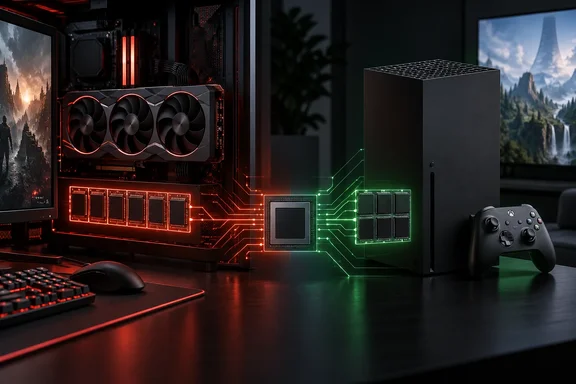
Radeon RX 6700 XT Is the Closest Desktop Match for the Xbox Series X GPU
The Xbox Series X, which Microsoft launched on November 10, 2020, runs on a semi-custom AMD system-on-a-chip. Microsoft's own spec sheet lists an eight-core custom Zen 2 CPU at 3.8 GHz (3.6 GHz with simultaneous multithreading enabled). It pairs that with a custom RDNA 2 GPU that has 52 compute units running at 1.825 GHz and is rated at 12 TFLOPS. SlashGear describes the semi-custom approach as a middle ground. AMD builds from its existing CPU and GPU designs, and partners such as Microsoft and Sony add some proprietary silicon of their own. This is much faster than designing a chip from scratch.
The RX 6700 XT uses the same RDNA 2 architecture in discrete desktop form. It launched in March 2021 at a $479 list price. It features 40 compute units (CUs) for a total of 2,560 RDNA 2 cores and is equipped with 64 ROPs—exactly half of the maximum configuration of the Navi 21 GPU, according to PC Gamer's launch review. The chip underneath is AMD's Navi 22. Tom's Hardware noted that RX 6700 XT uses the fully enabled chip with 40 CUs.
SlashGear's conclusion is that the 6700 XT is the Series X GPU's "closest relative" on both specs and performance, and the arithmetic backs that up. Keep the relationship clear, though. The Series X does not contain a 6700 XT. It contains a custom GPU built on the same architecture. SlashGear also calls the console GPU a pared-down Navi 21 that structurally resembles Navi 22. That's the outlet's own characterization, and AMD's and Microsoft's spec sheets don't confirm it.
Why 52 Compute Units at 1.825 GHz Lands Near 40 at 2.4 GHz
The two GPUs end up in the same performance range from opposite directions. The Series X has more compute units running at a lower, locked clock. The 6700 XT has fewer units running much faster. Theoretical FP32 throughput, the figure behind TFLOPS ratings, is roughly compute units times shader cores per unit times two operations per clock times clock speed. RDNA 2 packs 64 stream processors into each CU. It houses 40 Compute Units (CUs), with 64 stream processors per CU, giving a total of 2560, as KitGuru put it for the 6700 XT.
Here is what that formula gives for each chip:
| Xbox Series X GPU | Radeon RX 6700 XT | |
|---|---|---|
| Architecture | Custom RDNA 2 | RDNA 2 (Navi 22) |
| Compute units | 52 | 40 |
| Clock | 1.825 GHz, locked | 2,424 MHz game / 2,581 MHz boost |
| Rated FP32 | 12 TFLOPS | about 12.4 TFLOPS at game clock / 13.21 TFLOPS at boost |
| Memory | 16GB GDDR6, 320-bit, shared with CPU | 12GB GDDR6, 192-bit, dedicated |
| Bandwidth | 10GB at 560 GB/s, 6GB at 336 GB/s | 384 GB/s plus 96MB Infinity Cache |
The 6700 XT clock figures in the table come from AMD's launch specifications as reported by several outlets. PC Gamer lists a GPU Game clock: 2,424MHz GPU Boost clock: 2,581MHz, and TechPowerUp and KitGuru give the same 2,424 MHz game clock. Tom's Hardware put the card's raw theoretical performance at 12.4 TFLOPS at that clock. SlashGear's piece gives the 6700 XT's base-to-game clock as 2.321 GHz, which is lower than the 2,424 MHz AMD specified. Its 12.4 TFLOPS game-clock figure and 13.21 TFLOPS boost figure still match the official numbers.
Real-world clocks also hold up. PC Gamer wrote that the card was officially rated to 2,581MHz, we saw this card hit 2.4GHz in practice, on par with the listed Game Clock. So the comparison that matters is about 12.4 TFLOPS for the desktop card against 12 TFLOPS for the console. That's close enough to put them in the same class. Clock behavior is still different: SlashGear notes that the Series X runs at a fixed clock with no boosting or overclocking, while the 6700 XT boosts from the factory and can be pushed further if power and cooling allow.
Microsoft is also direct about the limits of TFLOPS as a number. Its Xbox Series X|S technology glossary defines TFLOPS as a measure of a GPU's raw math performance. It then argues that the console's real graphics gains over the Xbox One X come from more than that figure: RDNA 2's efficiency improvements plus features such as Variable Rate Shading and hardware-accelerated DirectX Raytracing. Two chips with similar TFLOPS can therefore still deliver different frame rates in a given game.
Xbox Series X Shares 16GB of GDDR6; the RX 6700 XT Keeps 12GB to Itself
Memory is where the comparison becomes least direct, and where most spec-sheet matchups go wrong. Microsoft lists the Series X with 16GB of GDDR6 on a 320-bit bus, split into two bandwidth tiers: 10GB at 560 GB/s and 6GB at 336 GB/s. That 16GB is the console's whole memory pool. SlashGear points out that the GPU, CPU and system functions all share it. Comparing "16GB" against the 6700 XT's "12GB" as if both were graphics memory gives a misleading result.
The 6700 XT takes a different approach. According to TechPowerUp, you now get 12 GB of GDDR6 memory, which is 50% higher than the 8 GB of the RX 5700 XT, but at 192-bit wide, the memory bus width is 25% narrower. AMD has tried to make up for this by using the fastest JEDEC-standard 16 Gbps GDDR6 memory chips, resulting in 384 GB/s bandwidth. On raw bandwidth alone, the console's fast 10GB tier is well ahead of the desktop card.
AMD makes up for the narrower bus with on-die cache. TechPowerUp describes a 96 MB fast cache on the GPU die that cushions memory access, and operates at 1.5 TB/s. PC Gamer's summary is that the 96MB of Infinity Cache is making up ground for a slim 192-bit bus. Tom's Hardware's reasoning at launch was that AMD halved the compute resources from the top Navi 21 chip but cut the cache by only a quarter, which should keep cache hit rates high, which means effective bandwidth — even from a 192-bit memory interface — should be much higher than the raw figure suggests. The Series X spec sheet doesn't list an equivalent Infinity Cache.
The two designs pay different costs. SlashGear frames it this way: the console's unified memory lets the CPU and GPU work from one pool, while on a PC the CPU, system RAM and graphics card are separate and data has to move between them, which adds latency. In exchange, the PC card has its full 12GB to itself and doesn't compete with game logic or the operating system for space.
Fixed Hardware Gives the Xbox Series X Its Optimization Edge
Even with matched silicon, the console keeps a software advantage. SlashGear's argument is that console developers aim at one fixed hardware target. PCs span several hardware generations and millions of configurations. On a console, developers can write low-level code close to the hardware with little overhead. On Windows, each game runs through extra layers: the operating system, a graphics API such as DirectX or Vulkan, and the vendor's driver.
Microsoft adds console-specific hardware on top of that. The Xbox glossary describes a dedicated hardware decompression block. Microsoft says it reduces decompression overhead at full SSD speed from more than three CPU cores to zero. It also describes Sampler Feedback Streaming, which loads only the parts of textures the GPU needs. Microsoft claims this works out to an average effective 2.5x multiplier on physical memory and SSD performance. Those are Microsoft's own figures. They help explain why a console can make 16GB of shared memory go further than the raw number suggests.
The feature gap is smaller on the rendering side. Both platforms support hardware-accelerated ray tracing and AMD's FidelityFX Super Resolution (FSR) upscaling. According to SlashGear, the real differences are cache, clock speeds and memory bandwidth. PC reviewers found the same limitation on ray tracing for this class of card. One spec roundup notes that on the RX 6700 XT performance drops by 30-40%, so enabling FSR is needed for comfortable gameplay with RT.
PC platforms have added some features that narrow the gap. SlashGear points to AMD's Smart Access Memory, AMD's branded version of the PCI Express Resizable BAR (Base Address Register) feature. It lets the CPU address the GPU's entire VRAM instead of a small window at a time. SlashGear says this can improve CPU-to-GPU efficiency and frame rates, which moves a PC a little closer to the console's shared-memory model. It does not give a PC true unified memory.
Building a Series X-Class Windows PC Around the RX 6700 XT
If you want roughly Xbox Series X-level graphics on a Windows PC, the RX 6700 XT is the right performance tier to aim for. Just don't expect it to match the console frame for frame. Among PC cards, PC Perspective placed it somewhere between an RTX 3060 Ti and RTX 3070, with higher performance possible in more AMD-friendly software titles. Those GeForce cards are the usual Nvidia reference points for the same class.
The GPU is only part of the console. The Series X has eight Zen 2 cores at 3.8 GHz, so a PC with the same graphics card and a much weaker CPU won't behave like the console in CPU-heavy games. That point is our inference from Microsoft's spec sheet, not a measured result. Settings matter too. Console games ship with fixed, developer-tuned presets, while PC games let you choose. A 6700 XT set to ultra won't be running the same workload as a console game in its optimized performance mode.
Power is the other practical difference. Notebookcheck, reporting AMD's launch specs, lists 96 MB of Infinity Cache and a Typical Board Power (TBP) of 230 W for the card alone. The complete console is a single sealed box, so a 6700 XT build will need a power supply and cooling sized for that load.
- The Radeon RX 6700 XT's roughly 12.4 TFLOPS at its 2,424 MHz game clock puts it closest to the Xbox Series X GPU's 12 TFLOPS, and it reaches that figure with 40 fast compute units instead of the console's 52 slower ones.
- Don't compare the console's 16GB against the card's 12GB. The Series X shares 16GB of GDDR6 between the CPU, GPU and system, in two bandwidth tiers (10GB at 560 GB/s and 6GB at 336 GB/s). The 6700 XT has 12GB dedicated to graphics at 384 GB/s, backed by a 96MB Infinity Cache.
- On a 6700 XT build, enable Smart Access Memory (Resizable BAR) if your platform supports it, since it's the PC feature most often cited as narrowing the CPU-to-GPU gap with consoles.
- Pair the card with a capable multi-core CPU. The Series X's eight-core Zen 2 processor at 3.8 GHz is part of its performance, and a GPU match alone won't reproduce it.
- Expect to use FSR upscaling when ray tracing is on. Reviewers report large ray-tracing performance drops on this class of RDNA 2 card, and consoles use upscaling and tuned settings in the same way.
- Treat any "console-equivalent PC" claim as game-specific. Fixed console hardware, low-level development and Microsoft's decompression and Sampler Feedback Streaming hardware mean identical silicon won't give identical results.
SlashGear sets this comparison against a coming shift. It reports rumors that Microsoft's next console, tentatively called Project Helix, could be a PC in all but name, and it describes Valve's Steam Machine as an actual PC in a GameCube-sized case. For now, the RX 6700 XT is the most practical way to think about current-generation Xbox graphics in PC terms. It sits in the same class as the Series X GPU without being a copy of it, and the console's fixed hardware and shared memory still let developers get more out of each teraflop than a Windows PC usually can.
References
- What AMD GPU Offers Xbox Series X-Level Performance? - SlashGear SlashGear · 2026-09-24T23:15:00+00:00
- AMD Radeon RX 6700 XT Review | TechPowerUp techpowerup.com
- Defining the Next Generation: An Xbox Series X|S Technology Glossary - XBOX Wire news.xbox.com