

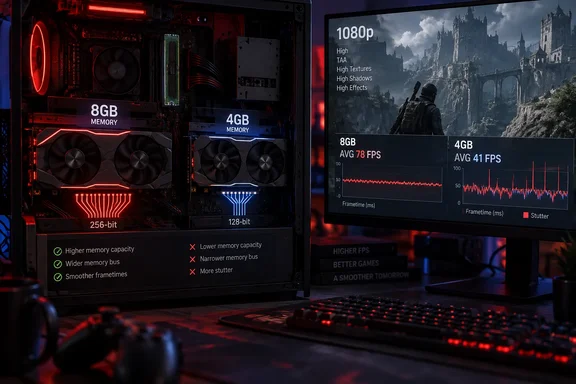
The distinction is important because AMD sells both under the Radeon RX 9050 family name, while reserving the 4GB model for system builders. Hardware Unboxed called the arrangement a “scam,” a deliberately loaded judgment. The underlying numbers support a narrower but still serious conclusion: AMD’s 4GB OEM part has a different memory subsystem, and buyers can receive substantially less gaming performance than the RX 9050 name alone implies.
The 4GB RX 9050 loses bandwidth as well as capacity
The major finding missing from the initial outrage is that this is not a clean VRAM-capacity comparison. AMD’s own specification pages list the Radeon RX 9050 with 8GB of GDDR6 memory on a 128-bit bus, 288 GB/s of peak bandwidth, and 32MB of Infinity Cache. The separately listed Radeon RX 9050 (4GB) has a 64-bit bus, 144 GB/s of bandwidth, and 16MB of Infinity Cache.
Both cards retain the same headline compute configuration: 16 compute units, 1,024 stream processors, 64 texture units, 64 ROPs, 16 ray accelerators, and clocks up to 2.6 GHz. That makes the product name technically defensible at the shader-count level. It does not make the two boards equivalent in games that need to move textures, geometry, frame buffers, and other assets through memory quickly.
Halving the bus and cache means the 4GB version starts at a disadvantage even before a game exhausts its local memory. Once a title does need more than 4GB, the card must lean more heavily on system RAM over PCIe, which introduces sharp frame-time problems that an average-fps number can understate. Lowering texture settings can reduce memory pressure, but it cannot restore the bandwidth and cache AMD removed.
That is why calling the issue “just 4GB VRAM” is incomplete. Four gigabytes is a restrictive ceiling for modern high-end game releases, especially at 1080p with current texture packs. But the RX 9050 4GB is also a slower implementation of the same GPU design, with half the memory throughput available to the 8GB product.
The average results are better than the worst games — and still troubling
Hardware Unboxed tested the two RX 9050 variants across 18 games. VideoCardz and VGTimes, reporting on those results, put the RX 9050 4GB at a 78 fps average at 1080p low, versus 107 fps for the 8GB RX 9050. That makes the 8GB card roughly 37% faster in the same test suite. At the lowest settings Hardware Unboxed used, the figures were 111 fps for the 4GB model and 147 fps for the 8GB card, a gap of about 32%.
Those averages are the needed corrective to claims that the card categorically cannot game at 1080p. It can run lighter games and less demanding competitive titles, and it can post playable average frame rates across a broad mixed test suite. A 4GB RX 9050 is not incapable of displaying modern games, nor is every owner automatically limited to 30 fps.
The problem is predictability. Buyers do not purchase a new desktop advertised for gaming on the assumption that it will work acceptably only in esports titles, older releases, or carefully selected settings. A modern GPU in a 2026 prebuilt should not require shoppers to research which new games will fall apart at the 1080p low preset.
The worst cases in Hardware Unboxed’s testing show precisely where the 4GB configuration stops making sense. Black Flag Resynced and Crimson Desert could not maintain 60 fps at 1080p low. In Space Marine 2, the card reached 59 fps only at minimum settings. Those are not claims that every game requires more than 4GB; they are evidence that the margin has already disappeared in a meaningful group of current releases.
A 78 fps average accompanied by 55 fps one-percent lows, as VideoCardz reports from the test data, also changes how the headline should be read. An average above 60 fps does not guarantee smooth play. The card’s weakest moments are the concern, and games limited by memory capacity or memory bandwidth tend to produce those moments in sudden, visible stutters rather than a stable lower frame rate.
OEM-only sales make the naming issue harder to spot
AMD’s RX 9050 4GB is not sold as a normal standalone graphics card. VideoCardz reported in July that AMD confirmed it had been developed for a partner system and would remain OEM-only, rather than entering the DIY retail channel. That decision places the burden of disclosure on prebuilt-PC listings and on buyers who may not know that an RX 9050 can mean two notably different memory designs.
AMD has at least made a formal distinction in its documentation. Its product and driver pages call the reduced card “AMD Radeon RX 9050 (4GB),” including the parenthetical capacity. The company’s Windows driver support also recognizes it as a discrete product. This is better than silently treating it as identical to the 8GB board in software documentation.
But that clarity needs to survive the trip from AMD’s website to retailer listings, marketplace search results, product stickers, and sales staff descriptions. A listing that says only “Radeon RX 9050” provides insufficient information. The capacity matters, but so do the attached specifications: 4GB, 64-bit memory interface, 144 GB/s bandwidth, and 16MB Infinity Cache identify the cut-down card. An 8GB, 128-bit, 288 GB/s RX 9050 is the materially different version.
Toasty Bros obtained a CyberPowerPC desktop with the 4GB model and found an XFX dual-fan card inside, according to VideoCardz. Its reporting also highlighted another complication for OEM buyers: that system shipped with a Ryzen 5 5500 and 8GB of single-channel DDR4 memory. Adding a second memory module and moving the graphics card to a faster platform improved some results.
That does not excuse the GPU’s limitations, but it does reinforce a broader rule about budget prebuilts. The graphics card cannot be assessed in isolation when the machine also has one memory channel, minimal system RAM, a slower CPU, or an undersized SSD. Those parts can compound the stutters that low VRAM already makes more likely.
A “gaming PC” label needs a usable baseline
AMD’s official RX 9050 4GB page promotes modern media features, DisplayPort 2.1a, HDMI 2.1b, AV1 encoding and decoding, PCIe 5.0 x16 connectivity, and support for current Radeon software features. Those capabilities have value for a display-output card, an office system that occasionally plays lightweight games, or a budget PC focused on older titles.
They do not establish a credible baseline for current AAA gaming at 1080p. Modern display standards and AI-assisted graphics features cannot overcome a 4GB frame buffer paired with 144 GB/s of bandwidth when the game itself needs more data than the card can hold or move efficiently.
Upscaling may help performance in some titles, particularly where the primary bottleneck is shader work. It is a less reliable answer to severe memory limits. Rendering fewer pixels can reduce some pressure, but texture allocation, game-engine streaming behavior, cache constraints, and the bandwidth penalty remain. Buyers should regard upscaling as an option to test, not as a promise that turns a 4GB card into an 8GB model.
The comparison with Intel’s Arc B570 is also uncomfortable for AMD. Hardware Unboxed’s figures, as reported by VideoCardz, put the Arc B570 at 112 fps in the 1080p-low comparison — about 44% ahead of the 4GB RX 9050’s 78 fps. Exact availability and whole-system pricing will vary by region and prebuilt configuration, but the result makes one point plain: the RX 9050 4GB is not merely losing to its better-equipped sibling. It is leaving enough performance on the table for alternatives to look fundamentally better suited to the job.
What prebuilt buyers should verify before purchase
The practical response is not to reject every RX 9050 system automatically. It is to stop treating the GPU name as the full specification. The 8GB RX 9050 is itself an entry-level card, but it avoids the 4GB version’s halved memory path and delivered a substantially higher result in Hardware Unboxed’s comparison.
Before buying a desktop advertised with Radeon RX 9050 graphics, shoppers should insist on the complete configuration in writing:
- The listing should state whether the card is the Radeon RX 9050 (4GB) or the 8GB RX 9050.
- The specification should identify a 64-bit, 144 GB/s memory design as the 4GB model, while the 8GB model uses a 128-bit, 288 GB/s interface.
- The system should have at least two installed memory modules or an explicit dual-channel configuration, rather than a lone 8GB DDR4 stick.
- The seller should identify the CPU, total RAM, storage capacity, and power-supply specification instead of relying on the graphics-card badge as the sales pitch.
Hardware Unboxed’s “scam” language reflects the mismatch between the shared RX 9050 branding and the scale of the downgrade. AMD’s records show that the company does distinguish the 4GB model in formal specifications. The risk is that buyers encounter the distinction only after the purchase, when a new prebuilt struggles with the games it was bought to play.