

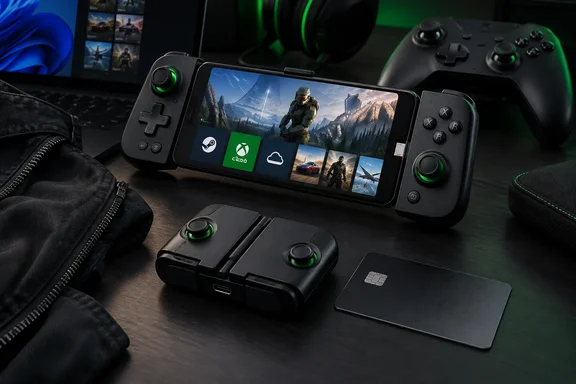
The headline feature is real, but the language around it needs tightening. The Prio folds to a credit-card-like footprint, not credit-card dimensions: Razer’s own support documentation lists it at 107 × 67 × 32 mm when its band cover is included, or 23 mm thick without it. That makes it small enough for a jacket, cargo, or many front pockets, but still substantially thicker than a wallet card. The meaningful achievement is that Razer has put a conventional two-stick layout, D-pad, face buttons, bumpers, triggers, and menu controls into something that is far less awkward to bring along than a rigid telescopic controller.
For PC gamers, the consequence is straightforward. The Prio may be the more practical controller for short remote-play sessions, but it is not a replacement for a full-size gamepad or a larger phone controller during a long flight, an RPG grind, or competitive shooters. Independent hands-on reviews from Windows Central, Android Central, and CGMagazine broadly agree on that point: portability is the product’s strongest advantage, while the compact controls and limited grip space become more noticeable over longer sessions.
A folding mechanism changes what “portable” means
The Prio uses two controller halves that slide and rotate around an elastic bridge. The right section slides to unlock the assembly, then swivels into position before the phone is inserted through the USB-C connector and held by the opposite side. Razer calls the result a palm-sized controller; 9to5Google’s measurements-based description is more useful: its height and width are only modestly larger than a credit card, while the depth remains the unavoidable trade-off.
That mechanism is more than a visual trick. Existing telescopic controllers are portable in the literal sense, but many are objects users decide to leave at home because they occupy a bag compartment or need a case to protect their sticks and buttons. The Prio folds inward, which also shields the controls when it is stored. Windows Central’s Daniel Rubino reported that the folding sequence was initially unintuitive but became routine after repeated use, while CGMagazine similarly found the unlock-and-swivel process simple once learned.
The Prio is therefore aimed at a different behavior than Razer’s larger Kishi models. A Kishi V3 Pro is designed to make a phone feel closer to a handheld console. The Prio is designed to disappear until there is a spare 10 or 20 minutes. Razer’s marketing leans hard on commuting and waiting rooms, but the better framing for Windows users is remote access: it lowers the friction between having a capable gaming PC at home and actually using it from a phone away from the desk.
Razer’s own support instructions are worth reading before purchase because the form factor has consequences. The controller does not simply stretch open in the familiar Kishi style; it must be slid, rotated, connected, and snapped around the handset. Users who swap controllers often or expect a one-handed deployment will find the extra motion less elegant than the promotional renders suggest.
It has a complete layout, not full-size controls
Razer describes the Prio as delivering “full-sized” controller controls. The documentation supports the first half of that idea: it has a complete layout. There are clickable capacitive thumbsticks, a tactile four-way D-pad, ABXY face buttons, L1/R1 bumpers, L2/R2 triggers, Menu, Options, Home, and a dedicated Razer Cortex Mobile button.
What independent testing does not support is reading “full-sized” as “the same physical experience as an Xbox Wireless Controller, DualSense, or Kishi V3 Pro.” Windows Central found the sticks noticeably smaller than traditional controller sticks, described the triggers as usable but unusual and clickier than expected, and reported greater hand fatigue after roughly an hour than with a larger Kishi. CGMagazine reached a similar conclusion, noting that the Prio has little meaningful hand grip and is best suited to short sessions, especially for players with larger hands.
Android Central was more positive on the stick feel, saying Razer’s small capacitive sticks performed unusually well for their size in games including The Witcher 3 Remastered through GeForce NOW and Fortnite. That is encouraging, but it is still a test result rather than proof that the sticks will satisfy every genre or every player. Small sticks reduce the physical distance available for fine movement; whether the Prio feels precise enough will depend heavily on sensitivity settings, the game’s controller implementation, and the user’s habits.
The capacitive stick design deserves attention because it is the unusual hardware choice here. Razer says its contactless sensing eliminates the mechanical contacts that wear in conventional analog stick assemblies, which is intended to reduce drift risk. That is a credible engineering rationale, and reviewers have found the sticks responsive. But “drift-resistant” should not be read as a lifetime guarantee: Razer has not published long-term durability data, a rated operating life, repair guidance, or a failure-rate comparison against Hall-effect or conventional potentiometer designs.
For buyers deciding between the Prio and a larger controller, the honest choice is not features versus missing features. The Prio preserves the expected inputs, but its ergonomics are deliberately reduced to achieve its folded size.
USB-C removes one problem and creates another
The Prio connects directly over USB-C. That avoids Bluetooth pairing, avoids input-device battery management, and should eliminate the intermittent reconnection issues that can derail a remote-play session. Razer officially lists iPhone devices running iOS 18 and later, along with Android 14 and later, as supported platforms.
For Windows players, the direct connection is useful with Steam Link and Razer PC Remote Play, both of which depend on the phone and home PC being configured correctly but benefit from a standard controller appearing immediately once the handset recognizes it. Razer also lists Xbox Cloud Gaming and PlayStation Remote Play as supported services. The controller itself does not turn unsupported games into controller-compatible games; software support remains dependent on each game or streaming service.
The no-battery design is an advantage for an accessory meant to live in a pocket. It is also why the Prio’s power arrangement deserves more scrutiny than it has received in early coverage. The controller draws power from the connected phone, and the submitted hands-on report says there is no pass-through charging. Razer’s consumer product page emphasizes that the Prio requires no charging, but it does not prominently state the absence of a charging port or quantify the controller’s impact on phone battery life.
That omission matters most for the people likely to use the controller for PC streaming. A short session on a train or in an airport lounge fits the Prio’s design. A long session with a game streaming over Wi-Fi or cellular data consumes phone power quickly, and without pass-through charging the user must choose between a cable-free controller session and recharging. The lack of pass-through is not disqualifying for a pocket controller; it is a design boundary buyers should understand before treating it as a travel controller for extended play.
Cases and foldables are the compatibility traps
Razer advertises compatibility with phones up to seven inches and says the Prio works with most common cases. Its support page is more precise: cases thicker than 14.5 mm should be removed. That number is close to the 15 mm claim repeated in launch coverage, but it is not a universal guarantee. Camera bumps, asymmetrical cases, straps, and reinforced corners can matter as much as nominal thickness.
Razer ships removable rubber cushions to adjust the fit, and Windows Central reported successful use with a Samsung Galaxy S26 Ultra in a Pitaka case after changing or removing the pads. CGMagazine also found that slim-to-medium cases could fit using the supplied brackets. Those are useful real-world confirmations, but they are not a compatibility matrix. Buyers with a thick protective case should assume they may need to remove it.
Foldables need even more caution. The submitted review could not fit a Galaxy Z Fold 8 in the phone’s folded, passport-style orientation and also encountered setup trouble. Windows Central had better results with a Galaxy Z Fold7 when it was opened into tablet mode, though it described that arrangement as clunky. The reports are not actually contradictory: the Prio’s physical geometry favors a conventional wide phone or a foldable used open in landscape, rather than a tall narrow folded device.
Razer’s official pages do not provide a foldable-device compatibility list. Until it does, owners of Galaxy Z Fold-class devices should regard compatibility as conditional rather than assumed.
The $99.99 comparison is less flattering than the design
The Prio costs $99.99 in the United States. That price is not a portability premium over Razer’s current basic Kishi V3; 9to5Google reports the two share the same list price. The submitted report instead compares the Prio with the older Kishi V2, but that is no longer the useful same-generation comparison.
At the same price, buyers are choosing a purpose-built compromise rather than getting an obvious bargain. The Prio’s case is stronger if a controller must fit in a pocket every day. The Kishi V3-style approach is stronger if comfort, grip, and longer gaming sessions matter more than storage volume. Moving up to Razer’s Kishi V3 Pro changes the question again, adding a more substantial form factor and higher-end features at a higher cost.
Razer has made a credible new category of accessory here: one that keeps a physical controller close enough to hand that it might actually be used. The caveat is equally concrete. The Prio earns its $99.99 only if its folded dimensions solve a real carrying problem; otherwise, a larger controller will be easier on hands, provide a more conventional trigger and stick experience, and better suit long sessions connected to a Windows PC.
References
- Razer squeezed a full controller into something that fits in your pocket MakeUseOf · 2026-09-17T22:00:14+00:00