

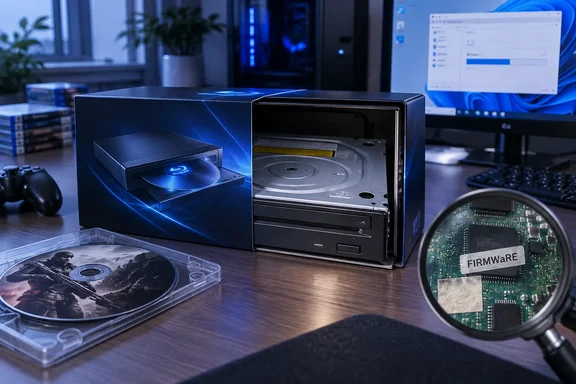
In a social media post dated September 30, 2026, Tom's Hardware reports, the developers described "a recent influx of fake Blu-ray drives." They said the fakes put older drives that can't read PS3 discs inside the enclosures and packaging of higher-end models, and add spoofed firmware. The post linked to a Redump wiki page with photos and guidance on spotting fakes.
What the RPCS3 team actually said
The warning is short but specific. Counterfeiters are allegedly doing three things:
- Swapping the hardware: an older optical mechanism that can't handle PS3 discs goes inside.
- Swapping the outside: that hardware ships in the enclosure and retail box of a more desirable model.
- Spoofing the firmware: the drive identifies itself as something it isn't.
The firmware part is what makes this nasty. A drive that announces itself as a sought-after model will pass a casual look in Device Manager. The case is a costume, and now the drive is lying about who it is too.
Tom's Hardware says warning signs include misspelled words on the drive label, misaligned logos, wrong manufacturing dates and covered-up PCB markings. According to the outlet, the linked wiki specifically warns against buying from the Newegg and AliExpress marketplaces, and RPCS3's general advice is to buy only from stores with good buyer protection.
Section summary: RPCS3 says counterfeiters are passing off older, PS3-incompatible drives as premium models, using fake packaging and spoofed firmware.
Why a PS3 emulator team cares about your optical drive
Any Blu-ray drive can play a movie, but very few can read PS3 game discs. RPCS3's quickstart guide says that to read PS3 discs fully, a drive needs a MediaTek chipset and a +6 read offset. Desktop dumping also only works when a matching .ird decryption file exists for the disc. The guide says plainly that this method won't work with standard Blu-ray drives.
The project publishes a list of known-compatible models from LG, ASUS, Samsung, LITE-ON, Sony and BenQ. Some entries are limited to certain revisions, such as "some revisions" of the LG WH12LS30 and ASUS BC-12B1ST. That's what makes counterfeiting pay: a model number on a list is worth money, and a cheap drive with that label attached can be sold at the premium price.
Demand has also grown recently. The Redump preservation project's wiki says that on February 18, 2026, developer RibShark released the OmniDrive firmware for MediaTek MT1959-based Blu-Ray drives manufactured by Hitachi-LG Data Storage (HLDS). Redump says it is highly recommended by Redump for drives that are compatible with it. Notebookcheck described OmniDrive as open-source custom firmware that lets people dump and preserve their own GameCube, Wii, Xbox, PlayStation, and other disc-based games. A specific MediaTek chipset suddenly became something preservationists actively hunt for, and that's exactly the kind of demand counterfeiters follow.
Tom's Hardware adds a wider market point: after 20 years of commercial availability, fewer brands make Blu-ray players and PC drives. At the same time, high HDD and SSD prices in 2026 are pushing more enthusiasts toward Blu-ray for storage. Shrinking supply and rising demand make a good market for fakes.
Section summary: PS3 disc reading depends on specific MediaTek-based drives, and this year's OmniDrive firmware has made those drives more sought after. That gives counterfeiters a reason to fake them.
How to check a drive before (and after) you buy
The Redump OmniDrive wiki page has a buyer's guide that addresses fakes directly. Here's what it says, along with RPCS3's guidance, as a practical checklist.
- Check the exact model and revision against RPCS3's compatibility list. Brand and product line aren't enough. Some listed models are only compatible in certain revisions.
- Look at the manufacturing date, but don't trust it on its own. For half-height desktop drives, Redump lists drives made before 2015 as guaranteed incompatible with OmniDrive. It also warns that some fake drives will use a more recent manufacturing date than their hardware would suggest, and calls the date the weakest evidence that the drive is compatible.
- Read the label closely. For slim laptop drives, Redump notes that fakes can carry misspelled words on the drive label due to OCR errors. Its examples include "Blu-DVD" where "Blu-Ray DVD" should appear, and a misspelled "The Netherlands."
- Check the chipset with MakeMKV. Redump's OmniDrive guidance says a drive is guaranteed incompatible if MakeMKV identifies it as an MT1939 chipset or doesn't identify it at all. MT1959 isn't a guarantee either: Redump notes reports of one drive identified as MT1959 being incompatible.
- Look for covered or tampered PCB markings and crooked logos, the other signs Tom's Hardware lists.
- Buy where you can return it. If a drive fails these checks, buyer protection is what gets your money back.
None of these checks is conclusive alone. A label with perfect spelling doesn't prove a drive is genuine, and the evidence so far gives no single test that authenticates every unit. Treat the checks as cumulative.
Section summary: Check the model and revision, the label, the chipset as MakeMKV reports it, and the PCB. Above all, buy from a seller that will take a return.
Don't blame the emulator (or the whole marketplace)
Two caveats keep this in proportion.
First, a fake drive doesn't mean RPCS3 is broken. If a "compatible" drive won't read your PS3 disc, check the hardware before you start digging through emulator settings or filing bug reports. Tom's Hardware suggests a supposedly compatible drive that fails with the emulator may itself be a sign of a fake. RPCS3's guide also recommends dumping your own discs on a PS3 console as the most compatible route, so a drive isn't the only option.
Second, the Newegg and AliExpress warning is about marketplace listings, not proof that every drive on those sites is counterfeit. Nothing published so far says how many fakes are in circulation or which sellers are involved. Third-party marketplaces have long had trouble keeping fake storage hardware out, from counterfeit flash drives to relabeled hard disks, so the advice is sensible. But it's a reason to be careful, not a verdict on either retailer.
The bigger picture
This is a familiar pattern. Once enthusiasts need a specific piece of hardware, a particular chipset or firmware platform or revision, counterfeiters follow. Old PC Blu-ray drives were nearly forgotten hardware until preservation tools gave the right chipsets real value. Now the people buying them have to check drives as carefully as they already check CPUs, GPUs and SSDs on gray-market listings.
If you're planning to build a PS3 dumping setup on Windows 10 or 11, get the drive from a reputable seller with an easy return policy. Run the chipset check as soon as it arrives, and test it with one of your own discs while the return window is still open.
References
- PS3 emulator devs warn of fake Blu-ray drives on Newegg and AliExpress Tom's Hardware · 2026-10-01T12:30:00+00:00
- OmniDrive turns PC Blu-ray drives into legal retro-game dumpers - Notebookcheck News notebookcheck.net
- RPCS3 - Quickstart rpcs3.jackkks.beget.tech