

What happened
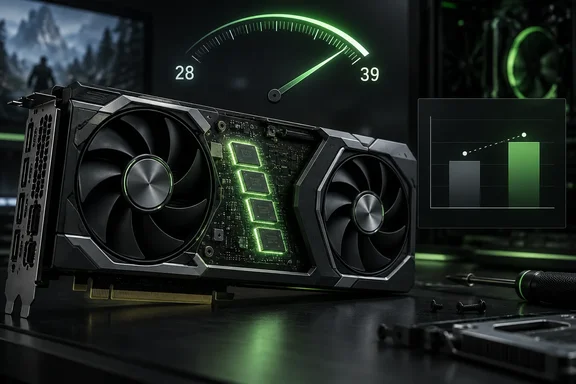
VideoCardz reports that RTX 5070 Ti owners have found that mVolt+ Extreme can remove the usual memory overclocking limit and push some GDDR7 modules well beyond 36 Gbps. The headline result comes from one Gigabyte RTX 5070 Ti Windforce owner who reports running Samsung 28 Gbps GDDR7 at 39 Gbps with a +5500 MHz memory offset.
Several other outlets have picked up the same claim, including TweakTown, Wccftech, OC3D and Hardware.com.br. All of them trace it to one Reddit user. TweakTown names the source: Sad-Victory-8319 on the Overclocking subreddit discovered that their GDDR7 memory on a GIGABYTE RTX 5070 Ti achieved a whopping +5500MHz offset. That means every outlet is repeating one person's report. No outlet has tested it independently.
In short: one owner used a third-party tool to run 28 Gbps Samsung GDDR7 at a reported 39 Gbps, and other owners say they've reached similar settings.
The bandwidth math
The bandwidth numbers are easy to check. The RTX 5070 Ti uses a 256-bit memory interface. At its stock 28 Gbps speed, this provides 896 GB/s of theoretical bandwidth. Raising the memory to 34 Gbps increases this to 1088 GB/s, while 39 Gbps corresponds to 1248 GB/s, or around 39% more bandwidth than stock.
Here are the figures for each speed on the 256-bit bus. The 36 Gbps row is our own calculation:
| Data rate | Theoretical bandwidth | vs. stock |
|---|---|---|
| 28 Gbps (stock) | 896 GB/s | — |
| 34 Gbps (+3000 MHz) | 1,088 GB/s | ~+21% |
| 36 Gbps (+4000 MHz) | 1,152 GB/s | ~+29% |
| 39 Gbps (+5500 MHz) | 1,248 GB/s | ~+39% |
The table also shows that each +1000 MHz of offset adds roughly 2 Gbps of effective data rate. Knowing that helps when you read offset numbers in forum posts.
TweakTown points out that 1,248 GB/s is over 200GB/s more memory bandwidth than what an RTX 4090 achieves stock. That's eye-catching on a spec sheet. Keep in mind that this is peak interface bandwidth, not how fast games actually run.
Why the software limit matters
The jump in results comes from the tool's controls, not from any change to the hardware. Most common overclocking tools allow up to a +3000 MHz memory offset on this card, equivalent to 34 Gbps. Hydra Pro can reportedly extend this to +4000 MHz, or 36 Gbps, while mVolt+ Extreme allows higher values through its extended tuning controls. TweakTown names MSI Afterburner as one of the tools capped at +3000 MHz, and describes mVolt+ Extreme as a third-party overclocking utility purpose-built to unlock overclocking headroom beyond NVIDIA's official limitations.
Hydra's 36 Gbps option is fairly recent. In August, VideoCardz covered the Hydra 2.3B Pro release, which raised the GDDR7 limit to 36 Gbps across the RTX 50 series. Its developer, 1usmus, said the feature needed no VBIOS flash, no modified driver and no security exploit.
mVolt+ has pushed limits before. Wccftech notes the tool has been shown to unlock up to 700W of TDP for the GeForce RTX 5090 without shunt modding, which typically maxes out at around 600W on stock.
The 39 Gbps report is also different from Teclab's March demonstration. That Brazilian team pushed a GALAX RTX 5070 Ti past 36 Gbps with a lab hardware modification that changed the reference used for clock management. VideoCardz said at the time that ordinary users couldn't reproduce it. The new result is a software-only report, so the two shouldn't be compared directly.
In short: the GDDR7 chips probably had headroom all along. Mainstream tools just didn't let users reach it.
Results vary from card to card
The original tester found a clear limit: the Reddit user reached +5500 MHz before a +6000 MHz setting immediately caused the graphics driver to restart. Others reported different ceilings. An ASUS Prime RTX 5070 Ti reached about +4500 MHz; another Gigabyte unit ran stable at +5000 MHz. VideoCardz adds that a second user confirmed +5500 MHz but saw artifacts above that point.
The subheading on the VideoCardz story mentions SK Hynix results. However, the 39 Gbps result comes specifically from Samsung memory, and the reporting doesn't show a Hynix card hitting the same speed. Don't assume every 5070 Ti will match it, whichever memory it uses. In its Spanish-language coverage, Fanáticos del Hardware explains why: the tool can remove or raise a software-imposed limit, but stability still physically depends on the memory, the controller, the power delivery and the GPU itself.
RTX 5090 owners hit a lower limit
Owners of the bigger card have reported a lower ceiling, oddly enough. RTX 5090 owners in the Overclock.net thread are reporting a different ceiling despite also using 28 Gbps GDDR7. One user got to +3999 MHz, found a way around the interface to set +4000 MHz, and still had driver resets above that. VideoCardz says the reason isn't clear yet. These are anecdotes from different users. They don't prove that the 5070 Ti has more inherent headroom.
How much faster are games?
Not much faster. The original tester says Cyberpunk 2077 with path tracing gained roughly 1 FPS for every additional +1000 MHz memory offset. That would put the total gain from stock to +5500 MHz at roughly 5 to 6 FPS in that specific test. The reports don't give a baseline frame rate, so we can't turn that into a percentage. Another user saw about 1.5% to 2% more performance in 3DMark Speed Way going from +3000 to +5000 MHz.
There is one more upbeat claim. Brazil's Adrenaline says the in-game gains were modest, but an exception was a 20% gain observed in Steel Nomad. We couldn't verify the run settings behind that number. Treat it as a single synthetic-benchmark result, not something you should expect in games.
Our analysis, based on general GPU knowledge: a 39% increase in bandwidth only translates into frame rate when the GPU is actually waiting on memory. Most games are limited by shader throughput, ray tracing hardware or the CPU, so extra memory speed often goes unused.
What this means for RTX 5070 Ti owners
The following is our guidance, based on general industry practice. None of it comes from tested procedures in the reporting:
- Not crashing isn't the same as stable. A short run at a high offset doesn't prove the memory is working correctly. Artifacts and driver resets are only the obvious failures.
- Run benchmarks at each step. Modern GDDR memory can retry failed transfers, so an unstable overclock may lose performance before it shows any visible errors. If a higher offset gives the same or a lower score, back off.
- Weigh the payoff. VideoCardz itself says the added stability and hardware risks are difficult to justify because the gains are usually small. TweakTown also warns that the utility bypasses NVIDIA's limits, so overclocking carries risk.
- Check your warranty terms. No source here says how tools like this affect warranty coverage, so check your card maker's policy before you experiment.
Bottom line
The 39 Gbps result shows that the RTX 5070 Ti's Samsung GDDR7 has much more headroom than standard tools allow. It also shows how little that headroom matters for frame rates. Benchmark hobbyists will find it interesting. Everyone else gains a few frames in path-traced Cyberpunk and takes on stability and hardware risk on an expensive card.
If you've experimented with mVolt+, Hydra or Afterburner on Blackwell cards, the GPU overclocking and NVIDIA driver forums are a good place to compare memory vendors and offsets.
References
- GeForce RTX 5070 Ti GDDR7 memory has been overclocked from 28 to 39 Gbps - VideoCardz.com VideoCardz.com · 2026-09-30T07:30:54+00:00
- Overclocker Pushes RTX 5070 Ti GDDR7 Memory To 39 Gbps With A +5500 MHz Memory Offset, Yet Games Gain Barely 5 FPS wccftech.com
- Usuário quebra limite de overclock da RTX 5070 Ti e passa de 28 para incríveis 39 Gbps de memória - Hardware.com.br hardware.com.br