

For PC gamers, the useful distinction is between the reported sequence and its proposed explanation. A crash followed by persistent startup problems warrants hardware investigation; it does not, by itself, identify the software, component or electrical fault responsible.
What the owner reported
According to VideoCardz’s account of Reddit user “wax469,” the MSI GeForce RTX 5080 16G Ventus 3X had worked normally for about a month and had never been overclocked. The owner was already running a heavily modified installation of GTA V Legacy, including the LSPDFR police modification, before adding the unofficial DLSS 5 injection.
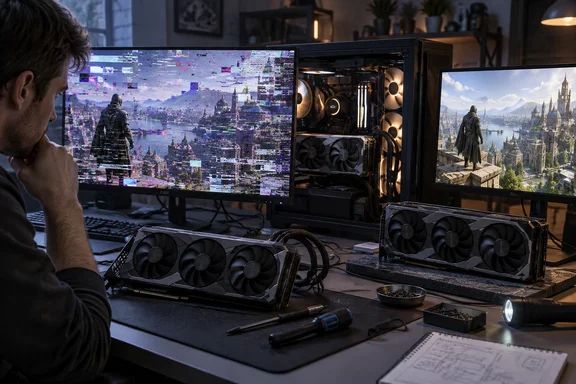
VideoCardz reports that the game ran at roughly 80 frames per second for about five minutes before the display froze and began flashing, leaving the PC unresponsive. That timing and frame-rate claim also appear in a Collector republication of Chinese-language coverage, but the repetition provides no independent hardware diagnosis.
The most consequential detail concerns what happened after the forced shutdown. VideoCardz reports that:
- The PC would no longer start properly with the RTX 5080 installed.
- Removing the card and using the Ryzen 9 9950X3D processor’s integrated graphics allowed the system to start normally.
- Reinstalling the RTX 5080 brought the problem back.
- A replacement RTX 5080 of the same model subsequently worked normally.
Those observations, if accurately reported, implicate the original graphics card or its interaction with the system more strongly than an isolated game crash would. They still do not establish which component failed or why. VideoCardz and Wccftech both trace the incident to the same owner’s account; their coverage is not two independently reproduced failures.
“Fried” goes beyond the available diagnosis
Wccftech characterizes the card as “fried” and proposes a power-related explanation. Its report also acknowledges that the owner had not supplied photographs demonstrating the suggested burn damage.
That leaves an important boundary: a card that stops functioning is not necessarily a card with a burned power connector. The reported symptoms establish neither visible thermal damage nor excessive electrical draw.
VideoCardz offers a different interpretation, saying the visible corruption resembles artifacts associated with unstable or failing graphics memory. That is an observation about the appearance of the failure, not a confirmed memory diagnosis. The outlet also raises the possibility that the workload exposed an existing manufacturing or component defect.
Wccftech connects the incident to separate RTX 5090 power-consumption reporting. Even if those measurements accurately describe the tested RTX 5090 configurations, they cannot establish what this RTX 5080 consumed when it failed. No case-specific power measurement or manufacturer diagnosis accompanies the causal claim.
The replacement’s reported stability without the injector is reassuring for the owner, but it does not resolve the cause: both the physical graphics card and the software configuration changed.
This was an unofficial GTA V implementation
VideoCardz explicitly describes the GTA V setup as an unofficial DLSS neural-rendering injection, rather than an NVIDIA-released implementation for that game. Readers should therefore avoid treating this incident as a demonstrated failure of an officially supported GTA V feature.
The exact injector and version are not established in the available reporting. That omission prevents a meaningful determination of which code ran or whether other users have the same configuration. A download advertised as “DLSS 5” is not, on that description alone, evidence of an official integration or a validated installation method.
For someone considering the same experiment, this account supplies no verified safe injector, installation procedure or configuration. It supports caution about an unverified software path, not a conclusion that DLSS 5 universally damages RTX 5080 cards.
The replacement does not prove the warranty was void
Wccftech reports that the owner received a replacement within a few weeks. It does not establish the applicable warranty terms, the service provider’s diagnosis or whether unofficial software affected the replacement decision.
Consequently, describing the owner as fortunate to receive a replacement despite a void warranty overstates the record. A replacement was reportedly supplied; warranty invalidation was not demonstrated. Nor does this outcome guarantee that another owner’s claim would receive the same treatment.
The concrete outcome is narrower than the headline: one owner reports a card failure during an unofficial DLSS 5 experiment, followed by a successful replacement. The failure deserves attention, but neither software-induced burn damage nor automatic loss of warranty coverage has been established.
Update: Later report identifies the alleged injector setup (September 21, 2026)
MakeUseOf reports that the owner used a community-sourced DLSS 5.0.1 file with the ReoDx wrapper, manually replacing GTA V’s DLSS DLL and forcing compatibility through the wrapper’s configuration tool. The report also says the failure occurred on the second day of testing that modded configuration, alongside visual modifications including LSPDFR.
Those details narrow the previously unknown software setup, but they still originate from the same Reddit account rather than a vendor investigation or independently reproduced test. They do not establish whether the injected DLL, wrapper, other mods, driver behavior, or an underlying defect was responsible.
MakeUseOf likewise notes that there is no proof the unofficial DLSS installation caused the RTX 5080’s failure. For Windows gamers and IT troubleshooters, the practical takeaway remains to isolate changes: remove unofficial rendering wrappers and mods, test stock drivers and game files, and document whether failures persist before assigning a software cause.
References
- RTX 5080 User Claims His GPU Fried After Using DLSS 5 In GTA 5; Unofficial Software Injection Would Have Voided Warranty, But He’s Lucky To Receive A Replacement Wccftech · 2026-09-21T10:22:35+00:00
- A Reddit user's RTX 5080 died after installing unofficial DLSS 5 in GTA 5 MakeUseOf · 2026-09-21T14:47:35+00:00
- Redditor says his RTX 5080 died after trying DLSS 5 in GTA V - VideoCardz.com videocardz.com