

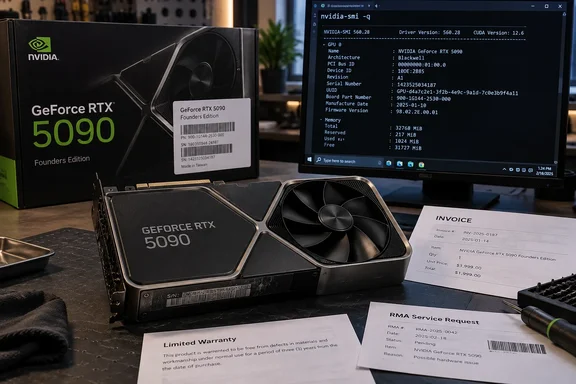
The important part is not yet that NVIDIA has adopted a blanket policy of denying claims over faded markings. It has not publicly announced one. The immediate problem is narrower and more practical: an identification marking placed on hardware that must be installed, removed, and serviced may become difficult to read before a three-year warranty expires—and a customer says that was enough to stop their claim.
Owners of RTX 5090 and RTX 5080 Founders Edition cards should treat the physical serial number as warranty evidence, not a detail to check only when something fails. Photograph it now, preserve the box label and proof of purchase, and save the GPU’s software-reported identifiers while the card still works.
One RMA claim, with important limits
The Reddit poster, using the name Willing-Avocado-4830, says their RTX 5090 FE developed black-screen crashes during high-load use and was sent to NVIDIA under RMA. The poster says NVIDIA held the card for more than 30 days, notified them of a rejection on September 11 without initially explaining why, then said on September 14 that the unreadable physical serial number was the reason.
Those details remain an unverified customer account, not a public statement by NVIDIA or a published service-policy document. The post includes an RMA number and incident number, but NVIDIA has not independently confirmed the decision, the condition of the returned hardware, or whether additional facts affected the claim.
That distinction is especially necessary here because the symptoms described—black screens under sustained load—can arise from several places besides a defective GPU. Driver faults, unstable overclocks, PCIe power delivery, a compromised 16-pin connection, a power-supply issue, an unstable system memory profile, or a display-driver reset can all produce failures that look similar from the Windows desktop.
Still, the identification issue is independently worth watching. Other commenters in the same Reddit thread posted photos or accounts of RTX 5090 and RTX 5080 Founders Edition serial markings that they said had become faint. One commenter reported that NVIDIA approved an RMA after the owner supplied packaging evidence. That does not establish a pattern of denials, but it does show that the reported outcome may not be handled consistently.
TweakTown also reported the incident on September 15, but it cites the same Reddit discussion. That is follow-on coverage, not independent corroboration. At present, there is no public record of a broader NVIDIA recall, service bulletin, or confirmed manufacturing-defect finding involving RTX 50-series serial-number markings.
NVIDIA’s warranty says proof of purchase matters
NVIDIA’s current U.S. Founders Edition warranty page explicitly lists the GeForce RTX 5090 Founders Edition and promises a three-year warranty from purchase for manufacturing defects or hardware component failures. It says NVIDIA will repair a defective product or replace it when repair is not possible. The warranty page also limits coverage for problems caused by misuse, unauthorized servicing, shipping damage, and other excluded conditions.
What the page does not spell out is how NVIDIA resolves a claim when a physical serial number has become illegible while the customer has matching retail packaging and purchase documentation. Nor does it publish a standard requiring that a particular printed serial marking remain readable as a condition of coverage.
That omission is the gap exposed by this complaint. A serial number is a reasonable anti-fraud control: NVIDIA needs a way to confirm that a returned card is the same product covered by the claim. But a marking that wears away through ordinary ownership creates a conflict between the vendor’s verification process and the customer’s ability to prove they own the covered card.
NVIDIA’s own Founders Edition support material tells buyers to retain their sales receipt because Customer Care may request proof of purchase to validate eligibility for the three-year warranty. The affected owner says they did exactly that. Whether the invoice, retail box, and card could be conclusively matched is unknown from the public record, but the published warranty materials make those records relevant—not disposable packaging.
For the UK purchaser at the center of the report, the manufacturer warranty is also not necessarily the end of the matter. The UK Consumer Rights Act 2015 provides statutory remedies for goods that do not conform to the contract, including repair or replacement within a reasonable time and without significant inconvenience where the requirements are met. That is separate from deciding whether NVIDIA’s voluntary warranty process accepted this particular RMA, and it does not establish that the customer’s claim will prevail. It does mean a rejected manufacturer RMA should not automatically be treated as the final consumer-rights answer.
Software can preserve an identity record before a failure
There is a useful technical wrinkle. NVIDIA documents nvidia-smi, its NVIDIA System Management Interface utility, as a tool that can report GPU attributes. Its documentation describes the board serial number as a globally unique, immutable value that matches the serial number physically printed on the board.
That does not guarantee every GeForce configuration will expose every field; NVIDIA’s documentation warns that unsupported data can appear as N/A, and GeForce support in the utility is more limited than on its enterprise products. It also cannot help much after a card has failed so completely that Windows can no longer initialize the NVIDIA driver.
But for a working card, it is worth capturing the output of:
nvidia-smi -q
Save the resulting text alongside photographs of the card’s external marking, the serial label on the original box, invoice or order-confirmation documents, and the GPU’s UUID. The UUID is not the same thing as the board serial number, but it is another persistent identifier that can help establish continuity of ownership and system configuration.
For a Windows workstation used for professional work, keep the evidence outside the PC as well: cloud storage, an encrypted archive, or a copy attached to your asset-management record. A serial number written into a spreadsheet after the fact has less value than a dated photo showing the card in the system and a contemporaneous command output.
Do not disassemble a Founders Edition card merely to hunt for an internal label. The Reddit thread includes claims that another serial label may exist on the modular PCIe portion of the card, but those claims are not established by NVIDIA documentation reviewed for this report. More importantly, opening the card creates an avoidable dispute over handling or unauthorized service precisely when the goal is to preserve warranty coverage.
What RTX 50 Founders Edition owners should document now
A few minutes of documentation is a sensible precaution, particularly for owners whose bracket marking is already pale or low contrast.
- Photograph the serial number in good light from several angles, including one wider shot showing the card installed in the PC and another showing the retail box label.
- Retain the original order confirmation, invoice, and packaging. NVIDIA’s support material specifically says proof of purchase may be required to validate warranty eligibility.
- Run
nvidia-smi -qwhile the system is stable, then retain the report with the driver version, GPU name, serial field if present, and UUID. - If the card is having black-screen failures, record the date, workload, game or application, GPU temperature and power readings, Windows Event Viewer entries, and whether the failure survives a clean driver reinstall or follows the card into another known-good system.
- Do not send a card in without photographing its condition and confirming the RMA case description in writing. Include the readable box serial and proof of purchase before shipment rather than assuming support will request them later.
The documentation will not turn every hardware fault into an approved warranty claim. It can, however, prevent an avoidable identity dispute from becoming the main issue after a card is already out of the owner’s hands.
A small marking can become a large service problem
The broader lesson is about serviceability rather than a proven RTX 5090 defect. Hardware identification needs to survive normal use for the life of the warranty. If an external serial print becomes hard to read through ordinary installation, heat exposure, or handling around the PCIe bracket, a vendor should have a documented secondary verification route using packaging records and electronic device identifiers.
NVIDIA has not said whether it considers fading serial markings on RTX 50-series Founders Edition cards a manufacturing issue, normal wear, or an exceptional condition. Until it does, the public evidence supports only this conclusion: one owner says an RMA was rejected after the printed identifier became unreadable, and the same discussion contains additional unverified reports of fading with mixed service outcomes.
For RTX 5090 and RTX 5080 Founders Edition owners, the concrete consequence is immediate: preserve the physical and software identity trail before the first black screen, before the next system rebuild, and before a serial marking becomes too faint to document.