

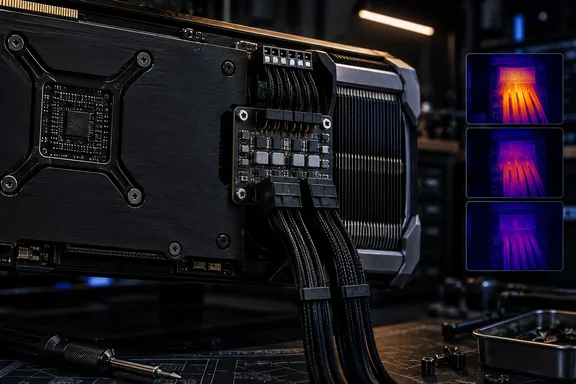
What the mod actually is
Tom's Hardware describes a module screwed onto the back of the GPU. It appears to be a custom power distributor that splits the current across more wires to lower connector temperatures. The modder soldered extra connections to the power rails on the card's PCB and routed them to a distributor board carrying the two female 8-pin connectors. The housing looks resin-printed and appears to be made to fit his specific card.
Other outlets add detail on how it is wired:
- The original connector stays in use. VideoCardz reports that he added two conventional 8-pin PCIe inputs that operate alongside the original connector, rather than replacing it. The GPU therefore draws power from the original cable and two additional PCIe cables at the same time.
- The board attaches at the 16-pin header. VideoCardz says a small pickup PCB is soldered to the contacts of the original 12VHPWR header.
- The card is an MSI. TechPowerUp says the modified card is an MSI GeForce RTX 5090.
- Current per wire is said to be low. TechPowerUp reports that each conductor now carries roughly 3 A, and the wires never crossed 40°C during the 48-hour, 550 W run, even at the joint.
These details come from the modder's own account, relayed by several outlets. I haven't seen a schematic or any independent measurement.
Why the 16-pin connector keeps making headlines
The 16-pin connector pushes high current through what is essentially a 12-pin connector. Four of the smaller pins are sensors, and the rest are split between six +12V and ground connections. Tom's Hardware says slight misalignment and uneven current distribution can cause connector-melting temperatures.
Background on the standard helps here. The 12V-2×6 revision, published by PCI-SIG in July 2023, shortened the four sense pins so the connector won't push power if it isn't fully seated. Even so, the 12V-2x6 revision was supposed to fix the melting problem, and owners are still modding their cards.
The arithmetic behind the appeal is simple, and it is my own illustration. If 550W flows at 12V, that is roughly 46A. Spread across six +12V conductors, that is about 7.6A each. The modder's reported figure of about 3A per conductor would mean the load is shared over considerably more copper. That is plausible as a concept. Whether the current really splits evenly is a different question, and I have no measurements to answer it.
What we don't know
Tom's Hardware is clear about the gaps. It is unknown whether the modder designed the distributor himself, and whether it contains other power-delivery or protection components such as capacitors and fuses. Further open questions:
- Measurement method. The instrument, ambient temperature and test load were not detailed in the reporting I reviewed.
- Fault behavior. Nothing shows what happens if one of the three inputs is unplugged or fails. Parallel feeds can leave the card running on the remaining paths in unpredictable ways.
- Current sharing. Joining several sources to the same rails doesn't guarantee that each one carries an equal share. Tom's Hardware's own explainer says uneven distribution is a common cause of these failures.
- Reproducibility. It's one card and one test.
For perspective, a different RTX 5090 soldering experiment ended badly. A YouTuber soldered an extra 12VHPWR connector onto a Gigabyte RTX 5090 Aorus Master, and the card ended up with two burnt-through holes in the PCB. That was a different mod with a different goal, so it doesn't predict this one's fate. It does show that adding power inputs to a flagship card carries real risk.
The warranty claim
Asked whether the mod would be covered by PNY's warranty, the modder said: "We're a PNY partner. You'll be able to buy a PNY-specific card with a similar modification directly from us with a full warranty." Tom's Hardware notes the mod isn't on his website yet and that PNY hasn't been great at honoring warranties for the 12VHPWR issue with third-party cables, so it advises taking the warranty claim with a grain of salt. The modder's post is the only evidence of any such arrangement. I found no PNY statement endorsing it.
The card in the photos is reported as an MSI, not a PNY. Any modification done on a card from another vendor would not carry that vendor's blessing.
How it compares with other approaches
| Approach | What it does | Main caveat |
|---|---|---|
| Stock 16-pin cable | Single connector carries the whole load | Little margin if contact or alignment is poor |
| Third-party adapters | Change the cable-side connection | Mezha notes they can melt too |
| Inline fuses | Cut power on a fault | They shut the card and PC off rather than solve the problem |
| This mod | Adds two parallel 8-pin inputs | Invasive soldering, unverified, no independent testing |
| TecLab's Galax mod | Soldered wires direct to the PCB on an RTX 5090D | A stunt, not a product |
The last row's source note is my own, drawn from Tom's Hardware's coverage of TecLab's experiment, which it called unsafe to try at home.
Practical takeaways for RTX 5090 owners
- Don't copy this. Soldering to the rails of a card that costs thousands of dollars is a good way to void a warranty and potentially destroy the card. TechPowerUp says it is probably best left to experienced hands.
- Seat the connector fully. Nvidia's guidance for its own adapter and cables emphasizes full insertion, according to the research notes for this story. I couldn't open the guide directly, so treat this as general manufacturer advice.
- Check your cable's rating. Older third-party cables caused trouble before. Moddiy told owners not to use its 12VHPWR custom cables made before 2025 with RTX 50-series cards.
- Consider monitoring. Tom's Hardware has pointed to external monitoring tools as a stopgap, though they add another component to the power path.
- Wait for the product. If the modder does sell a PNY-specific version, get the warranty terms in writing before buying.
Bottom line
This is a clever hardware experiment, and the reported numbers are encouraging. They come from one user's test with no independent verification. The warranty promise is a claim, not a published policy. The mod does nothing about the underlying design, a high-current connector with a thin safety margin. It is a reminder that owners are still improvising fixes for a problem Nvidia hasn't fully put to rest.
References
- Modder 'fixes' melting RTX 5090 power connectors with custom distributor Tom's Hardware · 2026-10-04T14:50:00+00:00
- RTX 5090 mod adds two 8-pin power connectors to reduce 12VHPWR load - VideoCardz.com videocardz.com
- Modder Solders Dual 8-Pin Board to RTX 5090's 16-Pin Header, Wires Stay Below 40°C techpowerup.com