

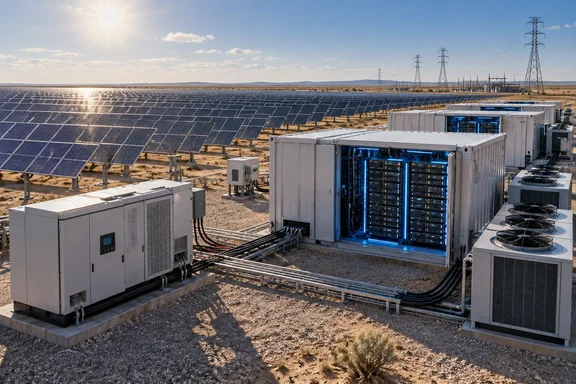
The company announced the system alongside a $40 million Series A led by Spark Capital, bringing its stated total funding to $53.5 million. Rune says its first disclosed deployment is operating at a 200 MW solar facility in Texas. The core proposition is technically plausible: solar panels produce direct current, servers consume direct current internally, and a load located behind the inverter can avoid sending power through the AC transmission system only to convert it back again at the data center.
But the launch material leaves out the number that will decide whether RELIC is a data-center breakthrough or an early-stage niche product: how many megawatts of GPU load Rune has actually deployed at the Texas site.
A 200 MW solar farm is not a 200 MW data center
Rune’s announcement repeatedly identifies the Texas host plant as a 200 MW solar facility. That describes the generation asset, not the compute installation. Fast Company, which interviewed Rune co-founder and CEO William Layden, corrected an earlier report that had described the Texas data center as a 1 MW facility. The corrected article says 1 MW is Rune’s total current computing capacity across multiple Texas and California sites.
That correction changes how the launch should be read. RELIC may be operating at a 200 MW solar plant, but there is no public evidence that Rune has installed anything close to 200 MW of GPUs there. A 1 MW fleet is still a real deployment, especially for a young hardware company, but it is a proof point rather than evidence that utility-scale solar can immediately become a utility-scale AI campus.
Rune’s own website advertises more than 80 MW of contracted power and a pipeline exceeding 1 GW. Those are forward-looking commercial figures, not deployed GPU capacity. The distinction matters to AI infrastructure buyers accustomed to announcements that blur a site’s eventual power potential, signed capacity, electrical capacity under construction, and live IT load.
For enterprise customers, those measurements are not interchangeable. A model provider deciding where to place inference workloads needs to know the actual available GPU count, the power profile per rack, network path and latency, uptime history, maintenance coverage, and what happens when solar output falls. Rune has disclosed a claimed 99.5% service-level agreement and clusters ranging from eight to 1,024 GPUs, but it has not publicly identified the GPU models, networking hardware, customer workload mix, or delivered capacity at its Texas deployment.
The DC architecture cuts equipment, but does not remove operational limits
RELIC’s technical design is more interesting than the “solar farm as data center” slogan suggests. Rune says it connects its equipment to the solar plant’s DC bus before the inverter. In a conventional arrangement, solar output is converted from DC to AC for grid transmission; a data center then transforms and rectifies incoming AC back into DC for servers, storage, and networking gear.
Putting compute on the DC side can eliminate some power-conversion stages and reduce the need for transmission equipment and transformers. SiliconANGLE reported that the units combine GPUs, cooling equipment, and Rune’s power-management electronics, while Rune says its hardware is organized as 100-kilowatt building blocks. The company claims an 85% reduction in non-compute infrastructure spending, or approximately $620 million in savings for a hypothetical 100 MW deployment.
Those savings remain vendor claims. Rune has not published a bill of materials, a comparison baseline, or a breakdown of which costs are excluded from its conventional data-center comparison. A solar-farm deployment still needs physical security, site access, replacement-part logistics, fiber connectivity, remote management, environmental monitoring, and enough cooling to keep expensive accelerators inside operating limits in hot, dusty conditions.
It also does not erase the need for power electronics. GPUs do not run directly from a solar string; they require stable, tightly controlled power. RELIC’s differentiation is that Rune owns the conversion and control stack needed to safely translate high-voltage DC generation into usable server power without routing energy through the ordinary grid path.
That design should reduce electrical infrastructure complexity if it works at scale. It also puts more responsibility on Rune’s controls software: it must predict available surplus generation, protect the solar operator’s existing commitments, and adjust compute demand fast enough to avoid becoming a liability for the generation asset.
Flexible inference is the likely first market
Rune is pitching RELIC as a route around the power shortage constraining new AI data-center builds. The U.S. Department of Energy has projected a steep increase in data-center electricity use through 2028, while solar deployment is expanding faster than transmission infrastructure in several regions. ERCOT, Texas’s grid operator, has documented periods of high renewable output and significant solar and wind curtailment, including an 8,422 MW renewable-curtailment figure during a June 2025 record-renewables event.
The business opportunity exists because the grid’s surplus is often time-specific rather than permanent. Solar production rises sharply during daylight hours, frequently when wholesale prices are weak, then disappears in the evening just as residential demand can increase. A data center drawing only truly unused power needs workloads that can pause, slow down, or move elsewhere without breaking a customer promise.
Rune acknowledges this indirectly in its design. Unite.AI reported that RELIC can ramp or curtail computing loads in milliseconds, while the solar plant retains control over its primary grid obligations. That makes the platform best suited, at least initially, to interruptible and schedulable work: batch inference, model evaluation, synthetic-data generation, rendering, scientific computation, some fine-tuning tasks, and jobs that can be checkpointed and resumed.
Always-on inference for consumer applications is harder. A chatbot, transaction-scoring service, Windows Copilot-style assistant, or enterprise agent with a strict latency target needs predictable capacity regardless of cloud cover, sunset, equipment faults, or the solar site’s grid commitments. Rune could address that by shifting workloads between sites, combining solar with storage, or maintaining access to conventional capacity elsewhere. None of those arrangements has been detailed publicly.
The company’s claim that it can deploy capacity in six weeks should therefore be understood as a deployment timeline, not a guarantee that a customer can instantly replace a grid-connected AI cluster with solar-only infrastructure. The hardware may arrive quickly; production-grade integration, workload scheduling, redundancy planning, and connectivity still determine whether it is useful compute rather than an impressive container of GPUs.
“No water use” is a meaningful claim with a narrow boundary
Rune also says RELIC consumes no water. That is a material distinction in regions where large data-center projects have met resistance over water demand, particularly when facilities use evaporative cooling towers. The Department of Energy notes that cooling-tower water consumption is linked to IT heat load and the efficiency of the heat-rejection system, while dry and refrigerant-based approaches can reduce or avoid that particular water draw.
Rune has not publicly described the exact cooling configuration used in RELIC, the ambient-temperature envelope it supports, or how accelerator performance changes during Texas summer conditions. The claim should be read as referring to operational water consumption at the compute module, not a declaration that no water is involved anywhere in manufacturing the equipment, producing the solar hardware, or maintaining the host facility.
Even so, eliminating on-site water use would give a solar-sited module a clearer permitting and community-relations profile than a large new campus dependent on water-intensive cooling. Rune’s investor Union Square Ventures has also promoted the system as avoiding concrete pours, cranes, grid strain, and noise pollution. Those characteristics could make a small modular deployment much easier to place than a hyperscale project, provided site operators and nearby communities accept the added equipment.
The test is no longer installation speed
Rune has demonstrated the first thing it needed to demonstrate: it can put compute equipment on a working solar site without building a traditional data center or waiting for a new grid connection. The $40 million financing gives it room to turn that installation into a fleet.
The unresolved issue is utilization. GPU infrastructure earns its value when accelerators stay busy, customers can reach them reliably, and service levels hold through changing weather and power-market conditions. A forklift can place RELIC between solar rows in an hour, as Rune says. Proving that a large, solar-following GPU fleet can provide dependable AI capacity at a cost customers prefer over grid-connected alternatives will take far longer—and will require Rune to disclose far more than the capacity of the solar farm hosting it.