

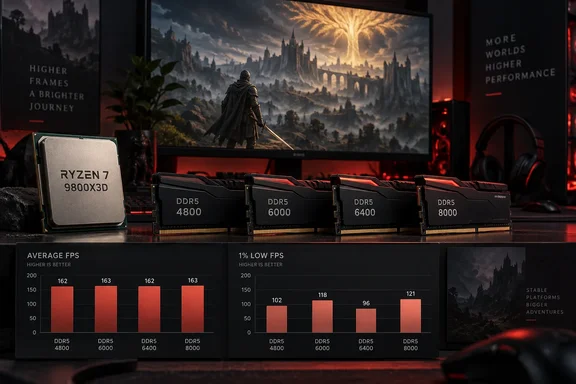
TechPowerUp’s comparison removes Elden Ring’s normal 60 FPS limit using a mod. That qualification is essential: these are uncapped performance measurements, not the frame rates players should expect from an unmodified installation. Removing the limit exposes differences that a capped average could conceal, but it does not make the results a universal ranking of memory kits.
Independent testing provides some supporting context. In its November 2024 Ryzen 7 9800X3D review, TechSpot recommended DDR5-6000 for its balance of performance and value and reported less than 2% variation between its slowest and fastest memory configurations in Hitman 3. Those are different tests, rather than independent reproduction of TechPowerUp’s Elden Ring figures, but they reinforce the narrower point that higher DDR5 ratings need not deliver a substantial gaming improvement on this processor.
Ryzen 7 9800X3D memory scaling leaves Elden Ring averages almost unchanged
According to TechPowerUp’s benchmark reporting, the entire spread in average performance remains below one frame per second at 1080p, 1440p, and 4K. The absolute performance level changes considerably with resolution; the distance between memory configurations does not.
| Elden Ring test resolution | Lowest reported average | Highest reported average | Absolute difference |
|---|---|---|---|
| 1920 × 1080 | 91.00 FPS | 91.97 FPS | 0.97 FPS |
| 2560 × 1440 | 83.17 FPS | 84.13 FPS | 0.96 FPS |
| 3840 × 2160 | 61.57 FPS | 62.17 FPS | 0.60 FPS |
These are TechPowerUp’s reported measurements, not WindowsForum testing. No independent reproduction of these exact Elden Ring results is established by the available reporting.
At 1440p, TechPowerUp reports that DDR5-6000 ULL leads at 84.13 FPS, while a single 16 GB module finishes last at 83.17 FPS. Between them, DDR5-5600 using two 8 GB modules reaches 83.33 FPS, DDR5-4800 JEDEC reaches 83.40 FPS, and a DDR5-6400 EXPO configuration reaches 83.50 FPS. The higher advertised transfer rate plainly does not determine the finishing order.
The 4K results make that point particularly clearly. According to TechPowerUp, DDR5-8000 and DDR5-4800 JEDEC both average 61.63 FPS. DDR5-6000 ULL leads at 62.17 FPS, followed by DDR5-7600 at 62.07 FPS. Moving from the DDR5-4800 result to the leading result therefore adds just 0.54 FPS in this test.
For an owner considering a replacement kit specifically to improve Elden Ring’s average frame rate, those numbers provide little justification. They also put a boundary around the recommendation: this is evidence about one game on the Ryzen 7 9800X3D, not proof that memory configuration is irrelevant to every game or application.
Elden Ring’s lowest frame rates tell a less orderly story
Average FPS describes overall throughput, but it can conceal brief slowdowns. The 1% low and 0.1% low figures focus on the slower portion of a run. They deserve attention in a game that TechPowerUp describes as prone to traversal stutter when new regions load, although the exact calculation method and repeatability data are not established here.
At 1080p, TechPowerUp reports a 5.9% spread in 1% lows. Its dual-rank DDR5-6400 configuration using two 32 GB modules leads, with DDR5-6000 ULL close behind. That is a larger separation than the 1.1% spread in average FPS, showing why the average alone cannot describe every aspect of the benchmark.
The reported 0.1% lows vary more substantially:
| Memory configuration | Reported 1080p 0.1% low |
|---|---|
| DDR5-4800 | 41.07 FPS |
| DDR5-7600 | 47.70 FPS |
| Single-stick configuration | 48.17 FPS |
| DDR5-5600, two 8 GB modules | 48.53 FPS |
| DDR5-6000 ULL | 51.03 FPS |
Calculated from TechPowerUp’s figures, the difference between 41.07 FPS and 51.03 FPS is approximately 24.3%. That is worth examining, but it is not a 24.3% improvement in overall game performance. It describes one low-percentile metric at one resolution, while average frame rates remain tightly grouped.
Nor does the table establish a dependable progression from slower to faster memory. DDR5-5600 and the single-stick configuration both exceed DDR5-7600 in this metric. TechPowerUp interprets that irregular ordering as evidence that traversal stutter is influencing the worst results, rather than memory bandwidth alone determining them.
The defensible conclusion is that this benchmark records meaningful variation in its slowest frames without proving a reliable memory-speed remedy. Buying DDR5-6000 ULL on the expectation that it will eliminate traversal stutter would go beyond the evidence.
The Elden Ring comparison changes more than DDR5 speed
The configurations differ in module count, capacity, rank organization, and memory settings—not just the number following “DDR5.” That makes the comparison useful as a look at complete configurations, but less suitable for isolating the cause of an individual result.
For example, the two-module DDR5-6400 setup that leads the 1080p 1% lows has 64 GB of total capacity and is identified as dual-rank. The DDR5-5600 configuration has 16 GB across two modules, while another configuration uses a single 16 GB module. A winning result for the 64 GB setup does not, by itself, demonstrate that Elden Ring needs 64 GB or that capacity caused the advantage.
Similarly, DDR5-6000 ULL’s strong showing does not establish that every retail DDR5-6000 kit will perform identically. The precise timings behind that configuration are not established in the available benchmark excerpt. The label should remain attached to the tested configuration rather than becoming a promise about all memory sold at that transfer rate.
TechPowerUp’s interpretation also gives the processor’s cache a potential role: its reporting suggests that the game’s sensitivity to main-thread latency could make an X3D processor’s cache beneficial. But every result discussed here uses the Ryzen 7 9800X3D. Without a corresponding non-X3D comparison under the same conditions, these figures cannot isolate how much of the weak memory scaling comes from the cache itself.
That boundary keeps the buying advice grounded. The benchmark shows what happened across these configurations; it does not prove a separate causal explanation for each position in the charts.
A small Elden Ring lead is not a demonstrated upgrade
TechPowerUp characterizes the approximately half-frame-per-second separation at 4K as comparable to normal run-to-run variation. The exact range is 0.60 FPS. Without repeated-run distributions or error bars, however, the evidence does not establish which small differences are statistically distinguishable.
There is no need to turn that uncertainty into an accusation that the benchmark is flawed. Reporting numerical results and demonstrating a repeatable purchasing advantage are different tasks. A result can top a chart while offering too little demonstrated benefit to justify replacement hardware.
The decrease in average FPS as resolution rises is consistent with rendering work becoming a stronger constraint, but the available details do not establish the exact bottleneck. In particular, the supplied results do not identify the graphics card and settings needed to attribute the 4K outcome confidently to GPU limits.
The normal 60 FPS cap also changes the practical interpretation. All three uncapped average ranges exceed 60 FPS, but an average above 60 does not guarantee that every frame meets that target. The low-percentile results show why a player can still experience interruptions even when the overall average looks sufficient. Neither the cap nor faster memory should be presented as a demonstrated cure for the reported traversal behavior.
What this means for Ryzen 7 9800X3D buyers
Keep an existing memory kit if your proposed replacement is justified only by these Elden Ring average-FPS results. For a new build, the evidence supports resisting a large premium for extreme DDR5 transfer rates, while leaving room for other games and workloads to influence the final choice.
- TechPowerUp’s tested memory configurations differ by less than one average frame per second at each resolution, so this game provides little evidence for a speed-only replacement.
- DDR5-6000 ULL performs strongly in these charts, but its result should not be generalized to every DDR5-6000 kit without matching the tested settings.
- The 64 GB configuration’s leading 1080p 1% low does not establish a 64 GB capacity requirement or isolate capacity as the cause.
- The irregular 0.1% low rankings do not support buying DDR5-7600 or DDR5-8000 as a dependable fix for traversal stutter.
- TechSpot’s separate recommendation of DDR5-6000 for performance and value is useful corroborating context, not a guarantee of identical results across games.
For Ryzen 7 9800X3D owners, the useful outcome is permission to leave a narrowly justified upgrade unbought. TechPowerUp’s Elden Ring results show almost unchanged average throughput across a wide range of memory configurations, alongside low-percentile behavior that resists a simple faster-is-better explanation. A more expensive kit needs evidence of a worthwhile improvement in the workloads you actually run; its advertised transfer rate is not enough.
Update: Additional details (September 21, 2026)
TechPowerUp’s full report says it tested eight distinct AM5 memory configurations. It also identifies the Ryzen 7 9800X3D as carrying 96 MB of L3 cache, framing the test around whether that cache reduces the processor’s need to access system memory during gaming.