

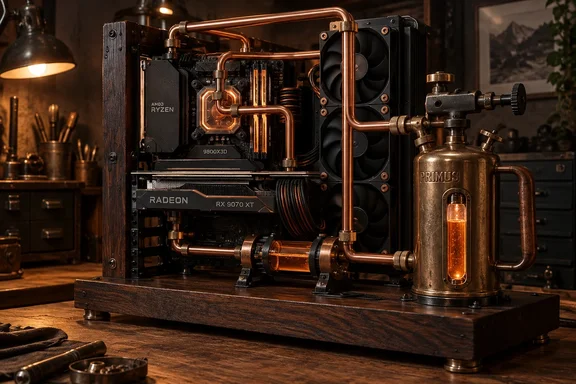
What the photos do not establish is whether the elaborate loop is a better-performing cooling system than a conventional custom loop—or even how it performs at all. The builder has not posted load temperatures, coolant temperatures, pump speed, fan curves, leak-test results, noise measurements, or long-term maintenance results. This is a remarkable piece of PC craftsmanship, but readers should treat it as a successful-looking showcase rather than a cooling benchmark.
A real AMD gaming system under the copper
The underlying PC is no museum prop. Old-Mate-Fetus lists a Ryzen 7 9800X3D, a Gigabyte B650M Aorus Elite WiFi motherboard, 32GB of Klevv DDR5-6000 CL28 memory, and Gigabyte’s RX 9070 XT Gaming OC. The machine uses a Corsair 850W SFX power supply, Noctua industrial 120 mm fans, an Alphacool DDC pump in a custom enclosure, an Alphacool GPU block, and a Heatkiller IV CPU block.
That component selection makes sense for an open-frame, display-first build. The 9800X3D is a high-end gaming processor, while the RX 9070 XT is a card that can justify putting the GPU on the same loop as the CPU. A single loop also removes the visual and acoustic clutter of the graphics card’s stock air cooler—important when the goal is to make the cooling hardware itself the centerpiece.
But the exact water-block models remain unclear. The builder named the brands and series, not full part numbers. PC Gamer inferred a likely Alphacool Core block variant from the listed Gigabyte graphics card, but that is still an inference rather than a confirmed SKU. For anyone attempting a similar build, a block’s exact PCB compatibility is the detail that matters; an RX 9070 XT label alone is not enough, because board layouts differ between models.
The memory story is also more modest than the coverage suggests. The builder says 32GB was installed after wanting 64GB, citing high prices. That is a personal purchasing constraint, not evidence that 32GB is inadequate for this machine. For today’s gaming use, the build remains well provisioned; for heavily modded games, local virtual machines, content creation, or AI workloads, 64GB would simply offer more headroom.
The blowtorch reservoir is the engineering risk point
The build’s defining feature is a Primus blowtorch body adapted into a reservoir and fitted with a sight gauge. A reservoir is not a passive decorative part: it must hold coolant, tolerate the loop’s pressure changes, provide a reliable fill and bleed path, and avoid introducing residue or particles into the pump and water blocks.
Neither the Reddit post nor the subsequent reports from Tom’s Hardware, PC Gamer, and Dexerto describes how the blowtorch was cleaned, stripped, pressure-tested, sealed, or fitted with internal connections. Those omissions are more important than the visual novelty. A former fuel vessel needs far more preparation than a purpose-built acrylic or glass reservoir, and any improvised reservoir needs to be tested away from powered electronics before it is trusted above a motherboard and graphics card.
Alphacool’s own guidance for water-cooling hardware emphasizes checking loop tightness, pump operation, and fan operation before running cooled components. Its reservoir documentation also specifies pressure limits for purpose-built equipment. There is no comparable rating available for this modified blowtorch, so nobody outside the builder can say what margin the finished reservoir has.
The sight gauge is a useful addition, assuming it is properly sealed. It provides an immediate view of coolant level in a system where the reservoir is otherwise opaque, and it fits the period-industrial visual language far better than a modern tube reservoir. Yet it also adds fittings and seals—more possible leak points in a loop already built around numerous soldered or joined copper runs.
Copper pipework changes the maintenance equation
The visible copper tubing is more than a style choice. Rigid pipework offers a permanent, structural presentation that soft tubing cannot match, and it can survive routing shapes that would kink flexible tubing. It also makes every fitting, bend, and joint part of the system’s reliability chain.
The principal concern in a mixed-material loop is not that copper will naturally darken on the outside. Old-Mate-Fetus has said the intention is to let the exterior tarnish, and that patina is cosmetic. The internal concern is corrosion chemistry. Copper and nickel-plated copper are common in enthusiast water-cooling equipment, but adding aluminum components to the same coolant circuit can create galvanic-corrosion problems unless the loop and coolant are designed for it.
The reporting does not inventory the metals inside the radiator, fittings, reservoir modifications, or every component of the GPU block. That means outside observers cannot verify the loop’s material compatibility from the photos. Alphacool has warned that copper-and-aluminum combinations require corrosion protection, and the company has advised builders to use appropriate coolant rather than assuming distilled water alone solves every mixed-metal case.
The loop’s many sharp turns also deserve a practical note. Commenters focused on the number of 90-degree elbows, and the concern is reasonable: every restrictive fitting reduces flow and increases the work required of the pump. A DDC-class pump is commonly used in compact, restrictive loops, but the final result depends on the actual pump model, radiator restriction, block design, tubing diameter, fitting bore, and loop routing. Without flow or temperature data, claims that the layout is either excellent or disastrous are speculation.
The wooden pedestal hides important compromises
The custom wooden base does much of the work normally performed by a PC chassis. It appears to conceal the Corsair SFX power supply and cable routing while holding the radiator assembly, motherboard, pump, fittings, and heavy copper plumbing in a coherent sculpture. PC Gamer reports that the complete system weighs close to 20 kg, a figure Dexerto also carried from the builder’s post.
That heft is a feature for a desk-bound art build but a liability for routine PC ownership. It will be difficult to move, awkward to service, and unlikely to travel safely without serious packing. A standard case offers removable panels, predictable mounting points, cable channels, dust filtration, and a known airflow path; this machine exchanges much of that convenience for a one-off presentation.
Dust is the other visible compromise. Open-frame systems expose fans, radiators, fittings, and motherboard surfaces to the room. There is no indication in the submitted material that this build includes a filtration strategy, and a large exposed radiator can become a maintenance item quickly in a home with pets, carpet, smoke, or workshop debris. The radiator will need periodic cleaning, while the wood and unsealed copper will continue to change appearance.
The phrase “antique blowtorch,” used in some coverage, should also be handled carefully. The builder called it an old Primus blowtorch, but no report identifies a model number, production year, provenance, or restoration history. It is a repurposed vintage-looking object; the record does not establish its age or collector status.
A build to admire, not a template to copy blindly
Old-Mate-Fetus has made the difficult part look effortless: combining a modern AMD gaming PC, hand-built woodwork, copper fabrication, custom cabling, and a nonstandard reservoir into a system that clearly powers on and runs games. The espresso-machine jokes from Reddit are fair, but so is the comparison to a piece of functional industrial art.
For experienced builders, the useful lesson is not “use a blowtorch as a reservoir.” It is that an ambitious case mod must be approached in layers: validate component compatibility, select the cooling hardware, prove the loop is clean and leak-free, establish stable temperatures and flow, then build the display around it. In this project, the aesthetics are the published achievement; the unavailable thermal and reliability data remain the unanswered engineering record.