

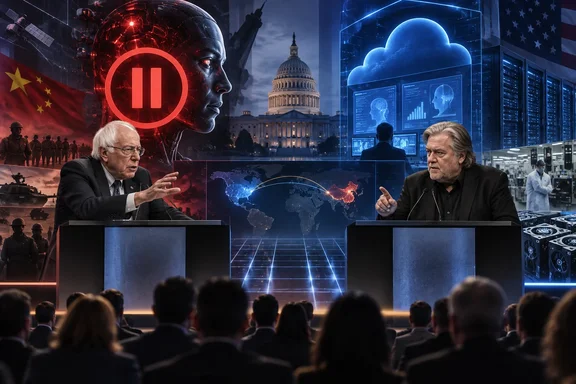
Reuters reported that Sanders and Bannon used the Future of Life Institute’s Pro-Human Assembly on September 15 to warn about job displacement, loss of human control, biosecurity risks, energy costs, and the concentration of AI power in a few companies. Sanders urged President Donald Trump to seek an agreement with Chinese President Xi Jinping to pause advanced AI development and ban “superintelligence.” Bannon called for slowing AI development, while arguing separately for keeping advanced American chips and related hardware out of China.
The useful takeaway for IT leaders is less dramatic: Washington’s AI argument is shifting toward limits on the development of frontier models, not a ban on ordinary enterprise AI use. But the policy machinery needed to turn that sentiment into enforceable rules remains absent.
A shared stage, not a shared AI program
Sanders and Bannon were both advertised speakers at the Pro-Human Assembly, which was organized by the Future of Life Institute. Axios, the Associated Press, and The Guardian each described the event as an unusual convergence of AI-safety advocates, labor voices, politicians, and critics of concentrated technology power.
That is different from a joint legislative platform. Sanders’ message centers on binding federal safety standards, a pause for unspecified categories of “advanced AI,” and an international agreement with China. Bannon’s concerns overlap on the pace of AI deployment and the influence of major technology companies, but his prescription also places far more emphasis on restricting China’s access to U.S. chips.
The China question is where the consensus breaks down. Sanders framed uncontrolled advanced systems as an international danger that cannot be solved by one country racing ahead; Bannon has argued for a harder technological separation. Those positions may produce the same sound bite—slow down AI—but they do not describe the same policy.
For enterprise administrators, this distinction matters. A bilateral pause on frontier-model development would be aimed at the companies training the largest and most capable models. Hardware export controls would instead bear more directly on GPU supply chains, cloud capacity planning, and the ability of overseas firms to obtain high-end compute. A domestic AI regulator could eventually affect both model suppliers and large deployers, depending on how Congress defines covered systems and obligations.
None of those policies exists as a new law today.
Sanders’ proposal still lacks the details that would make it enforceable
Sanders’ office announced on September 3 that he and Rep. Greg Casar planned to introduce the Ban Artificial Superintelligence Act. The announcement said the proposal would permanently prohibit the development and deployment of “superintelligent AI,” temporarily pause advanced AI development until a federal regulator establishes safety rules, and direct the United States to pursue international agreements.
The core problem is definitional. The public announcement does not provide statutory text, a bill number, a test for what qualifies as advanced AI, or a technical threshold separating a regulated frontier model from a powerful commercial model used in a product. It also does not identify the proposed federal regulator, its enforcement powers, the terms for lifting a pause, or the treatment of open-weight models, fine-tuned systems, cloud-hosted APIs, and models already deployed in business products.
Those omissions are not minor drafting questions. They decide who is regulated.
An AI law based on model capability could primarily target firms building foundation models and operating large training clusters. A law based on deployment risk could reach banks, hospitals, employers, software vendors, government contractors, and enterprises that use AI to make consequential decisions. A compute threshold could turn GPU clusters and cloud tenants into a reporting issue. A ruleset focused on data, evaluation, incident disclosure, or cybersecurity safeguards would put greater weight on governance controls rather than an outright development pause.
Sanders’ office has described the measure as forthcoming. Reporting from the event said Sanders would introduce legislation the following week. As of September 16, no public legislative text was identified in the material surrounding the announcement. That leaves the proposal at the agenda-setting stage rather than the implementation stage.
The White House is pursuing the opposite regulatory direction
The Sanders-Bannon event landed against a federal policy record that is difficult to reconcile with a moratorium.
The White House has promoted a national AI framework intended to reduce conflicting state requirements and preserve U.S. competitiveness. In a December 2025 executive order, the administration directed agencies to identify and challenge state AI laws deemed inconsistent with its national policy, and called for a legislative recommendation establishing a uniform federal framework. A March 2026 White House framework similarly emphasized avoiding a state-by-state compliance regime.
The administration has also issued national-security AI policy that focuses on deploying AI in government and strengthening cyber defenses, rather than slowing commercial AI development across the board. The June directive on advanced AI innovation and security calls for work with the private sector to modernize systems, protect intellectual property, harden critical infrastructure, and bolster AI-enabled capabilities.
That is why describing the current federal approach as simply hands-off is incomplete. The government is active on AI in areas it sees as central to national security, federal operations, export controls, and preemption of state rules. What Sanders and Bannon object to is the lack of a binding federal brake on the development of highly capable commercial systems.
House Speaker Mike Johnson made the administration’s political position clearer on September 15. Reuters reported that Johnson rejected an AI development moratorium, arguing that a pause would compromise the United States’ competitive position against China. He suggested companies could regulate themselves. Axios also reported that the House is not expected to take AI action before its lengthy recess.
The immediate obstacle to Sanders’ plan, therefore, is not merely partisan disagreement. It is a direct conflict between a frontier safety argument and a strategic competition argument that currently has support from the White House and House leadership.
What enterprise IT teams should—and should not—do now
No new federal rule announced this week requires organizations to halt AI pilots, switch off Copilot features, change Azure configurations, or stop using large-language-model APIs. Treating a political demand for a pause as an operational mandate would be premature.
The event does, however, point toward the questions that are increasingly likely to appear in customer contracts, procurement reviews, audits, and future regulation. Organizations using generative AI should be able to answer, in concrete terms:
- They should maintain an inventory of AI systems, including embedded features in productivity suites, security products, customer-service platforms, developer tools, and business applications.
- They should know which data types are allowed into each service, whether prompts or files may be retained, and which controls prevent sensitive information from reaching unapproved models.
- They should assign accountable owners for high-impact AI workflows, especially systems used in hiring, lending, health, legal, security, or customer decisions.
- They should require vendors to disclose material model changes, security incidents, data-use terms, and the availability of audit logs or administrative controls.
- They should separate experiments from production deployments, with documented human review and a tested rollback path where an AI output can affect money, access, employment, safety, or external communications.
These are practical governance measures regardless of whether Congress adopts Sanders’ proposal, the White House advances a lighter federal framework, or states continue to push their own laws. They also address the less speculative side of the Sanders-Bannon critique: concentration of power in a small group of providers can create procurement, resilience, data-governance, and vendor-lock-in risks even without an AI system escaping human control.
The next concrete test is legislative text, not rhetoric
The event is politically notable because Sanders and Bannon draw audiences that rarely accept the same premise, and because the argument for slowing AI now extends beyond traditional tech-policy circles. The Associated Press reported that public fears about AI’s social and economic effects have become harder for elected officials to ignore, even as national-security concerns reinforce the case for accelerating U.S. development.
But a shared warning does not settle the central questions: Which models would be paused? Who determines their capabilities? Would rules apply to closed systems, open models, or both? Could a federal regulator inspect training runs, require incident reporting, limit deployment, or impose liability? And how would a U.S.-China agreement be verified when advanced AI development is spread across private companies, universities, cloud providers, and national-security programs?
Until Sanders and Casar publish statutory language and the administration signals willingness to negotiate, the practical consequence remains political pressure rather than a new legal obligation. Enterprise AI users should strengthen their own controls now—but they do not need to rewrite their deployment plans on the basis of a Washington summit.
References
- Senator Bernie Sanders and Trump ally Steve Bannon unite in calls for more AI oversight TechRadar · 2026-09-16T19:30:00+00:00