

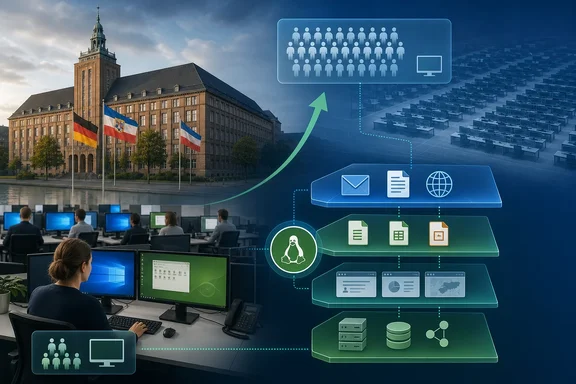
That correction changes the story without diminishing the significance of the project. As MakeUseOf reported, Germany’s northern state is dismantling several Microsoft dependencies at once: Office, Exchange and Outlook, collaboration services, telephony, and older Access-based internal applications. But the desktop operating system remains the least-complete part of the program, and its schedule is more cautious than the 30,000-PC headline suggests.
For Windows administrators, the useful lesson is not that a government has found a magic way to replace Windows. It is that Schleswig-Holstein began with the services and workflows that make Windows difficult to leave, then treated the Linux desktop as a later integration project.
The 30,000-PC figure is a destination, not the current deployment
Schleswig-Holstein’s own open-source strategy describes a future “+1 Linux Workplace” intended to replace the standard administrative desktop with GNU/Linux. The state’s project page confirms that a distribution, applications, operating concepts, and support arrangements are being developed for professional government use.
But the most specific official status update is much more limited. The parliamentary response says the state planned a phased transition of up to 250 IT workstations by the middle of 2026, followed by up to 500 more by year’s end. It also says lessons from earlier migrations would feed into the Linux plan.
That is pilot-scale deployment, not a mass migration of 30,000 Windows PCs. There may be additional activity that has not been publicly quantified, but Schleswig-Holstein has not published an official count showing thousands of staff already working on Linux. Readers should be wary of treating a strategic target, a workforce count, and an installed-base number as interchangeable.
The 30,000 figure is still meaningful. It indicates the approximate scope of the state administration the strategy aims to cover. Yet the operating-system portion is being tested after other components have been moved or standardized. The practical implication is straightforward: Windows remains in place for most of the administration while the state proves that its applications, identity processes, device management, support model, and specialist systems can work without it.
Email and office software have moved much further
The email migration is the clearest completed milestone. Schleswig-Holstein announced that it completed the move from Microsoft Exchange and Outlook to Open-Xchange and Thunderbird on October 2, 2025. The state initially described more than 40,000 mailboxes and more than 100 million emails and calendar entries; later official reporting raised the mailbox total to nearly 44,000.
That project matters more operationally than a desktop wallpaper or a browser change. Exchange and Outlook tend to sit at the center of identity, calendaring, mobility, archiving, delegation, conferencing invitations, compliance procedures, and help-desk practices. Moving them exposes all the integrations that a Windows-to-Linux desktop plan can otherwise postpone.
LibreOffice has also become the binding standard office suite for the state ministries and authorities, according to the Schleswig-Holstein government’s December 2025 update. The state said that, excluding tax administration, its Microsoft relicensing rate had already fallen to well below 10 percent. Roughly 20 percent of workplaces still needed Microsoft Office in certain areas because of technical ties to specialist procedures.
Those exceptions are the point. A spreadsheet and word processor can be replaced comparatively early, especially when they are deployed on Windows first. The difficult work lies in macros, document templates, line-of-business add-ins, records-management systems, digital signatures, third-party document exchange, and procedures that were built with Microsoft formats or desktop assumptions embedded in them.
Schleswig-Holstein’s sequence is therefore more credible than a “replace Windows first” project. By moving mail and office tools before the Linux desktop, it reduces the number of daily dependencies that would otherwise turn an operating-system migration into an all-at-once failure.
Access applications are the real migration test
The administration calls its specialized case-management and departmental applications Fachverfahren. These systems often encode rules that have been refined over years: benefit calculations, approval processes, inspections, registrations, internal databases, printed forms, and links into federal or state systems. They are usually where public-sector desktop migrations slow down.
Schleswig-Holstein is now replacing more than 100 Microsoft Access-based specialist applications with A12, a low-code platform from mgm technology partners. The company says subject-matter staff can model parts of applications after training, while the state’s Digital Minister Dirk Schrödter has described the goal as web-based replacements for older Access systems.
There is an important qualification to the open-source narrative. A12’s central components were released under the European Union Public Licence 1.2 on openCode and GitHub in May 2026, as mgm and the Interoperable Europe Portal document. But A12 also has commercial enterprise features, support arrangements, and subscription offerings. Open source can reduce dependence on a single proprietary desktop stack; it does not mean that the state will eliminate vendor relationships, implementation costs, or product governance.
That is not a flaw. It is a more realistic definition of digital sovereignty: retaining practical options to inspect, operate, adapt, and replace parts of the stack rather than promising an organization will build every tool itself. A web-based specialist application also narrows the importance of the endpoint operating system. If the business application runs in a supported browser and relies on open interfaces, the Linux transition becomes materially less risky.
Tax administration remains a notable unresolved area. Schleswig-Holstein says its tax systems are being addressed through a separate joint process among Germany’s states. For a public administration, that is precisely the kind of dependency that can determine whether a broad Linux deadline holds or slips.
Savings are a licensing comparison, not a full cost audit
The Schleswig-Holstein government says the project is already saving more than €15 million in licensing costs and plans €9 million in one-time 2026 investment for migration and further development of open-source solutions. Heise Online independently reported those figures when the state announced LibreOffice as its office standard.
The arithmetic is attractive, but it should not be oversold. The €15 million is a licensing-cost figure reported by the state, while the €9 million is a 2026 investment tranche—not a published total cost for the full program since its inception. Neither number, on its own, produces a complete comparison of ownership costs.
A serious Windows replacement calculation must include endpoint engineering, software packaging, directory and identity integration, device lifecycle management, hosting, security monitoring, application redevelopment, training, productivity disruption, accessibility validation, support staffing, and external-service contracts. Schleswig-Holstein will still pay for servers, support, development and operations after Microsoft licensing declines.
Its argument is broader than cost. The state says open standards and open-source components give it more control over future technical decisions and reduce reliance on individual suppliers. That outcome cannot be measured simply by subtracting €9 million from €15 million, but it is also not automatic. The state must maintain technical skills and avoid rebuilding a new single-vendor dependency around its replacement platforms.
Telephony shows the program is still years from completion
The state’s latest major procurement underscores how wide the project has become. In August 2026, Schleswig-Holstein said Viakom had won the contract for OSKAR, an open-source communications architecture meant to replace a heterogeneous telephone environment containing Voice over IP and remaining ISDN systems.
The rollout has only begun. The state estimates that replacing the telephone infrastructure will take three to four years, with Viakom responsible for further development of OSKAR and Dataport handling operation, rollout, and user service.
That timetable is revealing. Schleswig-Holstein is not conducting a one-time flight from Microsoft; it is rebuilding administrative infrastructure on staggered schedules. Email migration has finished. LibreOffice adoption is advanced but incomplete. Access replacements are beginning. Telephony will take years. Linux is in an early phased deployment.
Munich’s LiMux history explains the caution. Munich moved about 15,000 government workstations to its Linux-based LiMux environment by 2013, only to begin a politically charged reversal several years later. The Free Software Foundation Europe and reporting by Ars Technica noted that an Accenture review identified organizational problems, unclear responsibilities, aging software, and uneven client management as major causes of dissatisfaction alongside compatibility complaints. The evidence does not support using Microsoft’s later move of its German headquarters to Munich as proof that it caused the reversal.
Schleswig-Holstein appears to have absorbed the more defensible lesson: desktop software cannot compensate for unclear ownership, legacy applications, fragmented support, or a weak migration plan. Its public status report also makes clear that it has not yet demonstrated a full replacement for Windows at statewide scale.
The story worth watching is therefore more precise than a 30,000-PC “escape.” Schleswig-Holstein has completed a substantial Exchange-and-Outlook migration, made LibreOffice its standard suite, and started replacing the specialized applications that make old desktop environments sticky. Its Linux target remains ambitious, but the evidence as of September 14, 2026 shows that the state is still proving the desktop portion in hundreds of seats, while the surrounding infrastructure will continue changing for years.
References
- The biggest Linux migration happening right now is a 30,000-PC escape from Microsoft MakeUseOf · 2026-09-14T19:01:13+00:00