

Paul Thurrott wrote up the talk under the headline that Microsoft "gave up" on Windows. That wording is an interpretation of the talk. Microsoft has not said anything of the kind. The criticism is still worth hearing, because it comes from someone who has shipped products at the companies he is criticising.
The talk: what, where, and when
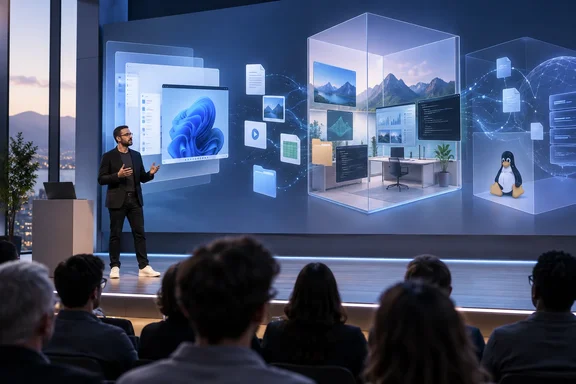
The talk is called "Are we really going to use the same Desktop UX forever?" The official recording on media.ccc.de lists it as a 40-minute talk from 2026-09-19, given in Room 2 at KDE's annual gathering. LWN.net covered the event from Graz, Austria for Akademy 2026.
The official synopsis spells out the argument:
- The desktop interface has remained fundamentally unchanged for over two decades, relying on legacy paradigms that haven't scaled to meet new modern needs.
- Industry leaders like Apple and Microsoft are too deeply entrenched in their established ecosystems to risk radical shifts.
- Linux has experimented some, but much of it has nibbled at the edges such as focusing on tweaking window management.
- Real progress, in Jenson's view, comes from richer input, better data flows, and breaking out of our 2d windowing prisons.
This talk follows an earlier one Jenson gave at Ubuntu Summit in late 2025. According to LWN, that talk "got more than half a million views on YouTube—which by YouTube standards is trivial, but by Scott standards is enormous." He told the Akademy audience that the response showed him the topic of desktop UX was something that people wanted to talk about. This time he also brought a few examples of prototypes he had to demonstrate his ideas.
Section summary: This was a recorded conference talk with a public synopsis and independent press coverage. It was not a stray comment on social media.
Who is Scott Jenson?
Thurrott's article lists Jenson's background:
- He helped create Apple's User Interface group in the 1980s.
- He worked on Apple's Human Interface Guidelines, Mac System 7 and Newton.
- He led Google's Mobile UX group for five years.
- He wrote the book The Simplicity Shift.
LWN adds that he now does work for Mastodon and Home Assistant, "just kind of trying to squeeze a little bit more good UX design into open source". His aim at Akademy was to persuade open-source projects to drive the desktop beyond the age-old "windows, icons, menus, pointer" (WIMP) model.
The Microsoft interview
This is the part Windows readers will care about most. Thurrott quotes Jenson saying he interviewed at Microsoft "eight years ago to be the head of UX for Windows." Jenson didn't give a year. Thurrott works out that it would have been around 2018, partway through the Windows 10 era.
Jenson said it wasn't "cool to kiss and tell." He still described what he brought to the interview. In his account:
- Candidates for a job like that arrive with an agenda of their own. They don't just offer to do whatever the company wants.
- His agenda was that "the desktop needed to evolve."
- He stressed that he didn't want to "blow up Windows." He said he understood that hundreds of millions of people use it and that sudden changes would "freak people out."
Thurrott's public excerpt stops in the middle of Jenson's next sentence. Several things are therefore unknown:
- what Jenson went on to propose
- how the interview process went
- whether he got an offer
- why nothing came of it
Thurrott suggests the timing overlapped with Microsoft's experiments in mobile-style interfaces that later showed up in Windows 11. That is Thurrott's framing. Nothing in the available material says Jenson's interview involved any specific Windows 11 design decision. Microsoft hasn't commented, and nobody else from the interview has confirmed Jenson's account.
Section summary: Jenson says he pitched gradual change to the desktop for the top Windows UX job around 2018. The rest of the story is either behind Thurrott's paywall or hasn't been told publicly.
"One mistake after another"
Thurrott reports that Jenson thinks Apple and Microsoft have both "fundamentally given up on desktop computing."
- Apple: Jenson criticises Liquid Glass on macOS. He says new Mac features mostly "tie it closer to the iPhone" and build "their moat higher" rather than improve the desktop.
- Microsoft: He judges it more harshly, saying it is "just making one mistake after another." His examples are forced OneDrive use, the Recall "disaster," and "ads everywhere."
On Recall, LWN's report gives a more precise version of his view. During the Q&A, a question came up about the privacy risk of his own ideas that depend on activity data. Jenson added that the biggest problem with Windows Recall was "how stupidly they protected it" and he was sure others could do a lot better job. So his complaint isn't with the concept of a searchable activity history. It's with how Microsoft protected the data.
His own design ideas face the same problem. He proposed collecting telemetry that is "not interesting information", which would significantly reduce the attractiveness of the data to would-be attackers. He wanted to build prototypes to see if the idea was good first, and then explore ways to encrypt or protect the data. He also agreed that even this data could be valuable information.
What "desktop innovation" means here
It's easy to read this as another complaint that the Start menu got moved. Jenson is making a different argument. Summaries of the talk describe a layered view of UX. According to daily.dev's summary, he addressed three common pushbacks against desktop innovation (mobile has won, WIMP is done, don't touch my stuff), and discussed layers of UX (style, structure, strategy, underlying technology constraints).
Windows veterans will recognise one name in particular. He revisited historical projects like WinFS and KDE's NEPOMUK semantic desktop as ideas ahead of their hardware. WinFS was Microsoft's ambitious plan for a storage system that understood the meaning of files, and it was dropped during the Longhorn era. Mentioning it cuts both ways. Microsoft did once attempt the kind of deep "better data flows" change Jenson wants. It also shows how hard those changes are to ship on a platform with a huge installed base.
Put simply, Jenson's case is that the important work is underneath the visual design:
- Input: richer ways to get information into the machine than keyboard, mouse and touch alone.
- Data flow: how files, tasks and applications relate to each other.
- Spatial model: whether overlapping 2D windows are still the right basic unit of work.
In this framing, visual changes such as rounded corners or translucent materials are the most surface-level layer. That helps explain why Jenson dislikes Liquid Glass.
Counterpoints
Some caution is warranted before accepting the "gave up" framing.
- Stability is something Windows users value. Enterprises that run large fleets of PCs reward predictable behaviour, not bold reinvention. Jenson himself admitted that sudden change would alarm hundreds of millions of users.
- "It's old" isn't a problem by itself. One commenter on Lemmy argued that the point isn't that interfaces should never change. It's that changes should solve identifiable problems. The same commenter noted that the move from Program Manager to the taskbar and Start menu fixed real scaling problems.
- Reception was divided. Lobsters discussion summarised by daily.dev ranged from enthusiastic praise to skepticism about big-company-driven UX innovation.
- Big companies aren't the only ones with limits. The talk argues open source has more room to experiment. LWN notes, though, that Jenson acknowledged open-source projects are understaffed. That is exactly the constraint that makes serious UX research hard.
Why this matters for Windows users
This story doesn't change any Windows 11 setting or patch. Its value is in giving a name to a feeling many long-time users already have: Windows keeps adding cloud accounts, AI features and promotions while the basic desktop model stays the same.
Jenson's critique separates two questions:
- Is Microsoft making Windows worse through dark patterns and poorly secured features?
- Is anyone making the desktop better in a deeper, structural way?
The second question gets far less attention. Jenson is asking it at a Linux conference rather than in Redmond, which says something about who he thinks will answer it.
Summary
- Jenson's Akademy 2026 talk says Apple and Microsoft are too entrenched to rethink the desktop. He urges KDE and the wider open-source community to take the lead.
- He says he interviewed for head of Windows UX roughly eight years ago with a message that the desktop should evolve gradually. The outcome hasn't been disclosed.
- His strongest Windows criticisms are aimed at forced OneDrive use, ads and Recall. On Recall, his main objection is how poorly the data was protected, not the idea itself.
- "Microsoft gave up on Windows" is an opinion, from Jenson and from Thurrott. It isn't a documented fact. It is an informed opinion, and that's why it's worth reading.
References
- Legendary UX Expert Says Microsoft Gave Up on Windows ⭐ - Thurrott.com Thurrott.com · 2026-09-29T17:03:16+00:00
- KDE Akademy: Scott Jenson: Are We Really Going to Use the Same Desktop UX Forever? - Lemmy.World lemmy.world
- Are we really going to use the same Desktop UX forever? - media.ccc.de media.ccc.de