

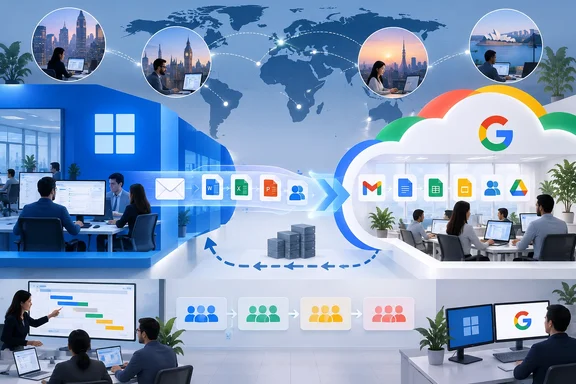
M365 administrators should know who is telling the story. ITWeb ran the item as material "issued by DigiCloud," Google's distributor and enablement partner for Africa. A companion case study, also on ITWeb, was issued by Smollan Technologies itself. That makes both documents vendor marketing about the vendor's own parent company. The numbers below may well be accurate, but nobody independent has audited them, and they should be read that way.
What Smollan and Argility say happened
According to the partner material, the business runs around the clock and had no acceptable outage window. Despite that, it reports:
- Zero downtime and zero data loss
- A 99.77% "verified success rate", a figure the material never defines
- 7.01 petabytes of data, 2.4 billion emails and about 290 billion documents moved, according to the case study
- More than 8,500 support queries resolved during the programme
The case study says the project ran from April 2024 to June 2026. It also describes Smollan as operating in more than 60 countries, while the migration covered "19+." So this was a group-wide productivity platform change, not a move covering every country the group touches.
CEO David Smollan said the group's technology estate is now "truly cloud-native" and called that a competitive advantage for a distributed business. That is an executive's description, not a technical audit. Note that the estate being described was already Microsoft 365, which is itself a cloud service.
Section summary: The scale is large, the claimed results are flawless, and the methods used to verify them are not published.
How the migration was run
This is the part with practical value for any IT team planning a large tenant migration, whichever direction it goes. The case study describes the method, and it is a recognisable playbook:
- Assessment and tenant design came first. The team says it finished a full environment assessment and designed the Workspace tenant (organisational units, admin roles, group hierarchies and domain configuration) before moving a single user.
- Identity was handled up front. Identity was synchronised with Google Cloud Directory Sync (GCDS), and single sign-on and MFA were set up before cutover.
- Coexistence instead of a hard cutover. Microsoft 365 and Workspace ran side by side for the whole transition, with dual-delivery mail flow meant to prevent lost email while mailboxes moved.
- Migration in cohorts. Users moved in groups ordered by business unit, geography and risk profile, under a dedicated project management office.
- Integrity checks and rollback. Each cohort had data verification before and after migration, a real-time dashboard for Smollan's IT team, and an active rollback protocol.
- Hyper-care. Each cohort got at least 30 days of post-go-live support, and Admin Console training was handed to internal IT.
Running two platforms in parallel is the key design choice. The case study says it avoided splitting the organisation mid-transition and gave every cohort a safe way back. That rings true from general migration experience: in a 24/7 business spread across time zones, a big-bang weekend cutover leaves no recovery window. The cost is complexity. Dual mail routing, directory sync and two sets of licences running at once are expensive and fiddly. The material doesn't say how long the overlap lasted or what it cost.
Section summary: Nothing in the method is exotic. The useful part is the order of the steps and the insistence on rollback paths at every stage.
The lesson Argility is selling
Japie Saunders, Argility's managing executive for Google solutions, says the main takeaway was not the migration tooling. In his telling, it was the champion network, the multilingual training (virtual, in-person and self-service), Gemini enablement that continued after go-live, and actually measuring adoption. His conclusion is that a technical deployment without real change management is a failed migration.
That applies to any platform, including Microsoft's. Any admin who has rolled out Teams to a workforce still using email attachments for version control will recognise the problem. It is also a convenient conclusion for a services firm, since change management is billable work. Both things can be true.
Saunders also says Argility moved its own business to Google in 2010, became a Google Premier Partner in 2024, and is now working toward Google's new Diamond partner tier. He says Premier status puts Argility in roughly the top 3% of Google partners worldwide. That ranking comes from the partner material and is not independently confirmed here.
The Workspace features in the pitch, checked against Google's documentation
Much of the DigiCloud piece is really about where Workspace is heading, not the migration. Here is what Google's own documentation supports:
- Workspace Intelligence. Google announced it at Cloud Next on April 22, 2026. Google describes it as a system that understands how content, projects, collaborators and organisational knowledge relate to each other across apps such as Docs, Slides and Gmail. That broadly matches Saunders' description, but it is Google's account of its own product.
- Workspace Studio. Google announced general availability on December 3, 2025, as a place to build, manage and share AI agents from natural-language instructions without coding. Saunders' example of a finance employee describing an invoice workflow in one sentence fits that design.
- Skills need a caveat. Saunders presents skills as reusable versions of how a company does things, something you could hand a new hire in their first week. Google's admin documentation currently says skills are only available to customers enrolled in the Gemini Beta program. Turning it on is not a single switch. Gemini Beta is turned off by default. Only an administrator can turn it on. In addition, when you enable access to these features, you enable access to all available Gemini Beta features. You can't control access to individual features. Admins then turn on skills separately under Apps > Google Workspace > Workspace Studio > Skills. One more limit: a skill directs how Gemini acts within its current capabilities. It doesn't grant Gemini new powers. A newer Workspace Updates post lists skills in Workspace across Business, Enterprise and some add-on editions, so availability looks like it is changing. Check your own Admin console before planning around it.
The governance claims mostly hold up, with narrower scope than Saunders implies:
- Google's August 2026 feature drop confirms that admins can view and suspend all agents, or revoke specific OAuth scopes on individual Studio flows.
- Gemini DLP currently restricts Gemini's access to Drive data based on content conditions and labels. Google says support for more services is "coming soon," so it does not yet cover everything.
- Studio DLP can block a flow from running or require end-user review based on data conditions.
- Data regions: Saunders says processing "can be pinned to a region." Google's Workspace Intelligence announcement names the US and EU, with countries such as Germany and India listed as future support. For a group headquartered in South Africa, that boundary matters.
- Client-side encryption: Google says it lets customers deny access to their most sensitive data to any agent or entity, including Google.
None of this material shows which of these controls Smollan actually uses, which Workspace edition it licenses, or whether any of it was involved in the migration.
What it means for Microsoft 365 shops
So should Windows and M365 admins expect a wave of defections? Probably not. One partner-run migration at a company that owns the partner is not a trend. The material includes no cost comparison, no productivity figures, no user-satisfaction data and no security outcomes.
The case study does criticise Microsoft 365 directly. It blames the platform for version conflicts, lost context across time zones and slower collaboration, and says it was poorly placed to embed Gemini. Those are the migrating party's claims, made in its own marketing, with no evidence offered. As general industry knowledge, Microsoft offers real-time co-authoring and Copilot across its apps, and version conflicts usually come down to how a tenant is configured and adopted as much as to the platform. Smollan may have had legitimate reasons to switch. The documents simply don't show them.
The case study also hints at what comes next: Chromebooks. It calls Chromebook adoption the natural next phase and backs that with claims of lower device costs, "near-zero malware incidents," and longer refresh cycles, again without data. For anyone managing Windows endpoints, that is the more relevant signal. Once the productivity suite has moved to the browser, the operating system on the desk is easier to swap out.
Bottom line: Smollan's move is a large, carefully staged migration, but the success figures come from the companies that did the work. The transferable lessons apply to any large tenant move: design the tenant before moving anyone, plan identity and mail coexistence carefully, migrate in cohorts with rollback paths, and keep measuring adoption well after go-live. Before you adopt the AI features in the pitch, check that they are actually turned on in your own Admin console.
References
- Greater than the sum of its parts: Google Workspace implementation to drive future innovation at Argility/Smollan Technologies - ITWeb ITWeb · 2026-10-01T06:31:43+00:00
- Case study: Smollan Technologies' Argility successfully completes world first – highly complex Google Workspace migration | ITWeb itweb.co.za
- New Workspace Intelligence delivers unified, real-time understanding to power agentic work. | Google Workspace Blog workspace.google.com