

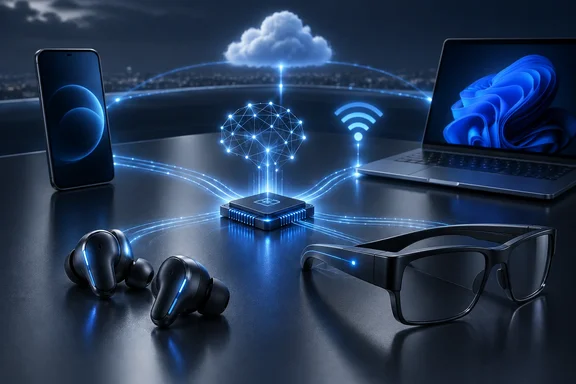
Snapdragon Sound Elite Gen 2 Puts the AI Workload Inside the Earbud
Qualcomm held this year's Snapdragon Summit in Maui, Hawaii. The company describes the platform as purpose-built for next-generation audio devices in what it calls "the agentic age," combining premium Snapdragon Sound technologies with on-device AI. It replaces the Snapdragon Sound S7 Gen 1 from 2023. Several independent outlets covered the announcement, including HotHardware, audioXpress, 9to5Google, CGMagazine and Android Central, and all of them report the same core specifications.
Qualcomm's pitch is about what the device does, not how it sounds. Ziad Asghar, Qualcomm's senior vice president and general manager of XR, Wearables, and Personal AI, said the company's research indicates "up to 70% of users want advanced AI capabilities in their wearable devices," and described the target experiences as "real-time translation, contextual assistance, personalized hearing, and multimodal interactions that combine audio, vision, and AI."
The platform does not arrive with any finished products attached. 9to5Google noted that Qualcomm didn't name any upcoming devices that will use the chipset. Qualcomm says it will provide reference designs to help manufacturers prototype and commercialize products. For buyers, that means the first Elite Gen 2 headsets depend on when brands like Sony, Bose, Cleer and others choose to ship them, not on Qualcomm.
Aroged described the change in plain terms: the platform treats wireless headphones not as peripherals but as small standalone computers. That is a fair summary of the design goal. Whether shipping products deliver on it depends on the manufacturers.
Inside the Silicon: eNPU, Cortex-M55 and a Split DSP Design
The biggest hardware addition is a dedicated neural engine. audioXpress reports that the eNPU provides up to 128 GOPS of AI acceleration, which Qualcomm describes as up to twice the on-device AI capability of the Snapdragon S7 Gen 1 Sound Platform. GOPS means billions of operations per second. That figure is tiny next to the NPU in a Copilot+ PC, but it is a big step for a chip that has to run all day on an earbud battery.
The rest of the chip splits work across specialized blocks. According to Aroged, the main processor is an Arm Cortex-M55, alongside the Qualcomm eNPU, a Hi-Fi 3 DSP audio subsystem for low-latency tasks and a pair of more powerful Hi-Fi 5 audio DSPs, so different types of load can be spread across dedicated units. Another summary of the summit specifications describes the same layout: three audio DSPs, a dedicated low-latency DSP for active noise cancellation, the eNPU accelerator and framework, and a multi-core application processor.
Splitting the chip this way explains how Qualcomm can claim the platform "is able to run multiple intelligent experiences simultaneously." Noise cancellation has to react within microseconds, so it runs on its own DSP. AI inference runs on the eNPU. The application processor handles connectivity and whatever agent software the manufacturer ships. As a result, a translation model running in the background should not interrupt ANC or music playback. That is an inference from the architecture; nobody has tested it on shipping hardware yet.
Reading Qualcomm's 2x, 40% and 30% Claims Against the S7 Gen 1 Footnotes
All three headline numbers are comparisons with the S7 Gen 1, and all are "up to" figures. The platform claims up to a 30% smaller footprint and up to 40% lower power draw. The fine print varies a lot from claim to claim.
The AI claim is the easiest to check. Qualcomm's specifications show Snapdragon Sound Elite Gen 2 reaching a peak of 128 GOPS and 256 MACs per cycle, versus 64 GOPS and 128 MACs per cycle for the S7 Gen 1. Qualcomm's footnote says both figures are measured at 250 MHz and that the comparison was run internally in July 2026. This is a peak-compute figure. It does not tell you how quickly any particular translation or assistant feature will respond.
The power claim is much narrower than the headlines make it sound. Qualcomm's footnote says the 40% figure comes from a Wi-Fi-connected idle scenario, comparing a simulated 0.6 mA target with a 1.0 mA comparison target. The Elite Gen 2 number comes from design simulation and is still subject to final silicon measurements. The footnote also mislabels the comparison figure as belonging to Elite Gen 2 itself. The footprint footnote has the same labeling error: it gives 31.185 mm² for Elite Gen 2 and 44.2225 mm² for the comparison part.
Some coverage treats the power figure as a battery-life promise. 9to5Google, for example, wrote that the SoC is poised for AI wearables with local and online models that should need less frequent charging. The footnote supports something smaller: lower idle current while connected to Wi-Fi, based on simulation. Real battery life will depend on the manufacturer's battery size, how often the radios run, and how much AI work the device actually does.
Micro-Power Wi-Fi 6E Makes the Phone Optional
The feature most likely to change how people use these devices is the new radio. Qualcomm built its micro-power Wi-Fi 6E module into the platform, which gives audio devices a low-power route to cloud AI services without sending everything through a smartphone. Aroged reports that the chip can connect on the 2.4, 5 and 6 GHz bands and talk directly to cloud services.
Bluetooth is still there. HotHardware reports a dual Bluetooth radio architecture supporting Bluetooth 7.0 with Higher Bands readiness, along with Qualcomm's Expanded Personal Area Network (XPAN) technology for wider whole-home coverage. One secondary summary lists Wi-Fi 6E and XPAN as if they were the same thing. Qualcomm's own product page describes them as separate technologies that work together, with XPAN extending audio connectivity beyond normal Bluetooth range.
On the software side, Qualcomm is introducing Snapdragon Sound Apps & Agents, a way to deliver AI assistants, services and content straight to the wearable and let those features change over time. Qualcomm has not said which assistants or services will be available, which cloud providers are involved, what accounts are required, or how Wi-Fi setup will work on a device with no screen. Readers who manage devices should hold off on deployment planning until those details exist.
For Windows users, the practical effect is that the PC may no longer be the device doing the work. Aroged frames the platform as built for wearables that can work entirely on their own, without a smartphone, tablet or PC. A headset that reaches its assistant over Wi-Fi does not need the PC for AI tasks, though it will presumably still pair with the PC for calls and audio. Qualcomm has not published any Windows-specific compatibility information.
aptX Lossless, XPAN and 5th-Gen ANC Keep the Audio Core Intact
Audio quality remains part of the package. CGMagazine lists aptX Lossless, improved Adaptive ANC, smarter transparency modes and better microphone processing for clearer calls and more reliable voice interaction. The platform supports audio streams up to 24-bit/96kHz using Qualcomm aptX Lossless. As with earlier Snapdragon Sound products, both ends of the connection need to support the codec for you to get lossless playback.
Noise cancellation moves to Qualcomm's fifth-generation Adaptive ANC. HotHardware says it uses dedicated hardware and AI to keep adjusting in real time, whether you turn your head, move somewhere noisier, or the fit in your ear changes. Qualcomm has not published figures for how much the ANC improves, so this should be treated as a design claim until reviewers test it.
Microphones get more attention than usual, because voice is now the main way you control the device. The new Snapdragon Audio Sense Solution combines multiple microphones with AI algorithms to pick up the wearer's voice and nearby sounds, and Qualcomm's cVc (clear voice capture) technology handles voice on calls. For anyone who spends the day on Teams calls from a headset, better voice capture would be the most noticeable improvement. It is also the one that most needs independent testing.
Camera Earbuds and the Cleer Concept Show Where Qualcomm Is Aiming
The list of target device types reaches well beyond earbuds. Qualcomm lists traditional earbuds and headphones as well as "open-ear hybrid audio designs, camera-enabled devices, audio glasses, and future multimodal wearables." 9to5Google highlighted the contextual image recognition planned for camera-equipped earbuds. Qualcomm describes these cameras as a way to understand the wearer's surroundings, not as a way to take photos.
Cleer showed a concept at Snapdragon Summit 2026 that combines audio, vision and AI on a Snapdragon Sound platform. Qualcomm called it an early look at a new class of wearables. It is a demonstration only: no commercial Cleer product, price or final specifications were announced.
Camera-equipped wearables raise obvious privacy questions, and so far Qualcomm has not answered them. It has not said when the cameras activate, whether images are stored or sent to the cloud, or how the wearer controls sensing. Organizations with rules about recording devices in offices or secure areas will need those answers before camera earbuds are allowed in.
What This Means for Buyers and IT Admins Planning Headset Purchases
There is nothing to buy or deploy yet. The practical move is to fold this platform into your plans for the next headset refresh, not to change what you're buying now. Existing earbuds and headsets will not get these features through a software update, because the gains come from new silicon. The more significant change is architectural. Once headsets have their own Wi-Fi connection and cloud agents, they become network devices in their own right, and security and IT teams will eventually need to treat them that way.
- Snapdragon Sound Elite Gen 2 is a chip platform announced on September 23, 2026, and no retail products or ship dates have been announced.
- Qualcomm's 2x AI figure compares peak eNPU compute (128 vs. 64 GOPS) with the S7 Gen 1 and does not measure real-world assistant speed.
- The 40% power figure comes from a simulated Wi-Fi-connected idle scenario that has not yet been confirmed on final silicon, so it does not promise longer battery life.
- Direct Wi-Fi 6E connections to the cloud mean future headsets could reach AI services without a phone or PC, which raises network-access and data-handling questions for managed environments.
- Camera-equipped earbuds and glasses are an explicit target, and Qualcomm has not yet explained how camera activation, image storage or user controls will work.
- Anyone who needs aptX Lossless playback should confirm that both the headset and the source device support it before buying.
The first Elite Gen 2 headsets will show whether manufacturers make standalone Wi-Fi connectivity and on-device AI the main feature or treat them as extras on top of a conventional earbud. Until then, the 40% power figure is a simulation, the Cleer device is a concept, and the details of Snapdragon Sound Apps & Agents are still unknown. What is settled is the direction Qualcomm has chosen: headsets that connect to the network themselves instead of acting purely as audio accessories for a phone or PC.