

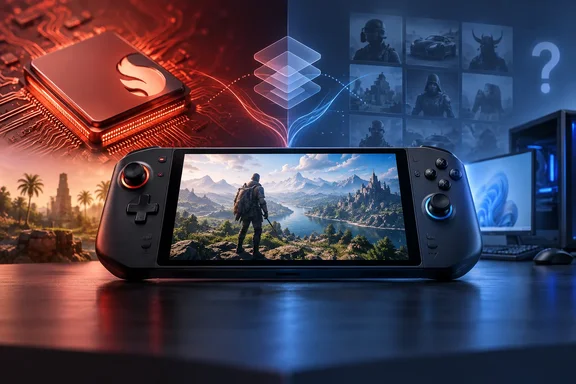
Qualcomm's Snapdragon X2 handheld comments amount to an open door
The exchange took place at a roundtable. XDA's reporter asked Kedar Kondap, Qualcomm's GM of Compute and Gaming, whether Snapdragon X series chips like the X2 Elite Extreme, X2 Plus or X2 Elite might eventually appear in a Windows 11 gaming handheld similar to the ROG Xbox Ally X. Kondap did not say such a device is actually happening. He did stress that "the interest is pretty high in terms of gaming devices," and said that from a technical standpoint nothing prevents a manufacturer from using a chip such as the 18-core X2 Elite Extreme in a dedicated handheld.
His main argument was that Qualcomm works across several operating systems. XDA quotes him as saying Qualcomm already has multiple handhelds on the market, "but not with the X series," and that those use the company's mobile and gaming-specific platforms. XDA is the only outlet carrying these roundtable comments, and no official transcript has been published. The quotes are best read as Kondap's reported words, not as a Qualcomm roadmap.
So the news is narrow. Qualcomm says it is possible and says OEMs are interested. That is a long way from a device announcement, but it is the clearest public signal yet that Qualcomm sees its laptop silicon as a candidate for the handheld category Microsoft and Asus have been building around the ROG Xbox Ally.
Where Qualcomm already sells handheld chips, and where Snapdragon X2 would be new
Qualcomm is already in handhelds, just not Windows ones. XDA notes that Snapdragon G-Series chips have so far appeared only in Android-focused handhelds from companies like Retroid, OneXPlayer and Ayaneo. The G-Series comes in tiers. According to GSMArena's coverage of the launch, the Snapdragon G1 Gen 1 targets fanless game-streaming handhelds, the G2 Gen 1 is meant for mobile and cloud gaming, and the G3x Gen 2 at the top of the range is aimed at flagship handhelds promising PC-level gaming on the go. Even the top G-Series tier runs Android, not Windows.
Kondap also pointed to older consumer examples. He mentioned the Snapdragon 680 in the streaming-focused PlayStation Portal and the Snapdragon 720G in the Lenovo Legion Play. In his words, "There are [gaming] devices already [that feature Qualcomm chips]. They range from streaming-only devices to devices that can run native games, to handhelds purpose-built for gaming. The first two we already have in market."
Put simply, Qualcomm has streaming handhelds and native Android gaming handhelds on sale. What it lacks is a purpose-built Windows gaming handheld. That third category is where an X2 chip would go. It would put Qualcomm in direct competition with AMD's Ryzen Z2 family and Intel's Panther Lake parts, on an operating system where most of the game library is compiled for x86.
What the Snapdragon X2 Elite Extreme brings to a handheld
On paper, the X2 family is a reasonable fit. Qualcomm's X2 Elite product brief lists the Extreme parts (X2E-96-100 and X2E-94-100) with 18 CPU cores, an Adreno X2-90 GPU running up to 1.85 GHz, 53 MB of cache and memory bandwidth of up to 228 GB/s. The 18-core non-Extreme Elite parts (X2E-90-100 and X2E-88-100) also use X2-90 graphics, but with GPU clocks up to 1.70 GHz and bandwidth up to 152 GB/s. There are also 12-core X2 Elite models with the smaller X2-85 GPU, so "X2 Elite" does not describe a single configuration. The brief lists DirectX 12.2 Ultimate and Vulkan 1.4 support. The headline 5.0 GHz boost applies only when one or two cores are loaded, not to the sustained all-core clocks a handheld would run while gaming.
Qualcomm's own gaming claims are bold. When the X2 launched, PC Gamer reported Qualcomm's figures that Black Myth Wukong runs 2.1x faster than before on first-generation Snapdragon X, and that the second-gen Snapdragon X is said to be 52% better than Intel's Lunar Lake laptop chips on GPU efficiency. PC Gamer pointed out that the same performance at lower power would suit a handheld PC well. These are vendor numbers, and they describe laptop platforms.
XDA makes its own comparison, saying the Adreno X2-90 GPU in the X2 Elite Extreme is somewhat comparable to Intel's Panther Lake-based Arc B390 integrated graphics, which is featured in the MSI Claw 8 EX AI+. That is a rough performance-class estimate, not a like-for-like benchmark at matched power limits.
There is one independent data point at handheld power levels. TweakTown reported in April on a YouTuber who tested the Snapdragon X2 Elite in its low-power mode to see if the chip could be used in a handheld PC. The result was playable gaming at 17-20 watts, matching or exceeding AMD Ryzen Z2 Extreme in some tests. The same testing found that game crashes, compatibility issues, and high core counts hinder handheld adoption. This was a laptop chip running at reduced power, not a finished handheld with its own cooling, battery and display. Those design choices would decide real frame rates, heat and battery life, and nobody has shown one yet.
Prism emulation sits between Snapdragon X2 and most Windows games
An X2 handheld running Windows 11 would be a Windows on Arm device. XDA notes that many x86/x64 Windows games would need to run through Microsoft's Prism translation layer on an Arm64 Snapdragon X2 handheld. XDA argues that the Steam Deck avoids this particular problem. It is also x86, so Proton only has to translate Windows APIs, not CPU instructions, and AMD-based Windows handhelds like the ROG Xbox Ally X run x86 games natively.
Microsoft's documentation says Windows on Arm PCs run x86 and x64 applications through Prism emulation. Microsoft adds that Prism is tuned by default to balance performance against compatibility, and that optional per-app settings exist for the "uncommon event" that an app misbehaves. Prism has also been expanding. On Windows 11 24H2 and later, it supports CPU features earlier versions lacked, including AVX, AVX2, BMI, FMA and F16C. Games that need AVX2 used to be a well-known failure case on Arm.
If a game won't run properly under Prism, Microsoft documents a per-app path:
- Right-click the game's executable and choose Properties.
- Open the Compatibility tab and find the Windows on Arm section.
- Select Change emulation settings to open the Arm emulation settings window.
- Try one of the presets (Default, Safe, Strict or Very strict), or choose Use advanced settings to change individual options such as multi-core behavior or the application cache.
Each step from Default toward Very strict trades performance for possible compatibility. The multi-core options add memory barriers that slow the app but reduce emulation errors. There is also an option to hide newer emulated CPU features, which returns an app to the previous Prism feature level if a recent change broke it. Microsoft warns that changing emulation settings might cause an application to crash or not launch at all, so these are troubleshooting tools with no guarantee. For a handheld buyer, the point is that performance-hungry games are the ones least able to spare the speed lost to stricter emulation.
Anti-cheat is the harder wall for Windows on Arm handhelds
Emulation covers application code. It does not cover kernel drivers. Microsoft's Arm FAQ says some games fail because they depend on anti-cheat drivers that weren't built for Windows 11 Arm-based PCs, and it tells players to check with the game's publisher or a community compatibility list. XDA reports that anti-cheat problems currently keep several major multiplayer games, including Valorant, Sea of Thieves and Rocket League, off Windows on Arm. Support changes title by title, so treat that list as a snapshot as of this week, not a permanent verdict.
Things have moved in the past year. Microsoft's Windows Experience Blog on December 9, 2025 described Prism's AVX/AVX2 support and local installs through the Xbox PC app for supported titles on Windows Insider Arm devices. It also said Easy Anti-Cheat had added Windows on Arm support through work with Epic, Qualcomm and Microsoft, and named BattlEye, Denuvo and XIGNCODE3 among anti-cheat systems with Arm support. Kondap made the same point at the X2 launch, telling BusinessWorld that Epic had brought Easy Anti-Cheat to Windows on Snapdragon and solved that problem, and that Fortnite is now available on Snapdragon.
Anti-cheat support at the vendor level does not mean every game that uses that anti-cheat works. Each publisher still has to ship and certify support. Qualcomm's broader compatibility claim reflects this. Windows Central reported in November 2025 that Qualcomm says Snapdragon X2 laptops can run 90% of top Windows games. That is a vendor figure about laptops, and the other 10% probably includes exactly the competitive multiplayer games handheld owners care about.
What this means for you
If you're buying a Windows gaming handheld today, the decision is simple: there is no Snapdragon X2 handheld to buy, and Qualcomm has not said one is coming. Choose between the AMD and Intel x86 handhelds on the market on their own merits. If you mainly play single-player games that already run well on Snapdragon X laptops, it may be worth waiting to see whether an OEM announces an X2 design. If your library includes kernel-level anti-cheat titles, an Arm handheld is the riskiest choice until those publishers support Arm.
- Kondap's reported comments confirm OEM interest and technical feasibility, not a product. No manufacturer, model, price or launch window has been named.
- Qualcomm's current handheld chips are the Android-focused Snapdragon G-Series. An X2 handheld would be Qualcomm's first purpose-built Windows gaming handheld.
- Independent low-power testing reported by TweakTown found X2 Elite gaming playable at 17–20 W and competitive with the Ryzen Z2 Extreme in some games. The same testing also found crashes and compatibility problems.
- x86 games would run through Prism emulation. On Windows 11 24H2 and later, Prism adds AVX and AVX2 support, and per-app emulation presets are under Properties, then Compatibility, then Windows on Arm.
- Anti-cheat is still the deciding factor for multiplayer. Check each game's publisher for Arm support, because Easy Anti-Cheat or BattlEye support at the vendor level does not mean every title works.
- If you already own a Snapdragon X laptop, the games you can and can't run on it are the best guide to what an X2 handheld would handle.
Qualcomm now has the silicon, the stated interest and a Windows on Arm platform with emulation and anti-cheat support that has improved noticeably since late 2025. None of that makes the handheld exist. The next thing to watch for is an OEM announcing an X2-based design, and until one does, anyone who needs a handheld now is better off with an AMD or Intel device than waiting on a device that may never be made.