

The important distinction: this is a partner-program announcement, not a Microsoft product launch or proof of a successful autonomous-agent deployment. For IT teams, its value lies in understanding what the recognition signifies—and what still needs scrutiny before an agent gets permission to change business records.
What the sixth Inner Circle recognition means
In Sonata’s announcement, distributed through PR Newswire, Microsoft representative Niels Jensen describes Inner Circle members as Microsoft’s top-selling partners worldwide. He also emphasizes collaboration with Microsoft, shared experience and innovation within its AI Business Solutions ecosystem. That gives the award a clear sales-performance dimension alongside the engineering and customer-success positioning.
The award count has supporting historical context. Sonata’s September 23, 2025 announcement identified the 2025–2026 award as its fifth recognition and explicitly described Inner Circle membership as based on sales achievements. The sixth-award claim follows that earlier disclosure, although these announcements do not establish a complete year-by-year history of all six awards.
For an enterprise evaluating implementation partners, that is a useful credential—not a substitute for evaluating the proposed solution. A partner’s commercial standing and a particular agent’s operational reliability are different questions.
What is expanding in the Microsoft relationship?
Sonata says it recently joined Microsoft’s Copilot Agents & Platform, or CAP, Engineering Depth Partners program, deepening engagement with Microsoft Engineering and Product teams around agentic AI. The announcement does not specify an entry date, customer entitlements or resulting product features, nor does it disclose a new contract or investment. “Expanded partnership” here means deeper program and engineering engagement, rather than a newly announced commercial deal.
The accompanying Frontier Partner status is not entirely new. Sonata announced that designation on March 3, 2026, describing its scope across Cloud & AI Platforms, AI Business Solutions, and Security. The October announcement therefore brings an existing designation into the company’s latest account of its Microsoft relationship.
StartUp Beat reports that Sonata’s Microsoft-related capabilities span Dynamics 365, Azure, Microsoft Fabric, Power Platform and Copilot, supported by a relationship the company says exceeds three decades. These are the platforms around which Sonata is positioning its enterprise-AI work; the article does not identify a new customer deployment across them.
The practical takeaway: the recognition and program participation are signals about partner positioning and engagement. They do not, by themselves, establish what a customer will receive.
From generating answers to executing work
StartUp Beat frames the development around a distinction between AI that produces responses and agents that retrieve business information, select a workflow and initiate an action. It also reports Sonata’s positioning of Harmoni.AI around modernization, AI-ready data, resilient AI operations and AI-led service delivery. Those are company-described capabilities and intended outcomes, not independently measured deployment results.
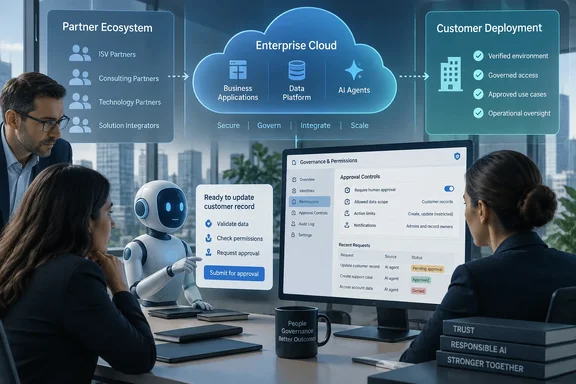
Microsoft’s own governance documentation provides a more concrete way to assess that shift: distinguish agents that assist from agents that execute. Drafting a response leaves a person responsible for the next step. Updating a customer record, submitting a ticket or moving money changes a system of record and requires different oversight.
That is the real enterprise boundary. A polished answer can be reviewed before use; a completed transaction may already have consequences. The badge on the partner’s presentation does not decide where that boundary belongs.
Microsoft documents controls administrators can verify
There is useful implementation context beyond the award announcement. Microsoft Learn documents that Copilot Studio data policies, configured through the Power Platform admin center, can govern agent connections and capabilities. Administrators can restrict knowledge sources, connector-based tools, HTTP requests, publication channels and event triggers.
One specific example concerns authentication. Microsoft documents that blocking the connector named “Chat without Microsoft Entra ID authentication in Copilot Studio” prevents makers from publishing agents that do not require authentication. It also notes that blocking locally uploaded document knowledge sources does not block SharePoint or OneDrive knowledge sources; those use a separate policy connector.
That distinction matters when assessing an implementation proposal. “We applied a data policy” is less informative than a clear account of which sources, tools and channels it restricts.
These are Microsoft platform controls, not evidence that Sonata has configured them in any particular customer environment.
Questions to ask before granting an agent authority
Microsoft’s risk-based governance guidance recommends lighter oversight for low-risk productivity agents and stronger controls for business-critical or external-facing agents. For high-risk agents, it identifies requirements including a process owner, security review, responsible-AI assessment, explicit decision rights and an incident-response plan.
Applied to a partner evaluation, that guidance suggests asking:
- What may the agent decide alone? Separate recommendations from authorized changes.
- Who owns the business process? Establish accountability beyond the development team.
- What requires human approval? Define that boundary before production use.
- How will failures be detected and handled? Request monitoring and incident-response arrangements.
- What evidence demonstrates success? Ask for task-specific validation rather than relying on partner credentials.
These are evaluation questions derived from Microsoft’s governance framework, not claims about an existing Sonata deployment.
The bottom line
Sonata’s sixth Inner Circle recognition and deeper CAP program involvement are concrete developments in its Microsoft enterprise-AI relationship. They support a story about implementation capacity and partner engagement—not a demonstrated leap to safe autonomous operations.
For organizations considering agents across Microsoft business systems, the sensible next step is to translate that positioning into a verifiable deployment plan: defined authority, enforceable access controls, accountable ownership and measurable results. Recognition can help start the conversation. It should not finish the technical evaluation.
References
- Sonata Software expands Microsoft partnership around enterprise AI and agentic technology - StartUp Beat StartUp Beat · 2026-10-07T21:21:11+00:00
- Sonata Software earns sixth Microsoft Inner Circle recognition as enterprise AI shifts toward agentic systems sociable.co · 2026-10-07T21:15:24+00:00
- Sonata Software Achieves the 2026-2027 Microsoft AI Business Solutions Inner Circle Award prnewswire.co.uk