

The regional leadership claim holds up. The timing needs a correction. The op-ed calls the Q1 report "the latest," but Microsoft published a newer quarterly edition eight days before the piece ran. What follows separates the verified numbers from the vendor's own observations.
What Microsoft's Q1 2026 numbers say about South Africa
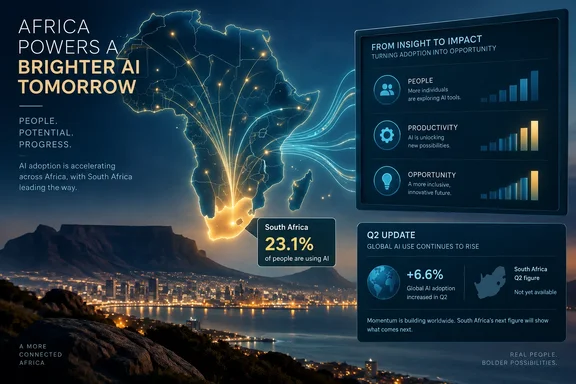
The key figure is 23.1%. Engineering News, reporting on the Q1 release, said South Africa ranks forty-sixth out of the 147 economies measured for the report, and its AI use increased by two percentage points to 23.1% in first quarter of the year, up from 21.1% in the second half of 2025. Ecofin Agency put the year-on-year change more sharply: the figure was compared with 19.3% during the same period a year earlier.
South Africa also led the continent by a wide margin. Ecofin's African ranking shows how wide: with a usage rate of 15.1% during the first three months of 2026, Namibia ranked second in Africa, ahead of both Libya and Gabon at 15%, followed by Egypt and Botswana at 14.8%. That is an eight-point lead over the second-placed country, so Fourie's line that South Africa is "comfortably ahead" of the rest of Africa is fair.
The global picture from the same report:
| Metric (Q1 2026) | Figure |
|---|---|
| Global working-age usage | 17.8% (up from 16.3% in H2 2025) |
| Economies above 30% | 26 |
| Global North vs Global South | 27.5% vs 15.4% |
| South Africa | 23.1%, 46th of 147 |
Those figures come from Business Day's coverage, which said AI adoption continues to accelerate globally, rising to 17.8% of the population in the first quarter from 16.3%. Engineering News added that 26 economies now exceeding 30% of the working age population using AI. Microsoft's own blog put usage now at 27.5% in the North and 15.4% in the South.
Fourie's comparisons with Japan, Brazil, India and China also match the Q1 country table cited in the op-ed's references: Japan 22.5%, Brazil 19.1%, India 17.6% and China 16.4%. Microsoft's September blog separately confirms Japan's Q1 usage of 22.5%.
Section summary: South Africa's continental lead is real and large. Globally it sits mid-table: above the world average, below the North average, and well behind the leaders.
The Q2 report that arrived first
On September 21, 2026, Microsoft published its Q2 edition. Chief data scientist Juan Lavista Ferres wrote that in June, AI usage was 18.8% of the working-age population worldwide, an increase of about 1% from the first quarter of this year. He added that growth was broad-based: almost every economy saw increased usage.
Other headline changes in Q2:
- The leaders pulled further ahead. Quartz reported that the UAE led all countries at 73.3%, followed by Singapore at 64.3%, Ireland at 49.9%, and France at 49.6%.
- South Korea kept gaining. It posted the largest absolute gain among major economies, adding 3.5 percentage points to reach 40.6% and climbing from 16th to 12th in the rankings.
- The North-South gap widened. According to the Q2 report, 28.8% of the population in the Global North used generative AI, up from 27.5% in Q1 2026, a gain of 1.3 percentage points. The Global South reached 16.2%, up from 15.4%.
The Global South's gain was smaller than the North's, so the gap grew again. That matters for Fourie's argument: a regional leader can still lose ground to the global leaders.
The Q2 material reviewed here does not clearly state South Africa's own Q2 figure or its African ranking. Readers should treat the 23.1% as the Q1 figure, not the current one. Microsoft has also flagged a change to its method: it plans to expand its measurement methodology in the next report to include additional AI tools, an update it expects will raise measured diffusion across nearly all countries, with the largest projected increases in China. Comparisons across that change will need care, because some of any apparent jump will come from the new method rather than new users.
Section summary: The op-ed's numbers were accurate for Q1 but already a quarter old when it ran. The newer data shows global growth continuing and the North-South gap widening.
What the metric does and doesn't measure
"23.1% AI adoption" is easy to misread. Microsoft measures the share of people worldwide between ages 15 and 64 who have used a generative AI product during the reported period. The estimate is derived from aggregated and anonymized Microsoft telemetry and adjusted to reflect differences in OS and device-market share, internet penetration, and country population.
In practice that means:
- It is an estimate, not a count. No one surveyed South Africans. Microsoft infers usage from its own telemetry and scales it up.
- It covers the working-age population, not workers. Teenagers and unemployed adults are included. Retirees are not.
- Microsoft admits the method has limits. Its own framing is that no single metric is perfect, and this one is no exception. The underlying arXiv paper by Misra, Lavista Ferres and colleagues also notes that relying only on Microsoft telemetry may introduce biases linked to Microsoft's user base.
None of this makes the figure useless. It is consistent across countries and updated often. It is still an indicator, not a census.
4Sight's Copilot data: an interesting claim that can't be checked
This is where the op-ed shifts from public data to its own evidence. Fourie says that among 4Sight employees with Microsoft Copilot access, "almost everyone" actively used it over a 28-day period. His references cite the company's Microsoft 365 Copilot Dashboard in Viva Insights, covering 1 March to 30 August 2026 and extracted on 13 September. That dashboard is internal and access-restricted.
Nobody outside 4Sight can verify these figures, and the piece gives no headcount, licence count or exact percentage. Two qualifications apply:
- The group was already selected. "Almost everyone with access" leaves out everyone without a licence. A company that sells Microsoft services, measuring employees it chose to license, is not a random sample of South African employers.
- One company can't confirm a national figure. Fourie admits this, saying he can't settle the question "from a single report and a single company dashboard." He suspects the national 23% hides a split between industries that have fully adopted AI and industries that have barely started. That is a reasonable hypothesis, but it is still a hypothesis.
Why convenience may matter more than capability
Fourie's most practical point for IT administrators is his observation that Copilot use was "much higher" among employees who could reach it inside Word, Excel, Outlook and Teams than among those who had to open a separate app. He gives no numbers, sample size or method, so this is an internal impression, not a controlled finding. It is still a familiar pattern: every extra step between a user and a tool loses some users. As Fourie puts it, the gap between intention and usage is often "a few extra clicks."
For Microsoft 365 administrators planning a Copilot rollout, the lessons from his account are:
- Measure active use, not licences. 4Sight says it judges success by how many people use AI in daily work. The Copilot Dashboard's 28-day active-use view, which Fourie cites, is built for this.
- Treat unused licences as a cue for training, not a verdict. Fourie calls his non-users "our next opportunity."
- Put the tool where people already work. If some users only have Copilot in a separate app, it's worth checking whether that alone explains lower usage before concluding that people don't want it.
- Pay for skills as well as seats. 4Sight says it trains people to ask better questions and judge the answers they get.
Governance, security and compliance still matter. Fourie says so himself. His argument is that simplicity deserves as much attention in the rollout plan.
The developer-jobs argument, with its limits
Fourie cites the report's software-development section: AI makes coding cheaper, code production is rising, and developer employment is still growing. The Q1 report cites a 78% year-on-year rise in global Git pushes, and U.S. software-developer employment of about 2.2 million in 2025, up 8.5% year on year. Business Day summarised the theme as software development being where new coding models and agentic tools are dramatically increasing code production, repository creation and related activity.
The limits matter. The employment data is from the United States, and Microsoft says it is too early to judge the full effect on jobs. Fourie's comparison with cloud computing and smartphones, where cheaper technology led businesses to build more rather than hire less, is a plausible economic argument. It is not proof that South African developers are safe. Local context helps a little: Engineering News reported that South Africa, with more than 500 000 developers and a growth rate of nearly 15% between 2019 and 2024, ranks alongside Egypt and Nigeria as one of the continent's largest developer hubs.
The bottom line
A few things to keep in mind:
- This is vendor thought leadership. The piece was issued by 4Sight, a Microsoft partner, and its only non-public evidence is a Copilot dashboard nobody else can check. It is mostly a policy argument rather than a sales pitch, but its optimism suits the company that wrote it.
- The public facts are solid. In Q1 2026 South Africa led Africa at 23.1%, eight points ahead of Namibia, and ranked 46th worldwide.
- The context is less flattering. The world's leaders are far ahead, and the North-South gap widened again in Q2.
Fourie ends by calling South Africa's position "the starting line." That fits the data. South Africa's lead is clear within Africa. Globally, whether its growth is fast enough to catch the leaders is still an open question.
References
- SA is Africa's AI leader. That is only the beginning - ITWeb ITWeb · 2026-09-29T06:32:00+00:00
- (2511.02781) Measuring AI Diffusion: A Population-Normalized Metric for Tracking Global AI Usage arxiv.org
- South Africa Tops African Generative AI Adoption Rankings in 2026 Microsoft Report - Ecofin Agency ecofinagency.com