

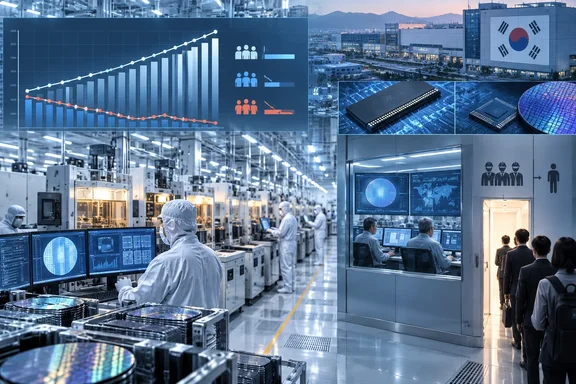
Chosunbiz first highlighted the contrast, and Yonhap and News1 separately reported the same Ministry of Data and Statistics figures. Semiconductor manufacturing employment was up 14.5% from 152,000 positions in the first quarter of 2018, while total manufacturing employment rose only 1.6% over the same period. That is meaningful growth in a sector at the center of global supply-chain planning. But the hiring composition matters more for workers, universities, suppliers and governments attempting to turn semiconductor investment into wider employment.
The numbers show an industry becoming larger without becoming proportionately more open to new entrants.
A record workforce, dominated by continuing positions
The 174,000 figure measures wage jobs in South Korean semiconductor manufacturing, not the number of unique people who walked through a fab gate during the quarter. These administrative job statistics distinguish jobs retained by the same worker from openings filled by someone new, and from positions created as companies expand or new businesses begin operations.
Continuing jobs reached 146,000 in the first quarter, an all-time high. In plain terms, the strongest part of the employment story is retention: existing positions and their incumbents account for most of the sector’s growth. Semiconductor manufacturers need experienced engineers, process specialists, equipment technicians, facilities staff and production workers to keep complex plants operating, especially as memory manufacturers push advanced DRAM and high-bandwidth memory output.
That stability should not be dismissed. A job base that expanded through the semiconductor downturn of 2024 and then rose for two consecutive years shows that South Korean fabs did not simply treat their core workforce as a temporary response to a favorable pricing cycle. For companies such as Samsung Electronics and SK hynix, preserving accumulated process knowledge is a strategic necessity. Training a worker for a highly controlled semiconductor production environment is slower and more expensive than filling a conventional manufacturing vacancy.
Yet the same feature limits the immediate labor-market payoff. A sector can post record employment while offering relatively few ways in for graduates, displaced workers or people changing careers. The statistic does not demonstrate a hiring freeze; 29,000 jobs were filled by people new to those positions. It does show that the share of such jobs has fallen sharply, from 24.3% in early 2018 to 16.7% this year.
The 29,000 figure is broader than net new jobs
“New hires” is an easy phrase to overread. The 29,000 jobs reported for the first quarter include replacement hiring—people filling jobs after a retirement, departure or role change—as well as jobs created through expansion. They should not be treated as 29,000 additional semiconductor positions.
The more revealing figure is 15,000: the reported number of net new jobs. That was down 25% from 20,000 in the first quarter of 2018, despite the sector’s total job count being at its highest point in the series. Based on the rounded figures, roughly 14,000 of the 29,000 positions filled by new workers were replacement positions rather than added capacity.
That distinction changes the practical reading of the data. A jobseeker can still be hired by a chip maker or a chip-production contractor when an existing worker leaves. But replacement demand does not expand the industry’s employment footprint. It maintains it.
The Ministry of Data and Statistics’ broader first-quarter release, reported by Yonhap in August, found that 74% of all South Korean wage jobs were held by the same worker as a year earlier, while 15.3% were filled by new workers after the prior holder retired or changed jobs. Semiconductor manufacturing’s 16.7% figure therefore is not radically outside the national pattern, but it does not support a narrative of exceptional new-hire creation in the chip sector either.
The data also cannot answer the question most relevant to prospective hires: which roles are being added or replaced. The published figures do not break the 174,000 jobs into design, fabrication, packaging, equipment service, facilities, software, quality assurance or management. They also do not identify employers, regions, pay, contract type, education requirements or whether new positions are concentrated around a small number of plants. A headline about “chip jobs” should not be mistaken for evidence that every part of the semiconductor labor market is expanding equally.
Capital intensity explains much of the mismatch
The Bank of Korea’s 2023 input-output data put the semiconductor industry’s employment-inducement coefficient at 2.4 people per 1 billion won of output or final demand. The manufacturing average was 5.1, and the all-industry average was 8.2.
This is not a measure of headcount at a single company. It estimates the direct and indirect jobs associated with demand across the economy. Even so, it captures the central issue: semiconductor manufacturing absorbs enormous capital investment in cleanrooms, lithography tools, deposition equipment, metrology systems, chemicals, wafers, power and water infrastructure. Those investments generate substantial output and revenue without requiring labor growth in proportion to the money committed.
The Bank of Korea made the broader point in an August research note on the current semiconductor upturn. It said the sector’s relatively low production and employment inducement effects, reliance on imported production equipment, and outward investment tied to supply-chain restructuring can limit the spillover from chip gains into domestic demand. Strong semiconductor pricing can raise national income while the benefits remain concentrated among manufacturers, shareholders, suppliers and workers already inside the industry.
That does not make chip investment unimportant to employment. A modern fab still requires specialized construction, utilities, logistics, materials and equipment support, and a healthy semiconductor base supports some domestic suppliers. But the jobs effect is narrower than the export figures suggest. The physical and technical characteristics that make a fab productive—automation, yield optimization, high equipment utilization and extreme precision—also make it a poor substitute for labor-intensive growth.
Why this matters beyond South Korea’s labor report
For the global PC and enterprise technology market, South Korea’s semiconductor workforce is not an abstract economic statistic. Samsung and SK hynix are central suppliers of memory used in laptops, desktops, servers, AI systems, storage products and data-center infrastructure. Their ability to retain specialized staff affects ramp schedules, yields and the resilience of supply for DRAM, NAND and high-bandwidth memory.
But the report is also a corrective to a common policy assumption in the United States, Europe and Asia: that subsidizing chip capacity automatically produces a large, durable local manufacturing workforce. Construction phases can be labor-intensive, and advanced-fab operations unquestionably create high-value jobs. The operating model that follows is far more selective. Plants depend on a smaller, deeply trained workforce managing highly automated production tools, while large portions of the equipment supply chain may sit outside the country where wafers are manufactured.
For enterprise IT leaders, the takeaway is indirect but concrete. Semiconductor supply risks should be assessed through capacity, technology nodes, memory mix, equipment access, geographic concentration and workforce retention—not by headline job totals alone. A rising employment figure may signal operational stability. It does not necessarily signal a surge in available technical labor or a broad increase in manufacturing capacity.
The missing test is whether expansion changes the mix
South Korea’s figures confirm that semiconductor manufacturing has added 22,000 wage jobs since 2018, even as overall manufacturing barely grew. They also confirm that the route into the sector has tightened relative to the size of its workforce: new hires fell by 8,000 over the same comparison period, while net new jobs fell by 5,000.
The next official releases need to show whether new fab and advanced-memory investment produces a sustained rise in net new positions, rather than merely protecting the jobs already attached to existing production. Until then, the record 174,000 total is evidence of a stronger and more stable chip workforce—not proof that the semiconductor boom is generating broad-based new employment.
Update: Broader electronics-sector job multiplier fell again in 2024 (September 21, 2026)
New Bank of Korea input-output tables show the employment-inducing coefficient for computer, electronic and optical equipment—an industry grouping that includes semiconductors—fell to 2.9 jobs per 1 billion won of final demand in 2024, according to Chosun Ilbo. That was down from 3.6 in 2023 and far below the all-industry average of 7.8.
The figure is not directly interchangeable with the semiconductor-only coefficient cited earlier because it covers a broader classification. It nevertheless reinforces the same practical conclusion: additional demand in Korea’s chip-centered electronics economy is translating into relatively limited direct and indirect employment.
For policymakers and IT supply-chain planners, the update adds evidence that automation and capital spending are further weakening the sector’s job multiplier even as semiconductor investment expands.
References
- South Korea grows chip jobs while new hires shrink - CHOSUNBIZ - Chosunbiz Chosunbiz · 2026-09-20T01:08:35.207000+00:00
- Semiconductor Industry's Job Creation Effect Declines Further - 조선일보 조선일보 · 2026-09-21T03:00:37.305000+00:00