

Valve's May 27 Steam Deck OLED Price Hike Changed the Handheld Math
The facts behind the argument are simple. When the Steam Deck OLED came back in stock, Valve raised the price of both models. Valve said this was "due to rising memory and storage costs." It also said "Steam Deck itself hasn't changed; these new prices reflect the current state of component costs and other global logistical challenges across the industry as a whole." In short, you pay more for the same hardware. Valve did not call the increase temporary. It only said it would post updates if anything changed.
The increases are large. Tom's Hardware reported that the 512GB Steam Deck OLED was previously $549, while the 1TB upgrade was $649, so the new prices are $240 and $300 increases, respectively. That works out to roughly a 43% jump on the 512GB model and 46% on the 1TB model. For comparison, the Steam Deck launched with a 64GB eMMC model for $399 in 2022. Buyers also no longer have a cheaper Deck to fall back on: Notebookcheck reported that Valve retired the more affordable LCD model late in 2025.
The shortage was visible months before the new prices. Dot Esports noted that Valve had already warned in February 2026 that Steam Deck OLED stock would be intermittent in some regions because of the shortage. The same report says AI companies consuming huge amounts of NAND flash and RAM are the cause: large tech firms are buying up months of production, which leaves consumer-focused hardware makers like Valve with less inventory and higher costs.
The Deck is not the only device hit. Tom's Hardware reported that the memory crunch also delayed Valve's other hardware. The Steam Machine and the Steam Frame VR headset were delayed from the first quarter of 2026 into a murkier time. According to gHacks, Valve recommitted to a 2026 launch in March but has not announced a specific price or release date for the Steam Machine.
The Xbox Ally X Price Gap Is $51 at the Top and $211 at the Bottom
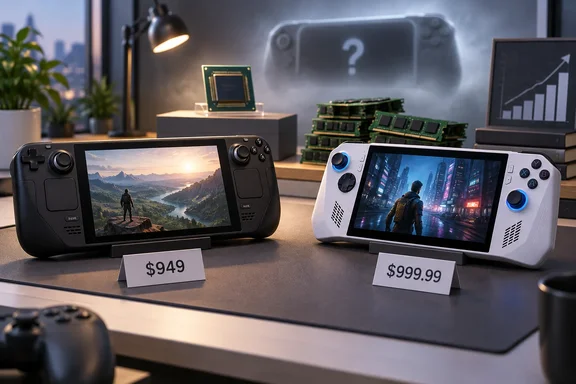
The NoobFeed piece's sharpest line is that a Deck buyer is now "less than $100 away from an Xbox Ally X" and doesn't "even get half the performance." Only part of the price claim holds up. ASUS's US store lists the 2025 ROG Xbox Ally X at $999.99. That is $50.99 more than the 1TB Deck OLED, but $210.99 more than the 512GB model. The "under $100" gap only applies if you are buying the 1TB Deck.
| Handheld | Operating system | US list price | Gap to Ally X |
|---|---|---|---|
| Steam Deck OLED 512GB | SteamOS | $789 | $210.99 |
| Steam Deck OLED 1TB | SteamOS | $949 | $50.99 |
| ROG Xbox Ally X (2025) | Windows 11 | $999.99 | — |
The "half the performance" claim comes with no benchmark, so it is the author's view. The performance figure ASUS actually publishes compares the Ally X to its own previous model. ASUS claims up to 30% more performance than the ROG Ally X in Indiana Jones and the Great Circle and Doom: The Dark Ages, tested at 1080p with default in-game settings. It does not compare the Ally X to a Steam Deck.
According to ASUS, the Ally X runs Windows 11 on AMD's Ryzen AI Z2 Extreme with an 80Wh battery. It has a 7-inch 1080p 120Hz display with FreeSync Premium and a standard M.2 2280 PCIe Gen4 SSD. It boots into the Xbox full screen experience, and you can switch to the Windows desktop to install other apps. ASUS says Steam, Epic Games and Battle.net games all install normally, because the device runs regular Windows.
Other reviewers have noticed the same shift in value. Tom's Hardware wrote that after the Deck's increase, the Lenovo Legion Go 2, which we reviewed at $1,349.99, and Asus ROG Xbox Ally X, at $999.99, don't seem quite as outrageous anymore. The same outlet pointed out that the entry-level Asus ROG Xbox Ally, despite some performance issues and technical problems, may look more attractive than ever if it keeps its $599.99 price. At that price, the base Windows handheld from ASUS costs less than either Deck OLED model.
The Steam Deck OLED's Case Now Rests on SteamOS and the Back Catalog
Yan's piece does not write the Deck off. It argues the Deck "doesn't inherently need to be the fastest," because it is "more designed for the back catalog" and built around community tools, emulation and older PC games. That is a fair description of how many owners use the device. It also points to where the Deck can still win on value: a buyer who mostly plays older or lighter games gets less out of the Ally X's extra power.
That argument has a weak spot, though. It works best when the Deck is also the cheap option. At $789, the 512GB OLED is no longer the impulse buy that made it the default recommendation. Yan says that is why they are now reluctant to recommend it to "pretty much anybody." The piece also says cheaper SteamOS-native devices now exist, but it names none, so that remains unconfirmed.
The piece's claim that the Deck "should" cost around $300 by now, or at least have stayed at $400, is a counterfactual. It assumes a normal hardware lifecycle, where old consoles get cheaper as successors arrive. Yan compares it to picking up a PS4 or Xbox One cheaply once the PS5 and Xbox Series consoles launched. Valve never promised that path. And the cost pressure Valve cites is exactly what breaks it: memory and storage prices are going up, not down.
The Deck is not alone here. Tom's Hardware notes that the hike follows a pattern of years-old machines getting price hikes as their manufacturers deal with the current component landscape, including Microsoft's increase on the standard Xbox Series X. For people who already own a Deck, nothing changes. Only new purchases pay the new price.
ARM Handhelds Against the Steam Deck: A Forecast Without a Shipping Product
The headline claim is that "the most lethal blow to the Steam Deck's future will be the rise of the ARM-based handheld." Yan's reasoning is about software overhead. In the author's words, "nothing is as bloated as Windows," Linux is leaner, and Android has "all the same benefits." The prediction is that ARM hardware will eventually match and then beat what the Deck can do, while still playing both retro games and PC games.
This is opinion, and it should be read that way. The piece names no ARM handheld, gives no specs or prices, and offers no battery, performance or compatibility tests. The overhead comparison between Windows, Linux and Android is stated, not measured. Most important, it does not explain how an Android device on an ARM chip would run the library of x86 Windows games that the Deck handles through SteamOS. Without that, the idea of beating the Deck at PC gaming is a hope, not a finding.
There is a more concrete lead elsewhere. In an August 13 article, NoobFeed reported that recent SteamOS updates are laying groundwork for ARM devices. It named the AYN Pocket S2 and Conker Fit, both ARM-based emulation handhelds, as devices Valve has started working on, and said Valve's SteamOS work for the ARM-based Steam Frame headset should carry over. That report also says the Steam Frame is expected to use a Snapdragon 8 Gen 3, and that the AYN and Conker devices are weaker. It suggests full SteamOS support would let such hardware run most games apart from the most demanding AAA titles. No other outlet in this review confirmed those device names, so treat them as NoobFeed's reporting.
If that work ships, the most likely result is that ARM handhelds become another way to run SteamOS, not a rival platform that replaces it. That is an inference, but the implication is fair: an ARM future could just as easily grow Valve's software reach as shrink the Deck's appeal. Cheap ARM hardware running Valve's own OS would compete with the Deck on price while keeping buyers inside Steam. For now, no ARM handheld sold with full SteamOS support has been documented.
Windows 11 Handhelds and the Overhead Argument
For WindowsForum readers, the piece's jab at Windows deserves some context. Yan calls Windows the most bloated of the three operating systems. That's a long-running complaint about Windows handhelds, but the NoobFeed piece gives no numbers to back it up.
The Ally X shows how Microsoft and ASUS have tried to answer that complaint. The device boots straight into the controller-driven Xbox full screen experience instead of the regular Windows desktop, and the desktop stays one task-switch away. ASUS also runs a handheld compatibility program. It labels games as handheld optimized or mostly compatible, and says "mostly compatible" games may need minor adjustments. A "Should play great" badge from Windows Performance Fit marks games expected to run well on the device.
The trade-off is real either way. Windows gives the widest game compatibility: every storefront, anti-cheat-protected titles, mods and desktop apps. You pay for that with a heavier OS and, at the Ally X's price, more money. SteamOS gives a leaner, console-like experience tied to Valve's compatibility layer. After the May price increase, it no longer comes with a big price advantage at the 1TB tier.
What this means for you
Whether to buy now depends on which Deck model you're considering and which games you play. If you're choosing between the 1TB Steam Deck OLED at $949 and the ROG Xbox Ally X at $999.99, the price difference is now small enough that the decision should come down to operating system and performance. If the 512GB OLED at $789 fits your budget and you mostly play older, lighter or emulated games, the Deck's software strengths still count, but you are paying far more than buyers did before May. If you're holding out for an ARM handheld to replace your PC gaming, you are waiting on a product nobody has shown yet.
- The Steam Deck OLED costs $789 (512GB) and $949 (1TB) in the US after Valve's May 27, 2026 increase, up from $549 and $649.
- Valve blamed rising memory and storage costs, did not call the hike temporary, and said the hardware itself is unchanged.
- The ROG Xbox Ally X lists at $999.99, which is $50.99 above the 1TB Deck but $210.99 above the 512GB Deck.
- The claim that the Deck delivers less than half the Ally X's performance has no published benchmark behind it, so compare independent reviews before buying on performance.
- The only verified way to get a cheaper Deck new, the LCD model, was retired in late 2025, so no lower-cost Deck is sold new.
- Valve's reported work on SteamOS for ARM devices is early groundwork, and no ARM handheld has been shown to match the Deck on x86 PC games.
The Steam Deck's problem today is price, and that part is well documented. The ARM threat NoobFeed describes may come, but it is more likely to arrive running Valve's own software than to replace it. The next real turning points are the Steam Machine and Steam Frame launches, both delayed by the same memory shortage that raised the Deck's price. How Valve prices them will show whether a SteamOS device can be the budget choice again.