

The Windows-only view strengthens the finding
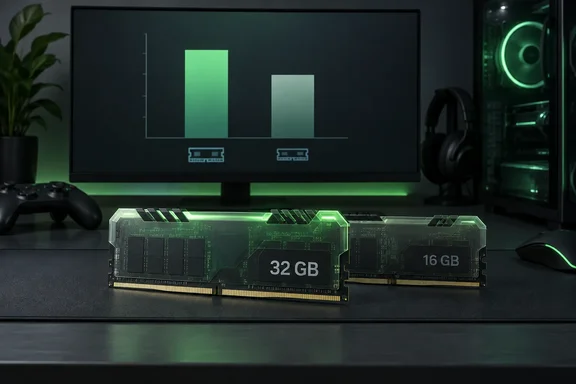
Filtering Valve’s September results to Windows produces a slightly larger lead:
| System RAM | Windows-only share | Monthly change |
|---|---|---|
| 32 GB | 43.28% | +4.81 percentage points |
| 16 GB | 37.60% | −3.47 percentage points |
The crossover therefore holds within the Windows sample, rather than depending on the inclusion of Mac and Linux systems. 32 GB is the largest individual capacity category, but still not a majority.
There is also an important correction to the apparent August comparison. The figures 38.47% for 32 GB and 41.07% for 16 GB are the baselines implied by September’s Windows-only results. The combined-platform changes imply 37.45% and 41.20%, respectively. These are different platform populations, not evidence of conflicting August results. Keeping the filters consistent matters when comparing months.
A changing sample, not an upgrade counter
Valve describes participation as optional and anonymous. Meanwhile, Simplified Chinese increased by 7.42 percentage points to 31.39% of the sample. Those facts warrant caution: the survey does not track a fixed group of owners upgrading the same machines, and the language shift does not establish what caused the RAM movement.
The memory table reports capacity, not DDR generation, speed or benchmark performance. It cannot tell readers whether 32 GB configurations delivered better gaming experiences. Popularity and necessity are different questions.
Windows 11’s share needs the right denominator
Another useful distinction concerns Windows 11. It reached 71.34% across the combined sample, up 0.37 percentage points. But among Windows participants alone, its share was 75.08%, down 0.45 points. Both results can coexist because the denominators differ; “Windows 11 keeps growing” needs that qualification.
Elsewhere in September:
- AMD CPUs: 47.41% of the Windows sample, up 1.89 points.
- GeForce RTX 5070: the leading listed GPU model at 5.86%, up 2.30 points.
- 2560 × 1440 displays: 27.04%, up 5.18 points.
What the result means for PC owners
The defensible conclusion is narrow but significant: 32 GB overtook 16 GB in September’s combined and Windows-only survey samples. It is not proof that most gamers have 32 GB, that game requirements caused the shift, or that a memory upgrade will improve a particular PC. None of those questions is measured here.
Treat this as a hardware-planning signal, not a shopping instruction. A durable change would be more convincing if the lead persists across subsequent surveys. For now, 32 GB has won this month’s popularity contest; the survey has not established a universal requirement.
Update: Additional details (October 7, 2026)
The Windows-only September table also shows 8 GB at 6.03%, 24 GB at 2.40%, and 64 GB at 3.69%, according to the newly reviewed survey breakdown. These figures further show that capacities outside the 16 GB and 32 GB tiers remain comparatively small parts of the Windows sample.
References
- Steam Hardware Survey: 32 GB Overtakes 16 GB as the Most Common System RAM Configuration - TechPowerUp TechPowerUp · 2026-10-02T11:30:46+00:00
- Steam Survey: 32GB RAM Takes the Lead, but Is 16GB Still Enough for Gaming PCs? xda-developers.com
- Steam Hardware Survey: 32 GB Overtakes 16 GB as the Most Common System RAM Configuration - TechPowerUp TechPowerUp · 2026-10-02T11:30:46+00:00