

What has been shown
Belmante demonstrated a native Windows port of Super Mario Bros. Wonder running at roughly 60 FPS on an RTX 3050 laptop. Minor graphical glitches and occasional frame-rate drops remain. The project uses recompiled C++ code and an NVN-to-Vulkan translation layer. The developer plans further optimization, integrated GPU testing and a public release of the repository, which is currently private.
Coverage of the demo describes the game's menus, character select, opening cutscene and world map as working. GameGPU says level 1-1 is also fully functional, at roughly 60 frames per second. No public release date has been given.
XDA Developers adds a caution about the source. It points out that Belmante has only 458 YouTube subscribers, so readers are partly taking the developer's word. XDA still calls the port very legitimate-looking. That is reasonable, but "looks legitimate" is not the same as "independently verified."
How the port reportedly works
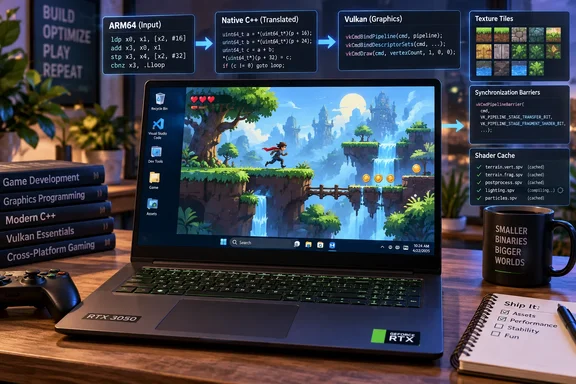
The port is not a conventional Switch emulator. Several outlets describe the same design:
- Static recompilation. The Switch's ARM64 code is pre-compiled into native machine code ahead of time. There is no emulator, no just-in-time (JIT) compilation and no interpreter. That is a different approach from Yuzu-style emulation, which translates code while the game runs.
- Recompiled graphics layer. The game's NVN graphics code is also rebuilt, and a custom layer turns its graphics work into Vulkan commands. On Windows, this layer talks directly to the NVIDIA driver.
- Shared code with the Mac build. The same C++ game code is used as on Mac, but it is built with clang-cl for Windows. Unlike the Mac version, there is no MoltenVK layer in the chain.
- Audio. Sound is output through the game's native audio renderer via XAudio2.
Here "native" describes the software path. It does not mean Nintendo made or authorized a Windows version. Nintendo hasn't announced a Windows release of the game, so the commercial game remains tied to Nintendo hardware.
Windows problems the developer ran into
The most useful part for developers is what broke on the move to Windows. According to the coverage:
- ASTC textures. The game stores key art and model textures in ASTC format, which most desktop NVIDIA GPUs don't support. The driver crashed when asked to create those images.
- The fix was a decoder that lets the CPU process ASTC textures.
- It was written from the Khronos specification and checked against a second independent decoder.
- Missing render-pass barriers. Interface overlay artifacts were fixed with rendering barriers. Coverage of the demo says the Mac's Metal layer had been adding such barriers on its own. That is why the bug only showed up on Windows.
- Upload buffer overflows. Ring buffer overflows also had to be eliminated.
- Stutter. An on-disk pipeline cache and multithreaded ASTC decoding cut down stuttering.
The developer's own write-up reportedly gives finer figures: about 58 FPS median, 12,717 shaders translated, and a pipeline-creation drop from 1.2 s to 0.36 s. I could not open that primary post, so I'm treating those figures as unconfirmed.
What this does and doesn't mean
- It is one laptop, one GPU and one demo. The "roughly 60 FPS" figure should not be read as a guarantee for other hardware or play sessions. Details on installation, graphics settings, input options and performance across PC configurations are still unknown.
- The Intel iGPU test is still to come. XDA says Belmante plans to test an integrated GPU "in the same class as the Switch's own Tegra X1". That would be the more telling test, but it hasn't been reported yet.
- Not all observers are convinced. Some replies under a social-media post about the demo dispute the "native" label or make unverified claims about how the port was built. I found nothing to substantiate those claims, but the private repository means nobody outside the project can check.
- The project isn't downloadable. There is currently no ETA for a release.
- Nintendo's reaction is speculation. XDA's headline says Nintendo "probably isn't happy". I found no Nintendo statement or action. XDA's piece also hopes the release won't ship copyrighted files and will require players to supply their own copy of the game. Static recompilation tools generally work from the user's own dump, but the legal risk of a public release is untested here.
The wider trend
XDA ties the demo to a broader shift. It notes the release of Suyu v0.0.4, an open-source Yuzu fork that reportedly has a Static Recompiler Mode which can turn Switch game code into native x86/x64 PC code. XDA says it's unclear whether the projects are linked. Notebookcheck says many projects have appeared in recent weeks aiming to port console games to the PC. DSOGaming also reported an unofficial PC port of Super Mario Galaxy is coming soon.
For Windows users, the notable shift is that ahead-of-time recompilation avoids the CPU overhead of emulation. In principle that could bring modern console games to modest hardware, though that is general industry reasoning and not something this demo has proven. The Windows-specific bugs, from driver crashes on ASTC to synchronization gaps that Metal had hidden, are a reminder that "it works on the Mac" is only half the porting job.
If the repository does go public, the thing to watch is how it handles game assets. That will decide whether it is a clever engineering demo or a legal target, and a test on integrated graphics would show whether it can really run on modest hardware.
References
- Super Mario Bros. Wonder now runs natively on PC without emulation, and Nintendo probably isn't happy about it XDA · 2026-10-05T21:21:30+00:00
- Super Mario Bros. Wonder is now playable on PC without emulation thanks to a native port - Notebookcheck News notebookcheck.net
- Super Mario Bros. Wonder Is Getting an Unofficial PC Native Port dsogaming.com