

What Notebookcheck says is wrong
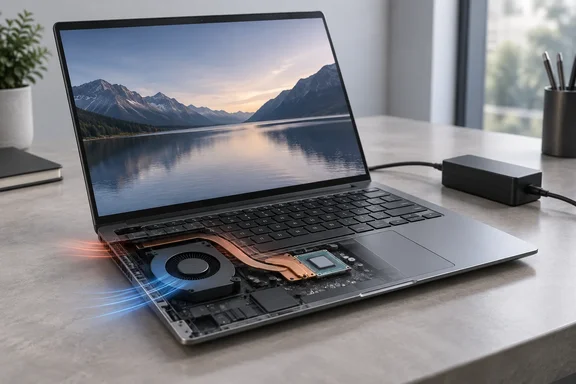
The review says the single-fan cooling is not great and sustained performance suffers a bit. It adds that the cooling was fine for the old Lunar Lake processor but cannot exploit the full potential of the faster Panther Lake chip. The follow-up editorial puts it more bluntly: Microsoft fitted a new processor without adjusting the cooling to match.
The main points are:
- Cooling: The single-fan system is carried over unchanged. Notebookcheck says it was adequate for Lunar Lake, which it describes as topping out at 37 W.
- Power limits: The review unit's Core Ultra X7 368H is listed at 65 W short burst (PL2) and 35 W sustained (PL1). Notebookcheck says the laptop reaches 65 W only briefly before falling to 35 W. It also says the Arc B390 graphics need slightly more than 40 W to reach full potential.
- Power adapter: The supplied 65 W brick is described as insufficient under heavy load. The review says it falls short at least for a few minutes before performance is reduced. The editorial says the system draws on the battery to cover the shortfall at peak load.
- A bigger charger doesn't help: Notebookcheck says even a 140 W adapter left the draw capped at 62 W. That points to a limit in the machine's design and not just the charger.
- Unused space: The reviewer says the internals are easy to access and the M.2-2242 SSD is replaceable. He also says there is plenty of unused space that could hold more ports, a regular M.2-2280 SSD or an extra cooling fan.
- Snapdragon angle: Notebookcheck argues better cooling would also let Microsoft offer the much faster Snapdragon X2 Elite Extreme. That is a suggestion, and nothing confirms Microsoft plans it.
How the rivals compare
Notebookcheck says the Dell XPS 16 and Lenovo ThinkPad X9-15p get a noticeable performance advantage from the same Intel processor family. The review data suggests that is only partly true, and the chips are not identical.
- The Surface review unit uses a Core Ultra X7 368H. The rivals use the Core Ultra X7 358H.
- Short single-run benchmarks look close. In Geekbench 6.7 multi-core, the Surface and the Dell both score 16,943, and the ThinkPad scores 16,876. Notebookcheck's own review says the Surface performs very similarly to the XPS 16 with comparable power limits.
- Sustained workloads separate them more. In the Cinebench R15 multi-loop rating, the ThinkPad scores 91.4 points and the Surface 79.2. That is the kind of gap a long render or compile would expose. It is also a stronger argument for the cooling complaint than any single peak score.
So the claim holds mostly for sustained workloads. In short bursts, the Surface keeps pace.
What Microsoft's own materials say
Microsoft's store listing for the consumer 15-inch Snapdragon model confirms a 65W power supply with Surface Connect. Windows Central notes that the larger 15-inch variant has a 65 W charger. Charging guidance is not the same as headroom under maximum CPU and GPU load, though. Microsoft's own pages don't confirm or refute Notebookcheck's finding that the battery gets tapped at peak load. That finding stands as one lab's observation.
Fair counterpoints
- Notebookcheck still likes the laptop. It praises the build quality, keyboard, speakers and webcam, and notes that it is one of the few premium devices with an IPS touchscreen. It calls this the best Windows laptop you can currently get, and better than the Snapdragon models for private customers.
- The "wasted space" claim is a judgment. Notebookcheck has not shown that a bigger fan, bigger battery, a full-length SSD and extra ports would all fit together. More cooling usually means more noise, thickness or battery trade-offs.
- The laptop is built for a different job. This is a business machine with a privacy display and enterprise firmware. Other reviewers focus on those features and the price. PCWorld says that without a $1,000 price cut there are too many cheaper alternatives.
- Panther Lake favors efficiency. Notebookcheck itself says the chip's emphasis is efficiency and not raw multi-core performance.
Practical takeaways
- Short-burst users (documents, browsing, meetings, light creative work): the thermal ceiling is unlikely to matter much. Notebookcheck rates battery runtime on the Intel model as very good.
- Sustained-load users (rendering, compiling, long graphics sessions): expect the 35 W sustained limit to apply. Compare rivals' sustained results before buying.
- IT buyers: the current Intel Surface Laptop for Business suits fleets that value repairability and firmware security. It is a weaker pick for heavy workstation-style tasks.
- Wait-and-see buyers: Notebookcheck's review says it hopes Microsoft will update the device next year and fix some of these issues. That is a hope, not a promise.
Bottom line
Notebookcheck's central argument is consistent across its review and editorial. Microsoft raised the power ceiling of the 15-inch Surface Laptop, but the cooling, charger and chassis layout limit how much of that ceiling the machine can actually use. Peak benchmarks look competitive, while sustained results trail the ThinkPad. Whether Microsoft acts is unknown, and any fix remains speculation until the company says otherwise.
References
- Microsoft needs to act - Challenges that must be addressed for the next Surface Laptop - Notebookcheck Notebookcheck · 2026-10-07T21:35:00+00:00
- Microsoft's best laptop uses an Intel CPU - Surface Laptop 15 Gen 8 Review - Notebookcheck Review notebookcheck.net
- Surface Laptop 8 review: Yesterday's laptop, tomorrow's price pcworld.com