

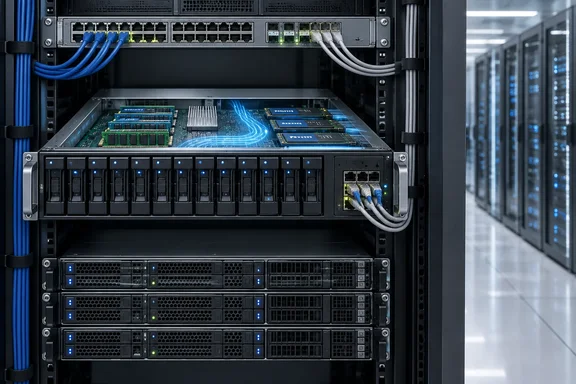
TerraMaster's 725 Series moves to Xeon D across four rackmount NAS models
TerraMaster announced the lineup through a company release on PR Newswire, and Neowin reported it on September 24. The release says TerraMaster "today officially launches its new 725 Series enterprise rackmount NAS, comprising four models: U8-725, U12-725, U12-725 Plus, and U16-725 Plus." Several other outlets carried the text, but they republished the release word for word. That makes them copies of one first-party source, not independent confirmation.
The configuration tiers are simple. Every model in the series uses an Intel Xeon D-series processor with 16GB of ECC memory. The standard models get 4-core Xeon chips and the Plus models get 8-core Xeon chips. Drive bays split the lineup the other way. Put together, the four models look like this:
| Model | Drive bays | Processor tier | TerraMaster's stated positioning |
|---|---|---|---|
| U8-725 | 8 | 4-core Xeon D | Enterprise file storage, backup, virtualization |
| U12-725 | 12 | 4-core Xeon D | Unified storage, media, AI data, surveillance |
| U12-725 Plus | 12 | 8-core Xeon D | High concurrency, AI, virtualization, professional media |
| U16-725 Plus | 16 | 8-core Xeon D | Large-scale enterprise data, demanding workloads |
The U12-725 and U12-725 Plus have the same number of bays, which matters for buyers. Choosing between them is purely about CPU headroom: more cores for many simultaneous users, virtual machines or heavier background work, at the same capacity. The launch release names a specific processor only for the standard U12-725, so the exact 8-core Xeon D part in the Plus models needs checking on the spec sheet before purchase.
Inside the U12-725: Xeon D-2712T, six network ports and PCIe 4.0 NVMe
TerraMaster uses the U12-725 as its showcase model. It features an Intel Xeon D-2712T 4-core processor and 16GB of ECC memory, along with four 10GbE SFP+ ports and two 5GbE network ports. It also supports PCIe 4.0 NVMe SSDs and PCIe expansion. The product page says the U12-725 is a 2U rackmount high-performance unified storage server designed for medium-sized enterprises, media & broadcasting, AI R&D, and campus security surveillance.
For context, the Xeon D-2712T is not a new chip. It belongs to Intel's Ice Lake-D generation, which launched in 2022, and the Xeon D family is designed for dense, embedded server and networking hardware. The 725 Series therefore gives TerraMaster a mature server platform, not a new processor. The features that separate it from desktop-class NAS chips are ECC memory support and a large number of PCIe lanes.
Networking deserves the most attention. Four SFP+ cages and two 5GbE copper ports add up to 50Gbps of nominal link capacity. That total only counts if you aggregate links and have enough clients to fill them. SFP+ ports also need matching transceivers or direct-attach cables, and a switch with SFP+ ports, so a shop running only RJ45 copper would need to budget for that. Because the two 5GbE ports are copper, a management or legacy network can connect without new optics.
The U12-725 supports standard protocols. According to TerraMaster, it supports multiple file services: SMB, SFTP/FTP, iSCSI, NFS, and WebDAV. For Windows-centric environments, SMB covers ordinary file shares, and iSCSI lets the NAS present block storage to Windows Server or Hyper-V hosts. Administration uses TerraMaster's own tools: the system can be reached via the TNAS mobile app, a desktop client, or a web browser.
Reading TerraMaster's 6,250 MB/s and 945,063 IOPS claims
The launch release gives three headline numbers. Under TerraMaster laboratory testing conditions, the U12-725 reaches sequential reads of up to 6,250 MB/s, sequential writes of up to 3,480 MB/s, and up to 945,063 IOPS in 4K random reads. The company notes that actual performance may vary with hardware configuration, RAID mode, network environment and workload.
The test notes on TerraMaster's product page explain how those numbers were produced. The test system was a Xeon D-2712T with 1 TB DDR4 ECC, 12 × HDD (Seagate Exos x24), 3 × NVMe SSD (PCIe 4.0 x4), link aggregation mode, RAID 6, and TOS 7, and throughput was measured with FIO at a 1 MB block size, pure sequential read/write.
The biggest gap between the lab unit and a shipping unit is memory. The test machine had 1TB of RAM, while the retail configuration comes with 16GB. With 1TB, a large share of a random-read test can be served from memory cache rather than disk. The near-million IOPS figure mostly shows how the platform behaves when it is fully loaded with RAM and NVMe cache. It does not tell you what a 16GB box with twelve hard drives will do. Three NVMe SSDs in the test system also point the same way. That is our interpretation of TerraMaster's disclosed setup, not a result anyone has measured.
The sequential figures are also higher than any single 10GbE client can reach, since one 10GbE link carries roughly 1,250 MB/s at most. Reaching 6,250 MB/s requires aggregated links and several clients pulling data at the same time. No independent reviews or benchmarks had been published when this article was written.
TOS 7 and the "AI-Native" pitch behind the 725 Series
The software half of the launch is TerraMaster's operating system. The 725 Series runs TOS 7, which TerraMaster calls an AI-Native operating system, with enhanced large-scale data search, indexing and intelligent management. TerraMaster presents the hardware as a central store for AI training datasets and as a local data layer for private-AI knowledge bases.
In that pitch, the AI role is about storing and serving data. The launch material does not list any on-board AI accelerator, and it gives no figures for model training or inference. For an AI team, the relevant specs are the ones any storage buyer would compare: NVMe caching, network bandwidth to GPU servers, and capacity. The AI label adds nothing a buyer can test.
TerraMaster's consolidation argument is a vendor claim. The company says that putting workloads on one platform lets enterprises reduce the need for multiple standalone storage systems, simplify IT infrastructure, and lower overall procurement and management complexity, but it offers no figures to support this. Consolidation also has a known downside: running backup, surveillance recording and live production storage on one chassis means one failure domain. Many administrators keep backups on separate hardware for exactly that reason.
A channel-first launch aimed at integrators
The release is aimed at partners as much as at end customers. TerraMaster says the series creates new opportunities for distributors, resellers, system integrators, IT service providers and security system integrators. The model table is presented as a way for partners to pick hardware based on a client's data volume and growth plans.
The launch release does not include pricing, full per-model specifications, support-life commitments, warranty terms, or power draw for full configurations. For a rackmount system expected to stay in service for years, the absence of stated firmware and TOS 7 support timelines matters. Buyers should ask for those terms in writing through the reseller before comparing the 725 Series with alternatives.
What this means for you
Treat the 725 Series as a candidate for a proof-of-concept, not a system to buy on spec-sheet strength. The hardware is credible, but performance has not been independently tested. Mid-size organizations, media shops and surveillance integrators that need 8 to 16 bays with ECC memory and 10GbE should put it on their shortlist. Teams that need proven long-term support, or whose infrastructure is copper-only, should confirm details first.
- Choose between the U12-725 and U12-725 Plus by expected concurrency and virtualization load, since both have twelve bays and differ only in CPU core count.
- Budget for more RAM if you have random-I/O-heavy workloads, because TerraMaster's headline IOPS came from a 1TB test unit and the shipping configuration has 16GB.
- Plan for SFP+ switch ports and optics or DAC cables to use the four 10GbE ports, and for link aggregation plus multiple clients to get anywhere near the quoted 6,250 MB/s.
- Confirm the exact 8-core Xeon D model in the Plus systems and the full specs for the U8-725 and U16-725 Plus, because the launch release details only the U12-725.
- Use SMB for Windows file shares and iSCSI for Windows Server or Hyper-V block storage, both of which the U12-725 supports.
- Get warranty, support-life and TOS 7 update commitments from your reseller before comparing total cost with competing platforms.
TerraMaster has built the 725 Series on real server-class hardware, and with its bay counts, ECC memory and multi-10GbE networking it can compete with established mid-range storage. Independent testing on retail-configured units, along with clear pricing and support terms, will show whether it is a genuine low-cost alternative. Until then, the case rests on the hardware spec sheet and on lab figures taken with 64 times the memory the systems ship with.
References
- TerraMaster's new 725 series brings Intel Xeon-D power to enterprise storage Neowin · 2026-09-24T18:28:01+00:00
- TerraMaster Launches 725 Series Xeon Rackmount NAS to Deliver Enterprise Unified Storage for the AI Era prnewswire.com
- U12-725 – TerraMaster Official Store terra-master.com