

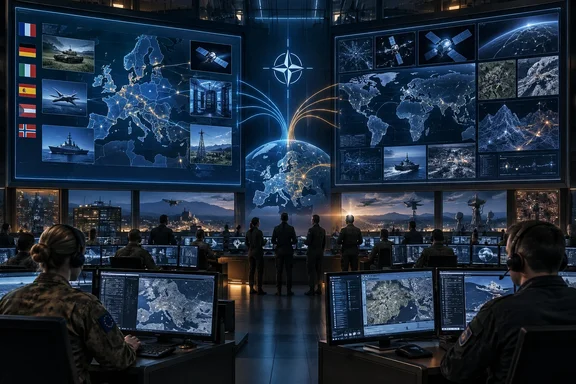
The distinction matters for IT professionals because both products sit in the uncomfortable but increasingly important category of software that turns vast, mixed data estates into operational decisions. Thales says HexaForce can ingest, correlate and prioritize feeds from military, public and civilian sources across land, air, sea, cyber, space, electromagnetic-spectrum and information operations. In enterprise language, it is a high-consequence, federated data-and-AI platform: an integration layer, an analytics layer and a workflow system expected to keep functioning when networks are degraded.
Reuters first reported Thales CEO Patrice Caine’s argument that Europe needs command software outside U.S. export controls and less exposed to U.S. technology dependence. Thales presented HexaForce on September 17, 2026 as a “sovereign” system free of the U.S. International Traffic in Arms Regulations, or ITAR. Yet NATO’s own records show that Maven is already deeply embedded in Allied Command Operations, making the more consequential competition one over interoperability, data control and future contracts—not an immediate rip-and-replace exercise.
HexaForce enters a NATO environment where Maven is already running
NATO’s Communications and Information Agency finalized its acquisition of Palantir’s Maven Smart System NATO on March 25, 2025. The Alliance described it as an AI-enabled warfighting capability for intelligence fusion, targeting, situational awareness, planning and faster decision-making. By August 2025, NATO’s Joint Warfare Centre was training personnel to use it in exercises; by June 22, 2026, the system had reached what NATO called full technical operational capability across Allied Command Operations requirements.
That record complicates the popular framing of HexaForce as the European alternative to Palantir. It is an alternative in future national and alliance procurement, but not a replacement decision announced by NATO. No NATO agency has said it is abandoning Maven, awarding HexaForce a contract, or selecting Thales as a substitute for the Palantir system.
In fact, the available evidence points to a coexistence problem that Thales itself acknowledges through its design choices. HexaForce is being presented as an open, distributed and interoperable C4I platform—command, control, communications, computers and intelligence—rather than as an isolated national stack. Thales says the system demonstrated interoperability with other nations’ command-and-control tools at NATO’s CWIX 2026 exercise and compliance with NATO Federated Mission Networking specifications.
That is more than a marketing checkbox. NATO’s operational model requires forces from different countries to share selected information at speed while retaining control of national systems, classifications and missions. A French, German or other European deployment of HexaForce therefore has to exchange data with existing NATO systems, which increasingly includes Maven. Caine acknowledged the practical reality when he declined to declare a direct corporate showdown with Palantir: Thales needs its systems to remain interconnected.
“Sovereign” does not mean the same thing as self-sufficient
Thales’ most pointed claim is that HexaForce is not subject to U.S. ITAR restrictions. For governments concerned that Washington could restrict access to a U.S.-controlled defense technology, that is a real procurement consideration. ITAR can impose approval obligations and export restrictions on covered U.S. defense articles, services and technical data; avoiding that regime could give European governments greater latitude in where and how they deploy a platform.
But ITAR independence is only one component of digital sovereignty. It does not, by itself, establish where every data feed is stored, how models are updated, whether components have non-European dependencies, which cloud infrastructure is used, or which integration partners gain access to sensitive information. Thales has said HexaForce is built on an open and sovereign architecture, but its public launch material does not spell out a hosting model, identify all third-party software dependencies, publish data-residency guarantees, or describe customer-operated key-management options.
Those omissions are important because command platforms are defined as much by their interfaces and governance as by their AI features. A system can be legally outside ITAR while remaining dependent on foreign processors, cloud services, model tooling, chips, telecom equipment, satellite links or classified data gateways. Conversely, a U.S.-origin system can be deployed under contractual, technical and policy safeguards that limit external access. The actual sovereignty test will be found in national contracts, deployment architectures and the authority customers retain over software updates and data—not in a launch-day label.
For Windows and enterprise administrators watching military technology move toward standard commercial AI patterns, the lesson is familiar. “Sovereign AI” is becoming a purchasing requirement for regulated workloads, but it should be interrogated like any other security claim: who hosts it, who administers it, where logs go, what identity system controls access, what external models are called, and what happens when a supplier relationship ends.
The technical claim is ambitious; the operational proof is still developing
HexaForce draws on cortAIx, Thales’ internal AI accelerator, which the company says includes 800 specialized engineers and data scientists. The platform combines large language models and agentic AI with conventional data fusion and workflow automation. Its stated goals are familiar to operators of large security operations centers and data platforms: shorten planning cycles, consolidate a current operational picture, move relevant information to users faster, recommend resource allocation and support field maintenance.
The scale claim is less routine. Thales says HexaForce is intended for high-intensity operations requiring command-and-control support for more than 100,000 personnel. It says experimentation has raised capacity from 100 to 1,000 targeting objectives processed per day. In a defense context, “targeting” does not necessarily mean that software autonomously selects and authorizes strikes; the public material describes data processing, correlation, prioritization and support for commanders.
Still, the language needs care. Thales’ September announcement says live trial phases are paving the way for full-scale deployment. That means the 1,000-objective figure is an experimental outcome and a target for rollout, not independently verified evidence that an operationally deployed force is processing that volume every day. The company also does not disclose accuracy rates, false-positive rates, latency under contested communications, model-evaluation methods, human approval gates, or how its LLM and agent features are constrained when they encounter incomplete or deceptive battlefield data.
Those are not minor implementation details. In military command software, confidence scoring, provenance, access control and auditability determine whether faster data fusion produces better decisions or simply accelerates error. The public launch material provides no technical assessment of these controls.
Thales does have a relevant foundation: its Artemis.IA data and AI platform has been used by France’s Ministry of the Armed Forces since 2023, and the company says HexaForce uses that work through its dataHub infrastructure. That helps explain why the product is more credible than a newly branded chatbot attached to a defense dashboard. But Artemis.IA’s existence does not validate every claim for HexaForce, which combines a broader C4I mission, coalition interoperability and new AI functions into a higher-stakes operating environment.
Open standards are the real competitive lever
HexaForce’s ability to integrate older national systems and coalition tools may prove more commercially important than its generative-AI features. Defense organizations do not get to rebuild their data estates cleanly. They operate with legacy radios, mission systems, intelligence databases, logistical tools, tactical networks and classification boundaries that cannot simply be replaced by a new dashboard.
Thales says HexaForce is distributed, so it is intended to remain functional during major communications disruption. That architecture is a practical requirement for a system expected to support dispersed operations. Centralized AI services perform poorly when bandwidth is scarce, links fail, or data cannot leave a national enclave; usable battlefield AI must push selected processing toward the edge while syncing only what can safely be shared.
The company’s CWIX 2026 testing is therefore meaningful but limited. CWIX is NATO’s Coalition Warrior Interoperability eXercise, designed to test whether systems can exchange information and conform to alliance requirements. Passing an interoperability exercise is evidence that interfaces and specifications work in a controlled setting. It is not proof that a product has won a deployment, met every national-security accreditation requirement, or can run reliably through a sustained operational campaign.
Maven faces the same broader integration reality. NATO’s own recent work describes Maven as a platform that can incorporate emerging alliance capabilities, and NATO’s DIANA innovation program has explicitly treated Maven alongside national systems rather than as a single answer to every command requirement. Caine’s claim that Palantir covers only a small portion of NATO’s needs is a competitive assertion, but the Alliance’s own procurement and training activity supports the narrower conclusion: NATO expects its AI command environment to include multiple applications, suppliers and national systems.
Europe has gained a bidding option, not an instant strategic escape hatch
Thales has created a credible European option for governments that want an AI-enabled C2 platform sourced from a major regional defense contractor, linked to French defense data work and built around NATO interoperability. That gives European procurement offices leverage they did not have when the debate was framed mainly around adopting a U.S. platform or building an unproven national alternative from scratch.
It also ensures Palantir will face sharper demands around data control, portability, integration and long-term supplier dependence. Those demands will not disappear because Maven has already reached full technical operational capability at NATO. They will become part of the next competition.
The practical milestone to watch is a contract award or an operational deployment outside trials—not another claim about sovereignty. Until a NATO member identifies where HexaForce will run, what data it will control, how it interoperates with Maven and other coalition systems, and which users will operate it in real missions, HexaForce is best understood as a serious procurement contender entering an alliance software environment that Palantir already occupies.